
Best DeFi Trading Platforms in 2026: Top Picks and How to Choose
Compare Nika, Hyperliquid, Pump.fun, Uniswap, and Jupiter by trading features, custody, fees, and the type of trader each platform suits.
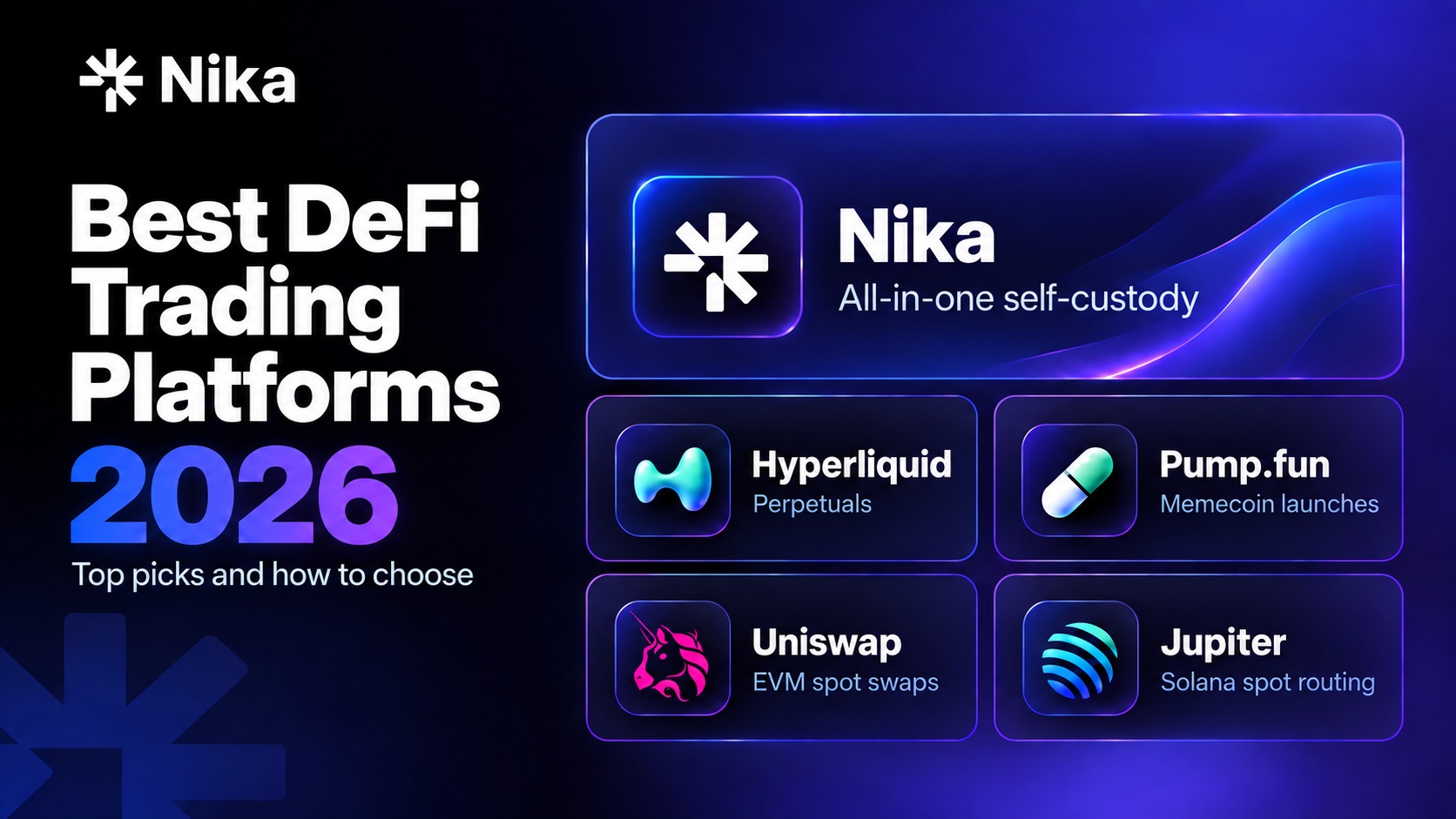
The best DeFi trading platform in 2026 depends on what you want to do. Swapping tokens, trading perpetual futures, launching memecoins, and managing a portfolio each require different tools.
Our picks are Nika for multiple products in one self-custody app, Hyperliquid for direct perpetuals trading, Pump.fun for Solana memecoin launches, Uniswap for EVM spot swaps, and Jupiter for Solana spot routing. This guide compares their features, costs, and limitations so you can choose the platform that fits your trading.
Disclosure: This guide is published by Nika, one of the platforms featured. Nika’s perpetuals are powered by Hyperliquid through builder codes, and its prediction markets are powered by Polymarket.
What to look for in a DeFi trading platform
A useful comparison starts with four questions:
- What can you trade? Spot tokens, perpetual futures, and prediction markets have different mechanics. A platform that suits one product may not suit another.
- Who controls your assets? Self-custody gives you control of your wallet, but you still need to understand where deposited collateral sits and which protocols your transactions use.
- What is the total cost? Trading fees are only part of the picture. Network fees, price impact, slippage, funding, and interface fees can also affect the result.
- Can you use it where you live? Product availability and geographic restrictions vary by platform and underlying protocol.
Self-custody does not remove smart contract risk, liquidation risk, or the possibility of losing access to your wallet. It changes who controls the assets, rather than making every transaction safe.
Best DeFi trading platforms at a glance
| Platform | Best for | Main products | How fees work | Main limitation |
|---|---|---|---|---|
| Nika | Multiple markets and portfolio tools in one self-custody app | Spot, Hyperliquid-powered perps, yield, Polymarket-powered predictions, portfolio tools | Fees depend on the product and underlying protocol; interface fees may also apply | Available products and markets vary by jurisdiction |
| Hyperliquid | Trading perpetual futures directly on an onchain order book | Perpetuals and spot | Standard base perp fees are 0.045% taker / 0.015% maker; tiers, discounts, and market-specific schedules can change the rate | Perpetuals require margin management and carry liquidation risk |
| Pump.fun | Creating and trading Solana memecoins | Token launches, bonding-curve trading, PumpSwap | Published bonding-curve trading fee is 1.25%; PumpSwap fees vary by pool and market cap | Newly launched tokens can be highly volatile and have limited liquidity |
| Uniswap | Spot token swaps across EVM networks | Spot swaps and liquidity pools | Pool fees vary by version and pool; network and applicable interface costs also matter | Pool liquidity and price impact vary widely between tokens |
| Jupiter | Finding routes for Solana spot swaps | Spot aggregation, plus other Solana trading and DeFi products | Costs depend on the swap mode, route, pool, and applicable platform fees | Its spot routing focuses on the Solana ecosystem |
Fee examples reflect the official documentation reviewed for this guide on 6 October 2026. They are not a complete transaction-cost estimate or a guarantee of the rate on every market.
1. Nika: best for multiple products in one self-custody app
Nika brings spot trading, perpetual futures, yield opportunities, prediction markets, and portfolio management into one non-custodial interface. It is available on web, iOS, and Android, with spot trading across supported networks.
You can create an account using email or a supported social login. The appeal is a simpler workflow: research a market, place a trade, review your portfolio, or explore yield without switching between separate apps for each activity.
Nika’s perpetuals are powered by Hyperliquid through builder codes. You access Hyperliquid’s trading infrastructure through Nika’s interface. Leverage limits depend on the market, and perpetual positions remain subject to funding payments and liquidation.
Prediction markets are powered by Polymarket, giving eligible users access to event markets alongside their other holdings. Availability depends on jurisdiction and the underlying protocol’s restrictions.
Nika also offers trader discovery, activity tracking, and trade alerts. Nika AI helps users research markets and analyze their portfolios. Transactions require approval unless the user has explicitly enabled automation under their own rules.
Fees: Costs depend on the product. For perpetuals, distinguish Hyperliquid’s underlying venue fee from the builder fee charged through an interface. Hyperliquid’s base maker and taker rates alone do not represent Nika’s total trading cost. Review the applicable fees in the app before placing an order.
Best fit: Users who want several trading and portfolio features in one self-custody app.
Main tradeoff: Access to more products means more types of risk to understand. Spot holdings, leveraged positions, yield strategies, and prediction shares should each be evaluated on their own terms.
2. Hyperliquid: best for direct perpetuals trading
Hyperliquid is an onchain trading venue with an order book for perpetual futures and spot markets. It suits traders who want to interact directly with its markets and manage orders, collateral, and positions through the venue’s own interface.
An order book lets traders submit bids and offers at specific prices. For an active perpetuals trader, the practical questions are how much liquidity exists near the current price, how a large order affects execution, and how margin is managed.
Hyperliquid also provides infrastructure for other applications. Its builder codes let interfaces submit trades and charge an additional fee within a maximum approved by the user. This is how Nika connects its perpetuals experience to Hyperliquid.
Fees: Hyperliquid’s official fee schedule lists standard base perpetuals rates of 0.045% for taker orders and 0.015% for maker orders. Volume tiers, staking discounts, and certain market configurations affect fees. A third-party interface can add a builder fee.
Best fit: Traders whose main priority is accessing Hyperliquid’s perpetuals markets directly.
Main tradeoff: You need to understand margin, funding, and liquidation. A familiar exchange interface does not make leveraged trading low risk.
3. Pump.fun: best for Solana memecoin launches
Pump.fun focuses on creating and trading memecoins on Solana. Tokens initially trade along a bonding curve, where price changes according to the curve’s mechanics. Tokens that meet the graduation conditions move into PumpSwap liquidity pools.
This makes Pump.fun a specialized choice for token creators and traders seeking exposure to newly launched memecoins. It serves a different purpose from a platform built around established spot assets or portfolio management.
Fees: Pump.fun’s published fee schedule lists a 1.25% total bonding-curve trading fee. Creating a coin carries no platform creation fee, while graduation to PumpSwap carries a 0.015 SOL fee. PumpSwap trading fees vary by pool and, for canonical pools, token market cap. Network charges and some interface-specific charges can apply separately.
Best fit: Users who specifically want to create or trade Solana memecoins and understand the launch mechanics.
Main tradeoff: Price swings, concentrated token ownership, bots, and thin liquidity can make entry and exit difficult. Graduation to a liquidity pool does not guarantee demand or protect a token’s value.
4. Uniswap: best for EVM spot swaps
Uniswap is a decentralized spot trading protocol available across supported EVM networks. Its core pools use an automated market maker model: users swap against liquidity supplied to smart contracts.
It is a useful choice when you want to exchange tokens from a wallet and compare liquidity across pools. Uniswap also allows users to provide liquidity, although doing so introduces risks beyond simply holding the underlying tokens.
Fees: Uniswap’s official documentation describes a 0.30% pool fee for v2, common v3 fee tiers of 0.05%, 0.30%, and 1%, and custom or dynamic fees in v4. Additional v3 tiers can be enabled through governance. The complete cost also depends on the interface, network charges, and price impact.
Best fit: Users focused on spot swaps and liquidity pools across EVM networks.
Main tradeoff: Each token pair has its own liquidity conditions. A low pool fee does not necessarily mean a better final execution price, especially for a large order in a thin pool.
5. Jupiter: best for Solana spot routing
Jupiter aggregates trading routes for Solana tokens. Instead of choosing a single pool yourself, you request a quote and Jupiter evaluates available execution paths.
Its routing can draw on multiple liquidity sources, making it useful when liquidity for a token is spread across venues. Jupiter also offers other Solana products, including perpetuals and lending; this comparison focuses on its spot aggregation.
Fees: Jupiter’s swap documentation distinguishes between routing modes with different fee structures. Depending on the mode and interface, costs can include pool fees, platform or integrator fees, and Solana transaction costs. Compare the final amount received rather than assuming every Jupiter swap has the same fee.
Best fit: Traders looking for spot swap routes within Solana.
Main tradeoff: Aggregation does not eliminate slippage or liquidity constraints. Quotes can change, and a routed trade still depends on the markets used to execute it.
How to choose the right platform
Start with your main activity. If you mostly swap EVM tokens, Uniswap is a natural starting point. For Solana spot routing, consider Jupiter. For direct perpetuals trading, look at Hyperliquid. Pump.fun is the specialized option for Solana memecoin launches. If you want several products and portfolio tools together, explore Nika.
Then compare an actual transaction. Use the same token pair, order size, and order type where possible. Check the amount you will receive after fees, the expected price impact, and whether a bridge or separate collateral transfer is required.
For perpetuals, also consider the costs and risks of holding the position. Funding payments can affect returns over time, while leverage increases sensitivity to price movements. A lower entry fee does not compensate for a position you cannot manage.
Before funding an account, understand the wallet setup, supported networks, withdrawal process, and regional restrictions. These details matter as much as the feature list.
Best DeFi trading platforms: FAQ
What is the best DeFi trading platform in 2026? There is no single best platform for every activity. Nika combines multiple products in one self-custody app; Hyperliquid specializes in order-book trading; Pump.fun focuses on memecoin launches; Uniswap provides EVM spot liquidity; and Jupiter routes Solana swaps.
How do Nika and Hyperliquid work together? Nika’s perpetuals are powered by Hyperliquid through builder codes. Hyperliquid provides the underlying trading infrastructure, while Nika brings perpetuals together with spot, yield, predictions, and portfolio tools in one interface.
Are DeFi trading platforms non-custodial? Many let you transact from a wallet you control. However, assets deposited into a trading protocol or yield strategy are subject to that protocol’s rules and risks. Check both the wallet’s custody model and how each product handles funds.
Which platform has the lowest fees? There is no universal answer. Costs depend on the asset, network, order type, trade size, fee tier, and interface. Compare the total execution cost, including applicable network fees and price impact. For perpetuals, account for funding during the holding period as well.
Is Pump.fun safe for beginners? Memecoin launches involve substantial price and liquidity risk. Connecting a self-custody wallet does not make the token safe, and a newly launched token can lose most or all of its value. Understand the bonding curve, ownership distribution, and exit liquidity before trading.
Does self-custody mean I cannot lose my funds? No. Self-custody gives you control of your wallet, but phishing, compromised credentials, harmful approvals, smart contract failures, and trading losses remain possible.
Explore DeFi trading with Nika
Nika brings spot, Hyperliquid-powered perpetuals, yield, Polymarket-powered prediction markets, and portfolio tools into one self-custody app. Explore the available products and choose the ones that fit your goals and experience.
This article is for informational purposes and is not financial advice. Crypto assets, leveraged products, and DeFi strategies involve risk, including loss of capital. Product availability varies by jurisdiction.