
APY vs APR: Difference, Formula, and Examples
APY vs APR explained: APR is the simple yearly rate and APY adds compounding. See the APY formula, worked examples, and how crypto yields are quoted.
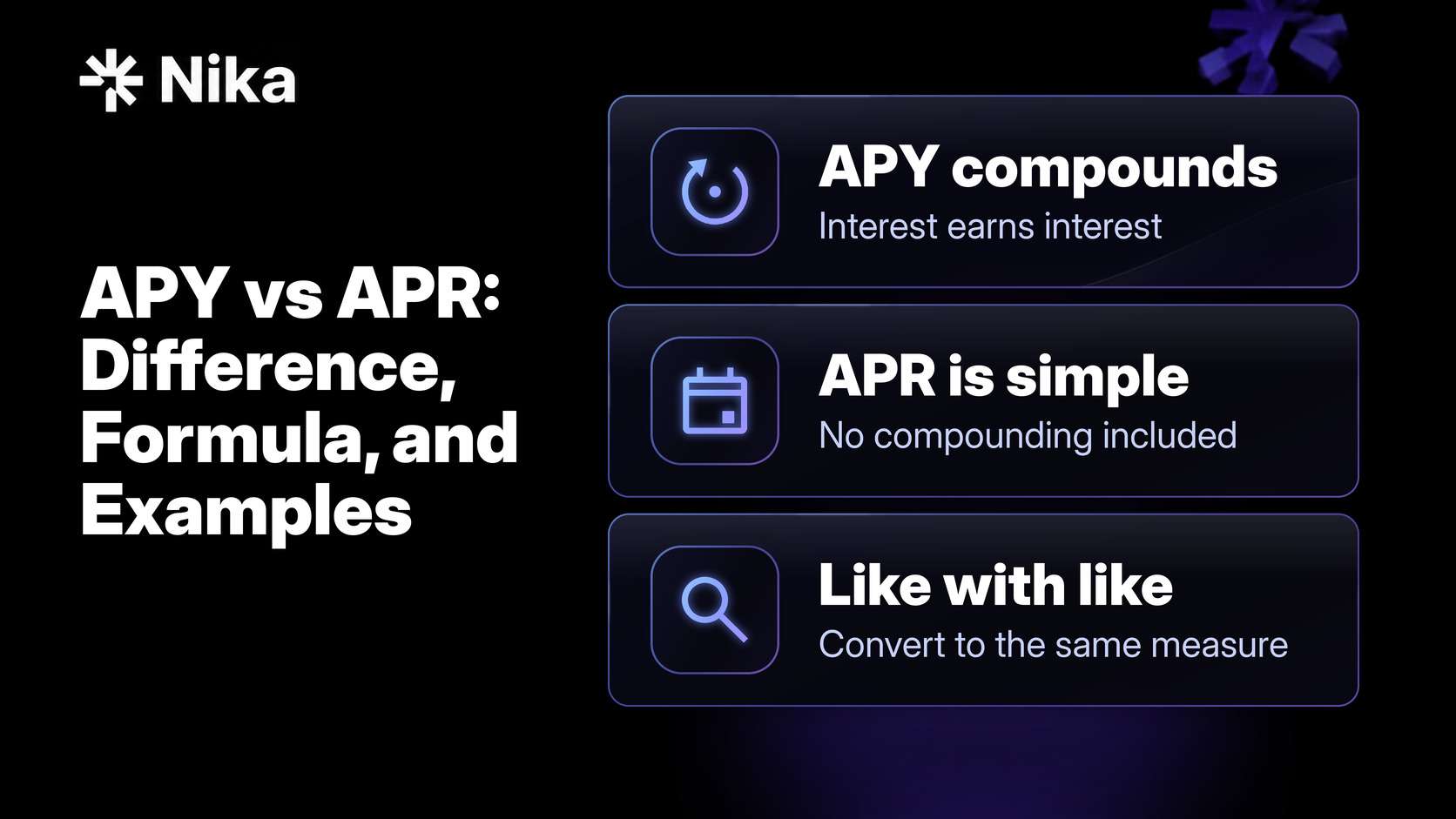
APR is a yearly rate that does not include compounding. APY is the yearly return after compounding, so for the same rate, APY is equal to or higher than APR. When you borrow, compare APRs, which on loans also include certain fees. When you save or earn yield, compare APYs.
Banks, lenders, and crypto apps quote rates both ways, so two offers that look alike can pay or cost different amounts. This APR vs APY guide explains what each term means under US disclosure rules, shows the APY formula with worked examples, and covers how both labels are used for crypto yields.
Disclosure: This guide is published by Nika, a non-custodial app that offers access to yield and borrowing through third-party protocols. It uses US federal disclosure rules and standard finance definitions. Examples are hypothetical.
APY vs APR: the short answer
- APR (annual percentage rate) is a simple yearly rate with no compounding. On loans, it also includes certain fees.
- APY (annual percentage yield) includes compounding, so it shows what a rate actually earns over a year.
- At the same rate, more frequent compounding gives a higher APY.
- Borrowers want a low APR, savers want a high APY, and both should compare like with like.
What APR means
APR has two common uses. They share a name but measure different things.
APR on loans and credit cards
Under the Truth in Lending Act and its Regulation Z, the annual percentage rate is “a measure of the cost of credit, expressed as a yearly rate”. That cost is based on the finance charge, which covers charges the lender imposes as a condition of the credit, not just interest. That is why a loan’s APR is often higher than its interest rate, and why APR is the better number for comparing loans.
Credit cards work a little differently. For card accounts and other open-end credit, Regulation Z computes the APR by multiplying the periodic rate by the number of periods in a year, so the APR itself does not count compounding. If you carry a balance, unpaid interest is added to it and starts to accrue interest too. OpenStax’s finance textbook uses a card that charges 1.5% a month: that is an 18% stated rate, but about 19.56% a year once monthly compounding is counted.
APR on savings and crypto yields
On savings and yield products, APR usually means the simple yearly rate without compounding. Regulation DD, which implements the Truth in Savings Act, defines a deposit account’s interest rate as “the annual rate of interest paid on an account which does not reflect compounding”, and it lets banks also call that rate the annual percentage rate in account disclosures.
Crypto staking is often quoted the same way. Ethereum.org’s staking page shows staking rewards as an APR, a simple rate that does not assume your rewards are reinvested.
Crypto borrowing rates are quoted as APR or APY, depending on the protocol. In the Nika app, borrowing is live, and the rate is shown as an APR when you borrow against your portfolio.
What APY means
Regulation DD defines annual percentage yield as “a percentage rate reflecting the total amount of interest paid on an account, based on the interest rate and the frequency of compounding for a 365-day period.” Banks must state both the APY and the interest rate, using those terms, in their account disclosures, along with how often interest compounds.
Compounding means interest earns interest. Once interest is added to your balance, the next payment is calculated on the larger amount. APY captures that effect over a full year, which is why it is the fairer number for comparing what two savings products pay.
APY reflects interest only. Under Regulation DD’s calculation rules, it leaves out bonuses and assumes the principal and interest stay on deposit for the full term. Fees are disclosed separately, so check them before you compare.
Crypto earn products use APY in the same way. In the Nika app, earning yield is live, and earn options such as staking, lending, vaults, and real-world assets are shown as APY.
APY vs interest rate
The interest rate is the base rate a product pays. APY is what that rate earns over a year after compounding. If interest compounds once a year, or not at all, APY and the interest rate are the same.
Here is a hypothetical example. Put $1,000 in an account with a 4% interest rate that compounds monthly. After a year you have earned about $40.74, so the APY is about 4.07%.
This is where two offers can trip you up. A 4% interest rate compounded daily works out to about 4.08% APY, so it pays slightly more than an offer quoted at 4% APY. Only the APY tells you the full-year result.
The APY formula, and how to convert between APR and APY
The formula
APY = (1 + r/n)^n - 1Here, r is the APR as a decimal (5% is 0.05), and n is the number of compounding periods in a year: 1 for yearly, 12 for monthly, and 365 for daily.
Appendix A of Regulation DD gives banks an equivalent version based on the interest a deposit earns over its term:
APY = 100 x [(1 + Interest/Principal)^(365/Days in term) - 1]For an account without a set term, the term counts as 365 days, so the APY is simply the year’s interest divided by the principal, times 100.
Worked example: APR to APY
Take a hypothetical 10% APR on $1,000. This is an illustration, not a forecast.
| Compounding | n | APY | Interest after 1 year on $1,000 |
|---|---|---|---|
| Yearly | 1 | 10.00% | $100.00 |
| Monthly | 12 | 10.47% | $104.71 |
| Weekly | 52 | 10.51% | $105.06 |
| Daily | 365 | 10.52% | $105.16 |
| Continuous | n/a | 10.52% | $105.17 |
For monthly compounding, the math is (1 + 0.10/12)^12 - 1 = 0.1047, or 10.47%. Continuous compounding is the limit the formula approaches as n grows, calculated as e^0.10 - 1. The biggest jump comes from moving from yearly to monthly compounding. Past daily, the APY barely moves.
Worked example: APY back to APR
To go the other way, rearrange the formula:
APR = n x ((1 + APY)^(1/n) - 1)A 5% APY compounded monthly equals 12 x (1.05^(1/12) - 1) = 0.0489, or about 4.89% APR. Run that APR back through the first formula and you get 5% APY again.
Why the gap grows with the rate
At 10% APR compounded daily, the APY is about half a percentage point higher than the APR. At 20% APR compounded daily, the APY is about 22.13%, a gap of more than 2 points. The higher the rate, the more the label matters, so check it every time you compare higher crypto yields.
Which is better, APR or APY?
When it comes to APR vs APY, neither is better. They answer different questions, and the one to use depends on which side of the deal you are on.
- When you borrow, look for the lowest APR. On loans, APR includes certain fees, so it gives a fairer comparison than the interest rate alone.
- When you save or earn, look for the highest APY after fees and risk.
Whichever side you are on, convert both offers to the same measure before you compare them.
Either rate can be fixed or variable. A variable rate can change after you open the account or take the loan, and Regulation DD requires banks to disclose that a variable rate and APY may change. A quoted variable rate tells you what a product pays now, not what it will pay all year.
APY and APR in crypto
Onchain, APY means the same thing it means at a bank: the yearly return after compounding. A few things work differently, though:
- Rates move. Lending rates usually change with demand. In Aave’s interest rate model, the variable borrow rate depends on how much of a pool is being borrowed. Staking rewards can change too.
- A quoted APY is a snapshot. It reflects recent conditions, not a promise for the year ahead.
- Rewards may be paid in a volatile token. If that token’s price falls, your dollar return can be lower than the percentage suggests, or even negative.
- Labels follow assumptions. A vault’s APY usually assumes rewards are reinvested on some schedule, while a staking APR usually does not. Some protocols use APY on both sides; Aave’s documentation lists supply and borrow APY.
- Incentives can be temporary. Extra token rewards can end, and the headline rate can drop when they do.
For the bigger picture, read about where onchain yield comes from and how it compares with a savings account.
In the Nika app, yield is generated by third-party protocols, not by Nika.
Common mistakes when comparing rates
- Comparing one product’s APR with another product’s APY.
- Ignoring how often interest compounds.
- Treating a variable rate as if it were fixed.
- Ignoring fees, lockups, or withdrawal terms.
- Looking at the percentage and not the asset it is paid in.
- Reading a loan’s APR as pure interest, when it also includes certain fees.
- Putting everything into one product because of its rate, instead of taking time to diversify and rebalance.
How rates show up in the Nika app
Nika brings yield, borrowing, and trading into one non-custodial app. Earning yield and borrowing are both live. Earn options, such as staking, lending, vaults, and real-world assets, are shown as APY, and borrowing is shown as APR, so each is quoted with the right kind of rate. Rates are set by the underlying protocol or market and can change. Yields vary and are not guaranteed. You can earn yield in the Nika app while you keep control of your assets.
You can create an account with email, Google, or Apple. Nika uses Privy for its embedded EVM and Solana wallets, so you do not need to write down or manage a seed phrase to get started. Both wallets’ private keys are exportable, allowing you to use compatible external wallet software. Nika does not hold users’ private keys. Privy’s user help center explains embedded-wallet access and export options; protect your login methods and any key you export. Gas fees are covered automatically in the Nika app.
You can use Nika in your browser at app.nika.finance, or get the Nika app on iPhone and Android.
Frequently asked questions
Is 5% APY the same as 5% APR?
No. A 5% APR compounded monthly is about 5.12% APY, and a 5% APY compounded monthly is about 4.89% APR.
Why is APY higher than APR?
APY counts interest earned on interest. With no compounding, or with yearly compounding, the two are equal.
Does APR include compounding?
Not in the rate itself. On loans, APR includes certain fees, and on a credit card an unpaid balance can still compound when you carry it.
Does APY include fees?
Generally no. APY reflects interest and compounding, so check account or protocol fees separately. Some vaults quote APY after their own strategy fees, so read the product’s terms.
What does APY mean in crypto?
It is the yearly return including compounding or reinvested rewards. Crypto APYs are usually variable, and the rewards are sometimes paid in a token whose price changes.
How should I compare two loan offers?
Compare them by APR, because it includes certain fees. For the same term, the loan with the lowest APR is usually the cheaper one.
Does the Nika app show APY or APR?
Both. Earn options such as staking, lending, vaults, and real-world assets show APY, and borrowing shows APR. Rates come from the underlying protocols and can change.
Is a 4% interest rate the same as 4% APY?
Not always. A 4% interest rate compounded monthly works out to about 4.07% APY, and compounded daily to about 4.08% APY. The interest rate and APY match only when interest compounds once a year.
Sources
- 12 CFR 1030.2, Definitions (Regulation DD, Truth in Savings), eCFR
- 12 CFR 1030.4, Account disclosures (Regulation DD), eCFR
- Appendix A to Part 1030, Annual Percentage Yield Calculation (Regulation DD), eCFR
- 12 CFR 1026.22, Determination of annual percentage rate (Regulation Z, Truth in Lending), eCFR
- 12 CFR 1026.14, Determination of annual percentage rate for open-end credit (Regulation Z), eCFR
- 12 CFR 1026.4, Finance charge (Regulation Z), eCFR
- OpenStax, Principles of Finance 2e, 8.4 Stated versus Effective Rates
- Ethereum.org, Ethereum staking
- Aave V3 documentation, Interest Rate Strategy
- Aave V4 documentation, User Balances
Definitions and examples checked on 30 October 2026.
Explore Nika
Earn, borrow, and trade from one non-custodial app.
Open Nika to compare earn options shown as APY and borrow against your portfolio at a rate shown as APR.
Asset and feature availability depends on your jurisdiction and the applicable issuer or protocol terms.
