
Is Kalshi Legit? CFTC-Regulated Exchange, Klear Custody, and State Limits
Yes. Kalshi is a CFTC-regulated exchange cleared by Kalshi Klear. Who holds your funds, what Klear LLC means on statements, and which state fights still matter.
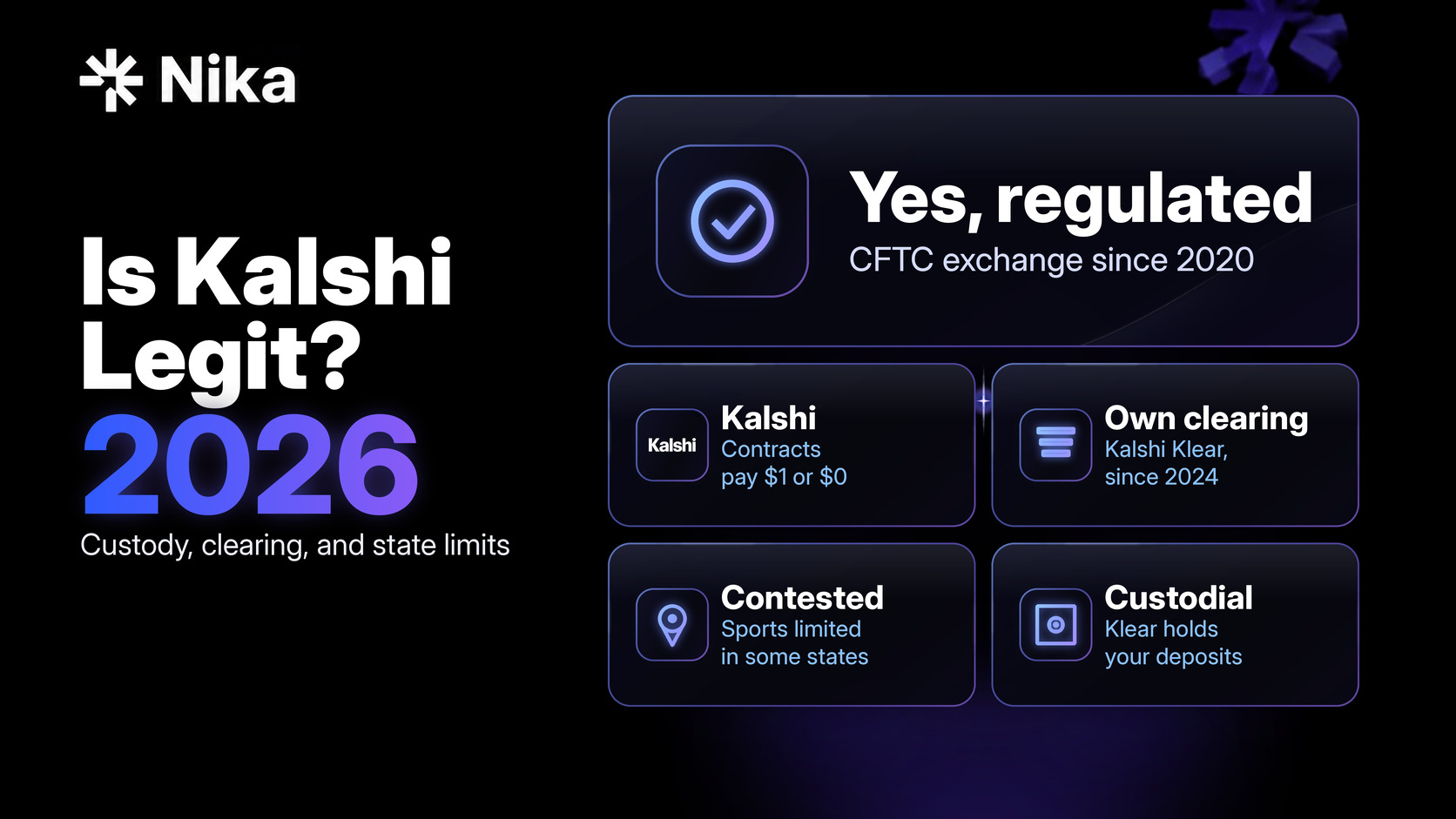
Yes, Kalshi is legit. Its exchange entity, KalshiEX LLC, has been a designated contract market regulated by the Commodity Futures Trading Commission (CFTC) since 4 November 2020. Trades clear through Kalshi Klear LLC, its affiliated CFTC-registered derivatives clearing organization. It is not a scam.
That does not settle every practical question. Kalshi is custodial, so a company holds your balance. Several states are contesting its sports and other event contracts in court, and federal appeals courts have split on whether those contracts fall under exclusive federal jurisdiction. This guide covers how Kalshi works, who holds your money, how deposits and withdrawals work, where it is available, and the risks to weigh before you fund an account.
Disclosure: This article is published by Nika, a non-custodial trading app. Nika’s prediction markets are powered by Polymarket’s international exchange, not Polymarket US. Nika is not a CFTC-registered exchange and does not offer a Kalshi-style dollar account.
The 30-second answer
- Is it regulated? Yes. KalshiEX LLC is a CFTC-designated contract market. Kalshi Klear LLC is a CFTC-registered clearinghouse.
- Is it a scam? No. You trade event contracts against other users, and contracts settle at $1 or $0 under each market’s published rules.
- Who holds your money? Kalshi Klear. Deposits sit in Klear’s settlement account at a bank, not in an account in your name. That is regulated custody, not a personal FDIC guarantee.
- Where is it available? Broadly across the US, subject to state limits that especially affect sports contracts. Outside the US, Kalshi accepts international users except from the 55 jurisdictions named in its member agreement and places subject to US sanctions.
- Main caveats: custodial funds, shifting state availability, public complaints about withdrawals and support, and the open federal-state jurisdictional fight.
How we assessed Kalshi
A legitimacy question is really four questions:
- Regulation: Is the exchange registered with the regulator it claims, and who clears the trades?
- Money flow: How do deposits, settlement, tax documents, and withdrawals work?
- Access: Where can you use it, and could that change while you hold a position?
- Risk: What could go wrong for a user, even if the company is legitimate?
We used Kalshi’s Help Center and member agreements, CFTC records, court opinions and attorney general releases, and reporting on the state cases. We did not open or fund a Kalshi account for this article.
What Kalshi is and how it is regulated
Kalshi is a peer-to-peer event-contract exchange. Instead of betting against a sportsbook that sets a line, you buy or sell contracts on whether an event will happen, and another user takes the other side.
Each contract is binary. If the outcome happens, the contract settles at $1. If it does not, it settles at $0. Prices are quoted in cents, so a contract trading at 80 cents implies roughly an 80% chance of that outcome. Being right about the event and wrong about the entry price is a common way to lose money.
The CFTC designated KalshiEX LLC as a contract market on 4 November 2020. On 28 August 2024 (announced 29 August), the CFTC registered Kalshi Klear LLC as a derivatives clearing organization, so Kalshi clears its own trades rather than routing them through a third-party clearinghouse. Before Klear, Kalshi’s contracts cleared through MIAXdx.
Federal registration means Kalshi answers to a US derivatives regulator for market integrity, reporting, and customer-fund handling. It does not mean your positions are insured, and it does not end the dispute with state gambling regulators over sports and other contracts.
What is Kalshi Klear LLC?
Kalshi Klear LLC is Kalshi’s affiliated clearinghouse, and it is the entity that holds funds you deposit. If you searched the name because it appeared on a bank statement, that is expected: Kalshi’s wire and real-time payment instructions name the receiving account “Kalshi Klear LLC.”
Under Klear’s member agreement, deposited funds are held in Klear’s settlement account at Silicon Valley Bank, a division of First Citizens Bank. The account uses an insured cash sweep program intended to seek FDIC coverage. The same agreement states important limits: because the settlement account is not in your name, FDIC insurance is not guaranteed to you, and new deposits may not be eligible for the sweep until two business days after they arrive.
That is a regulated custodial arrangement with stated limits, not a personal insured deposit account and not the same as holding funds in a wallet you control.
Is Kalshi safe to use?
Kalshi has a regulated structure, but no trading account is risk-free. Three points are worth understanding.
It is custodial. Your balance sits with Kalshi Klear, not in a wallet you control. Withdrawals can be held after deposits, paused for payment-processor compliance reviews, or limited by account-specific daily caps. Federal clearing rules set how customer funds are handled; they do not remove the risks of holding a balance with a company.
Trading risk is separate from legitimacy. A contract at 80 cents is an 80% implied probability with 80 cents of downside if you are wrong, before fees and spread.
Availability can change. If a court blocks a category of contracts in your state, the markets you can trade can change under an open position. The Michigan and Washington cases below are examples of that risk in practice.
Deposits, withdrawals, fees, and tax forms
Kalshi’s transfer information below reflects its Help Center as reviewed on 6 October 2026. Your Transfers page shows the limits and timing for your own account.
Funding methods
| Method | Deposit | Withdrawal | Hold before you can withdraw a deposit |
|---|---|---|---|
| Bank transfer (ACH), US only | Free, $10 minimum; typically settles within about 5 business days, with part often credited early | Yes | Up to 2 days after settlement |
| Debit card, Apple Pay, Google Pay | $10 minimum; may carry a 2% processing fee | Debit card, free | Up to 2 days after settlement |
| PayPal, Venmo, US only | Yes | Yes | No hold |
| Cash App, US only | Deposits only | No | No hold |
| Wire | Free on Kalshi’s side, $1,000 minimum | Aimed at very large amounts (Kalshi describes wires as suitable above $500,000) | No hold |
| Crypto | Yes | Only if you have deposited crypto before | No hold |
International accounts can deposit by debit card, crypto, or wire, and withdraw by debit card or crypto. ACH, PayPal, Venmo, and Cash App are not available for international accounts.
Three details matter more than the table:
- Holds apply to the deposited amount. Kalshi’s security holds guidance says earnings above what you deposited can be withdrawn once they are settled cash. Money in open positions is not withdrawable until those positions are closed or settled.
- Names must match. Bank accounts, cards, and wires must be in the same name as your Kalshi account, or the transfer can be delayed or returned.
- Withdrawals can pause for checks. Debit withdrawals are normally fast but can be held for a payment-processor compliance review, which Kalshi’s debit card withdrawal guidance says typically takes 3 to 5 business days. There is also a personal daily withdrawal limit.
Trading fees
Kalshi’s fee schedule, dated 7 July 2026, sets the general taker fee as 0.07 × number of contracts × price × (1 − price), rounded up. The fee is highest for contracts near 50 cents: a taker buying 100 contracts at 50 cents pays $1.75. That is 3.5% of the $50 purchase, because 0.07 is a formula coefficient, not a flat percentage.
Most series charge makers nothing, but some listed series carry a maker fee, some carry no fee, and combos have their own pricing. Maker and taker status depends on how an order fills, not on the order type: a limit order that matches a resting order immediately pays the taker fee. Fee schedules in this category change, so check the fee shown before you confirm a trade. For small trades, a card deposit fee or a wide spread can cost more than the trading fee.
Tax documents
Kalshi’s tax documentation guidance says users who reach IRS reporting thresholds receive 1099-INT for interest, 1099-MISC for credits and rewards, and 1099-B / 1099-DA for certain crypto activity. Kalshi also provides a yearly profit and loss statement for trading. Its Help Center does not describe a 1099 for event-contract winnings. How gains are taxed depends on your circumstances, so keep records and speak with a tax professional if you trade at any size.
Does Kalshi pay out?
Yes. When a market resolves, winning contracts pay $1 and losing contracts pay $0 under the settlement terms written into each market. The money then follows the withdrawal rules above.
Settlement is rules-based rather than discretionary. That is separate from service quality. Public reviews often cite withdrawal friction, identity-verification loops, disputed settlements on ambiguously worded markets, and slow support. Those are user reports about experience, not evidence that the exchange fails to settle winning contracts.
One 2026 episode shows how custody and jurisdiction can collide. After a Michigan court’s temporary restraining order required Kalshi to cancel sports trades already made by Michigan residents, Kalshi filed an emergency rule to unwind them. On 14 July 2026 the CFTC stayed that rule and ordered Kalshi to honor the trades through normal settlement. Kalshi later told the Michigan court it had already unwound the trades before the CFTC acted. On 1 September 2026 the Michigan court issued a preliminary injunction, an interim order, blocking Kalshi’s sports contracts for people in Michigan. For traders in the middle, the competing federal and state orders decided what happened to open positions.
How is Kalshi not gambling?
Kalshi’s legal position is that its event contracts are swaps under the Commodity Exchange Act, traded on a federally regulated exchange that matches users rather than taking the other side. Federal appeals courts have split on that question for sports contracts. All three rulings came at the preliminary-injunction stage, not as final judgments:
- Third Circuit (6 April 2026): sided with Kalshi against New Jersey, treating sports event contracts as swaps under CFTC exclusive jurisdiction. New Jersey has asked the Supreme Court to review.
- Ninth Circuit (28 August 2026): ruled against Kalshi in Nevada’s case, finding Kalshi had not shown federal law likely preempts state gaming law for sports contracts.
- Sixth Circuit (25 September 2026): ruled against Kalshi in the Ohio and Tennessee cases, holding the sports contracts had not been shown to be swaps.
Economically, buying a yes contract on a football game can feel very close to a bet. That overlap is exactly what several states have challenged. The CFTC has also proposed rules on event contracts; as of early October 2026 none of those proposals were final.
Is Kalshi legal in your state?
It depends on the state and the contract type. Non-sports markets such as economics, weather, and finance are broadly available across the US. Sports contracts are the most contested category, and in at least one state the restrictions reach politics, elections, and culture as well. Check eligibility in the app for your location before you fund an account. Treat every state list, including this one, as a dated snapshot.
| Where it stands | What happened | Status |
|---|---|---|
| New Jersey | Third Circuit ruled for Kalshi on 6 April 2026 (preliminary injunction) | Kalshi operating; Supreme Court petition pending |
| Nevada | Ninth Circuit ruled against Kalshi on 28 August 2026 (preliminary injunction) | State enforcement available |
| Ohio and Tennessee | Sixth Circuit ruled against Kalshi on 25 September 2026 (preliminary injunctions) | State enforcement available |
| Utah | Federal judge granted summary judgment for the state on 4 August 2026, a final district-court judgment; Tenth Circuit refused to pause enforcement during appeal on 8 September 2026 | Enforceable while appeal runs |
| Massachusetts | State court preliminary injunction against unlicensed sports wagers (order announced January 2026) | Sports blocked |
| Washington | King County Superior Court order of 13 August 2026, issued under a preliminary injunction granted in July 2026, covers sports, elections, politics, entertainment, culture, tech and science, and mention contracts | Those categories blocked |
| Michigan | State court preliminary injunction, 1 September 2026, bars Kalshi sports contracts for people in Michigan, with geofencing requirements | Sports blocked |
| New York | Federal judge denied Kalshi a preliminary injunction on 7 July 2026; New York’s lawsuit alleges illegal gambling and seeks forfeiture and penalties; CFTC emergency order of 11 August 2026 directs Kalshi to keep operating | Operating; active litigation |
| Minnesota | Federal judge preliminarily blocked enforcement of a prediction-market ban against CFTC-registered exchanges on 27 July 2026 | Ban not enforceable against Kalshi for now |
The practical answer is not that Kalshi is illegal nationwide. It is that two layers of American law disagree, the appeals courts are split, and availability can depend on your state and contract type.
Kalshi is not the only venue in that gap. Novig holds CFTC registration for a sports exchange and is litigating against several states of its own; see is Novig legit.
Who can use Kalshi?
You need to be 18 or older and pass identity checks. Inside the US, Kalshi is broadly available subject to the state limits above. Outside the US, Kalshi accepts international traders, but its member agreement bars trading event contracts from 55 named jurisdictions, including the United Kingdom, Canada, Australia, France, and Ireland, plus places subject to US sanctions. Local law still applies wherever you are.
Who Kalshi suits, and who it does not
Kalshi is a good fit if you:
- Want regulated, dollar-denominated event contracts funded from a US bank account
- Are comfortable with Kalshi Klear holding your balance
- Trade categories and from locations that remain available in the app
- Want a yearly profit and loss statement for your own records
Kalshi may be the wrong choice if you:
- Want to hold funds in a wallet you control
- Trade sports contracts from a contested state, or travel often between restricted and unrestricted locations
- Need fast human support when a withdrawal or settlement is disputed
- Live in a jurisdiction where Kalshi restricts event-contract trading
On any exchange, less popular markets can have thinner order books. Check depth on the specific market you want to trade.
If you want to hold your own funds
Self-custody is a different model rather than a replacement for Kalshi. If you specifically want regulated US dollar event contracts funded from a bank, Kalshi is built for that. If your main concern is that a company holds your balance, onchain prediction markets let you trade from a wallet you control.
Polymarket’s international exchange runs onchain prediction markets covering politics, news, crypto, sports, and other events, and you trade from a wallet you control. It does not accept US users and blocks or limits trading in other countries, including the UK and France. Polymarket US is a separate product: a CFTC-designated contract market operated by QCX LLC, launched in December 2025 after Polymarket acquired the licensed exchange and clearinghouse QCEX. It uses custodial dollar accounts, like Kalshi, so it is not a self-custody option. For the full side-by-side, see Kalshi vs Polymarket.
Nika is a non-custodial app that brings spot trading, perpetual futures, yield, and prediction markets into one interface. Its prediction markets are powered by Polymarket’s international exchange, not Polymarket US, and prediction market orders on Nika are not available to US persons. You can sign up with email or a supported social login, and you control your wallet. Assets deposited into a protocol remain subject to that protocol’s rules and risks, and availability of other products varies by jurisdiction. Trades through Nika can include Nika fees in addition to the venue’s fee, so review the total before you confirm. Nika is not a CFTC-registered venue. If you want a regulated dollar account, Kalshi or Polymarket US is the more direct fit. You can read more about prediction markets on Nika.
Verdict
Kalshi is a legitimate, CFTC-regulated exchange with its own registered clearinghouse, rules-based settlement, and a real legal fight over state gambling law. It is not a scam.
Before funding an account, weigh the custodial model, the fees and holds on deposits and withdrawals, the open circuit split on sports contracts, and whether your state currently restricts the markets you want. If those tradeoffs suit you, Kalshi is a straightforward way to trade dollar event contracts on a federally regulated venue.
Frequently asked questions
Is Kalshi a scam?
No. KalshiEX LLC is a CFTC-designated contract market, contracts settle at $1 or $0, and trades clear through Kalshi Klear, a CFTC-registered clearing organization. Custodial risk, state litigation, and service complaints are real caveats, but they are not signs of a scam.
Is Kalshi safe to use?
It has a regulated structure, but it is not risk-free. Your balance sits with Kalshi Klear rather than in a wallet you control, FDIC coverage is not guaranteed to you, withdrawals can be held or paused for checks, and you can lose the full cost of a contract.
What is Kalshi Klear LLC?
It is Kalshi’s affiliated, CFTC-registered clearinghouse. It settles trades made on the Kalshi exchange and holds deposited funds in its settlement account at Silicon Valley Bank, a division of First Citizens Bank. Wire and real-time payment instructions name that account, so the name can appear on your bank records.
Is my money FDIC insured on Kalshi?
Not guaranteed. Klear uses an insured cash sweep program to seek FDIC coverage, but its member agreement says coverage is not guaranteed because the settlement account is not in your name, and new deposits may not be eligible until two business days after they arrive.
Does Kalshi pay out?
Yes. Winning contracts pay $1 and losing contracts pay $0 under each market’s published rules. Deposited money can be held for up to two days after an ACH or card deposit settles before you withdraw it. Public reviews do report withdrawal friction and slow support, so service quality is the usual complaint, not missing settlement.
Does Kalshi send a 1099?
Kalshi issues 1099 forms for interest, rewards, and certain crypto activity when IRS thresholds are met, plus a yearly profit and loss statement. Its Help Center does not describe a 1099 for event-contract winnings.
Is Kalshi legal in my state?
It depends on the state and the contract type. Non-sports markets are broadly available. Sports contracts are blocked or restricted in a growing list of states, including Nevada, Massachusetts, Michigan, and Washington. Washington’s order also covers politics, elections, and culture. Check the app for your location before funding an account.
Can I use Kalshi outside the US?
Often, yes. Kalshi accepts international users outside the 55 jurisdictions named in its member agreement, including the UK, Canada, Australia, France, and Ireland, and places subject to US sanctions. International accounts have fewer payment options.
Is there a self-custody alternative to Kalshi?
Polymarket’s international exchange lets you trade from a wallet you control where it is available, and Nika offers prediction markets powered by that exchange in a non-custodial app. Polymarket’s international exchange does not accept US users, and prediction market orders on Nika are not available to US persons. Neither is a like-for-like replacement for a regulated dollar account.
Sources
- CFTC: CFTC designates KalshiEX LLC as a contract market, 4 November 2020
- CFTC: CFTC grants Kalshi Klear LLC DCO registration, 29 August 2024
- CFTC industry filing: Kalshi Klear LLC, derivatives clearing organization
- Kalshi Help Center: How is Kalshi regulated?
- Kalshi Help Center: What is Kalshi Klear?
- Kalshi Klear self-clearing member agreement
- Kalshi Help Center: Transfers FAQ
- Kalshi Help Center: Bank deposits
- Kalshi Help Center: Card deposits
- Kalshi Help Center: Debit card withdrawals
- Kalshi Help Center: Security holds
- Kalshi Help Center: What tax documentation does Kalshi provide?
- Kalshi member agreement
- Kalshi Help Center: Can I trade on Kalshi from outside the United States?
- Kalshi fee schedule
- US Court of Appeals for the Third Circuit: KalshiEX LLC v. Flaherty, 6 April 2026
- US Court of Appeals for the Ninth Circuit: KalshiEX LLC v. Assad, 28 August 2026
- US Court of Appeals for the Sixth Circuit: KalshiEX LLC v. Schuler and Orgel, 25 September 2026
- US Supreme Court docket 26-299: Flaherty v. KalshiEX LLC
- Massachusetts Attorney General: court order blocking Kalshi sports wagers
- Washington Attorney General: judge orders Kalshi to cease numerous Washington operations, 13 August 2026
- CFTC stays Kalshi emergency rule and orders Michigan trades fulfilled, 14 July 2026
- Michigan Attorney General: second order halting Kalshi sports wagers, 2 September 2026
- Michigan preliminary injunction order, 1 September 2026
- New York Attorney General: lawsuit against Kalshi, 31 July 2026
- Minnesota preliminary injunction order for CFTC-registered exchanges, 27 July 2026
- District of Utah: KalshiEX LLC v. Cox, summary judgment order, 4 August 2026
- Tenth Circuit: order denying injunction pending appeal in KalshiEX LLC v. Cox, 8 September 2026
- PR Newswire: Polymarket acquires CFTC-licensed exchange and clearinghouse QCEX for $112 million
- CFTC industry filing: QCX LLC d/b/a Polymarket US, designated contract market
- Southern District of New York: KalshiEX LLC v. New York State Gaming Commission, order denying preliminary injunction, 7 July 2026
- CFTC: emergency order directing Kalshi to continue operating, 11 August 2026
- CFTC: proposed rulemaking on event contracts, June 2026
- Law360: Kalshi unwound Michigan trades before CFTC order, court told, 18 July 2026
- Polymarket documentation: Geographic restrictions
Explore prediction markets with Nika
If you want prediction markets alongside spot, perpetuals, and yield in a self-custody app, Nika brings them into one interface. Explore the available products and choose the ones that fit your goals and experience.
This article is for informational purposes and is not financial, legal, or tax advice. Prediction markets and event contracts involve risk, including loss of capital, and their legal status varies by location. Product availability, fees, and terms can change.