
Kalshi vs Polymarket: Which Prediction Market Should You Use? (2026)
Compare Kalshi and Polymarket on regulation, custody, fees, markets, and where each one is available in 2026.
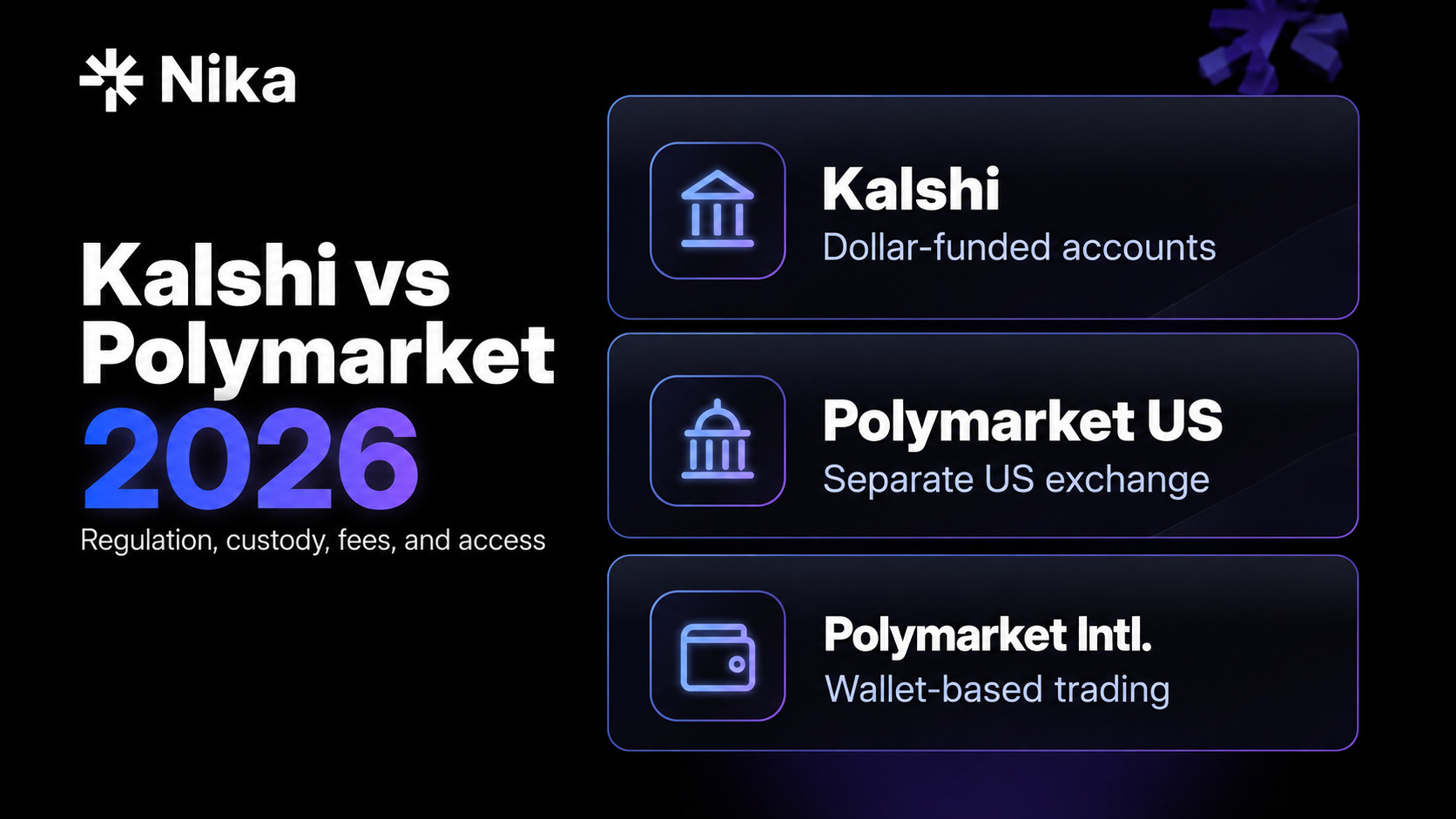
The right choice between Kalshi and Polymarket depends on where you live, how you want to hold your money, and what you want to trade.
In the US, the real comparison is Kalshi vs Polymarket US. Both are CFTC-regulated exchanges with custodial dollar accounts and similar fees on general straight trades. Outside the US, Polymarket’s international exchange works differently: it is an onchain market where you trade stablecoins from a wallet you control, while Kalshi accepts international users in permitted jurisdictions.
Our picks by use case: Kalshi for dollar-funded event trading with a large sports and combo market; Polymarket US for a separate regulated US account; and Polymarket’s international exchange for wallet-based trading where it is available. Compare the actual contract and execution price before choosing: the biggest platform is not automatically the cheapest place to place your order.
Disclosure: This guide is published by Nika, a non-custodial trading app. Nika’s prediction markets are powered by Polymarket’s international exchange. This guide distinguishes that product from Polymarket US.
The 30-second answer
- Regulation: Kalshi has been a CFTC-designated contract market since November 2020. Polymarket US is also a CFTC-designated contract market. Polymarket’s international exchange is not CFTC-regulated and does not accept US users.
- Custody: Kalshi and Polymarket US hold customer funds in custodial accounts. On Polymarket’s international exchange, you trade from your own wallet.
- Fees: For 100 contracts at 50 cents, the general Kalshi schedule charges a taker $1.75 and the standard Polymarket US straight-trade schedule charges $1.74; product exceptions apply. Polymarket’s international taker fees range from $0 to $1.75 on the same trade, depending on the category.
- Markets: Recent research identifies sports as the leading topic on Kalshi and across Polymarket’s combined venues. Kalshi recorded far higher notional volume in September 2026, while Polymarket’s volume has historically been spread more widely across politics and crypto.
- Availability: Kalshi serves US users and international users in permitted jurisdictions. Polymarket US is for US residents. The international exchange is available in many countries but blocks or limits trading in others, including the US and UK.
- Main caveats: state legal challenges in the US, custodial risk on regulated venues, self-custody responsibilities onchain, and the possibility of losing the full cost of a position.
How we compared them
We compared the platforms on five criteria:
- Regulation and access: Who regulates each venue, and who can legally use it?
- Custody and funding: Who holds your money, and how do you get it in and out?
- Fees: What does a typical trade cost, and how are makers and takers treated?
- Markets and liquidity: Which categories draw the most trading?
- Risk: What could go wrong, even on a legitimate platform?
We used platform documentation, regulatory records, published agreements, and independent volume research. We did not open or fund accounts for this article.
Kalshi vs Polymarket at a glance
| Feature | Kalshi | Polymarket US | Polymarket international |
|---|---|---|---|
| Who it is for | US users, plus international users in permitted jurisdictions | US residents | Users outside restricted jurisdictions; not available to US users |
| Regulation | CFTC-designated contract market; trades clear through Kalshi Klear, a CFTC-registered clearinghouse | CFTC-designated contract market operated by QCX LLC | Onchain exchange; not CFTC-regulated |
| Custody | Custodial | Custodial | Non-custodial; you trade from your own wallet |
| Funding | US dollars by bank transfer, debit card, PayPal, Venmo, wire, or crypto; fewer options for international accounts | US dollars by debit card, bank transfer, Apple Pay, PayPal, Venmo, wire, or USDC where available | Stablecoins on Polygon; trades settle in pUSD, a token backed by USDC |
| Taker fee, 100 contracts at 50 cents | $1.75 under the general schedule | $1.74 for standard straight trades | $0 to $1.75 by category |
| Makers | No fee on most markets; some listed series carry a maker fee | Maker rebate on eligible straight trades; exceptions apply | No maker fee; rebates subject to program rules |
How a prediction market trade works
For a typical binary event contract, a winning contract pays $1 and a losing contract pays $0. You buy exposure to a defined outcome at a price between those endpoints. The following examples are hypothetical and exclude fees unless stated otherwise; the contract’s own terms govern settlement.
Suppose a YES contract costs 60 cents and you buy 100 contracts:
| Outcome | Contract cost | Settlement payout | Profit or loss before fees |
|---|---|---|---|
| YES wins | $60 | $100 | $40 profit |
| YES loses | $60 | $0 | $60 loss |
The $100 winning payout includes the return of the $60 you spent. It is not $100 of profit. A market price of 60 cents can be read as roughly a 60% implied probability, but it is not a guarantee or a verified forecast.
You may also sell before the event resolves, provided another trader will buy at a price you accept. If the same 100 contracts sell at 70 cents, you receive $70 and make $10 before fees. If they sell at 40 cents, you receive $40 and lose $20 before fees. Fees can apply to both the entry and the exit.
An early exit is useful when your view changes or you want to reduce exposure, but it depends on available buyers. A displayed portfolio value does not promise that your entire position can be sold at that price.
Similar questions can have different settlement rules
Two markets can look identical in their headlines while using different deadlines, data sources, or definitions. A question about a rate cut might refer to a specific central bank meeting; a question about an election might specify a particular authority’s result; a sports contract might treat postponements according to its own rules.
Before comparing prices across platforms, confirm that you are comparing the same outcome under the same conditions. A cheaper contract with different settlement criteria is not necessarily a better deal.
Regulation and where you can use each
Federal status
The CFTC designated KalshiEX LLC as a contract market on 4 November 2020. Its affiliate Kalshi Klear became a registered derivatives clearing organization in August 2024. See the CFTC’s exchange designation and clearinghouse registration.
Polymarket US is operated by QCX LLC, listed in the CFTC’s designated contract market records. It is a separate product from the international exchange, with its own account and funding process. It launched in December 2025.
Polymarket international at polymarket.com is an onchain venue, not the CFTC-regulated US exchange. The two products do not share an interchangeable account or order book. US availability for Polymarket US does not give US residents access to the international exchange.
State challenges in the US
Federal registration does not settle every dispute over state gambling laws and particular event contracts. For example, New York’s attorney general announced a lawsuit against Polymarket US on 24 September 2026, seeking to stop its operation as an allegedly unlicensed gambling business. That announcement describes the state’s allegations, not a final ruling on the merits.
The practical issue for a trader is access: a venue may restrict particular products, new orders, or accounts while litigation and regulatory decisions develop. Check the platform’s current eligibility rules before depositing and before entering a long-dated position. For related background, see our Kalshi review.
Outside the US
Kalshi’s international access guidance confirms that it accepts users from many countries, subject to its agreements and identity checks. Its clearing member agreement restricts event trading from numerous jurisdictions, including the UK, Canada, Australia, France, and Ireland. Eligibility involves more than simply being outside the US.
International Kalshi accounts may use debit cards, crypto, or wire funding where supported. ACH, PayPal, and Venmo are unavailable to international users.
Polymarket international has its own geographic restrictions. Some locations are blocked completely; others are close-only, allowing existing positions to be closed but preventing new ones. The latter list includes the US, UK, France, Germany, Australia, and several Canadian provinces. Some restrictions differ between the website and the API.
Being able to open a website or create an account does not establish that you are eligible to trade. Check the rules for your location and intended product; local law also applies.
Custody: who holds your money
Kalshi is custodial. Its clearing member agreement says deposited funds are held in Kalshi Klear’s settlement account at Silicon Valley Bank, a division of First Citizens Bank. The agreement describes an insured cash sweep arrangement but explicitly warns that FDIC insurance is not guaranteed to an individual member. Do not treat the account as equivalent to a bank account in your own name.
Polymarket US uses a custodial exchange account. You manage an account balance and use supported deposit and withdrawal methods, rather than holding the account’s trading funds in a wallet whose private key you control.
Polymarket international uses wallet-based trading. Its collateral is pUSD, a USDC-backed ERC-20 token on Polygon. This is the version associated with self-custody, rather than the US dollar account described above.
Self-custody changes who controls the wallet; it does not remove protocol risk. Assets committed to a position remain subject to smart contracts and settlement rules. Protect your login, recovery methods, and keys, and review what you authorize before approving a transaction.
The choice is practical. A custodial venue handles more of the account and payment infrastructure, while you depend on its withdrawal process. A wallet-based venue gives you more direct control, while adding responsibility for wallet security, token transfers, and onchain interactions.
Funding and fees
Deposits and withdrawals
Kalshi: Its fee schedule lists no fee for ACH deposits or withdrawals and a maximum 2% fee for card deposits. Kalshi adds no fee to wire deposits, although banks may charge. Crypto payment processors can also charge fees. Supported methods differ for international accounts.
Polymarket US: Its funding documentation lists debit card, ACH, Apple Pay, PayPal, Venmo, wire, and USDC where available. Wire deposits have a $5,000 minimum. Some deposits provide buying power before they have cleared, which does not mean that the funds are immediately withdrawable.
The withdrawal documentation describes withdrawals as free. Deposits generally need three to four business days to clear before withdrawal is available; card and ACH payouts have their own typical three-to-four-business-day arrival windows. Those are separate stages, not a promise that a newly deposited balance can reach your bank within a single window. Routing and availability depend on the funding method.
Polymarket international: Polymarket lists no platform fee to deposit or withdraw USDC. On-ramps, exchanges, bridges, and other intermediaries can still charge for getting funds into or out of the trading environment.
Trading fees
For the general or standard trades shown below, the basic fee calculation is coefficient × number of contracts × price × (1 − price). Price is expressed in dollars, so 50 cents is 0.50. Dollar fees peak around the midpoint and decrease toward either extreme. Rounding and product exceptions differ by venue.
| Venue and category | Taker coefficient | Fee for 100 contracts at 50 cents |
|---|---|---|
| Kalshi, general schedule | 0.07 | $1.75 |
| Polymarket US, standard straight trades | 0.0695 | $1.74 |
| Polymarket international, crypto | 0.07 | $1.75 |
| Polymarket international, sports, economics, culture, weather, other | 0.05 | $1.25 |
| Polymarket international, politics, finance, tech, mentions | 0.04 | $1.00 |
| Polymarket international, geopolitics | 0 | $0.00 |
These examples describe direct venue fees, not the total cost through every app or intermediary. Source schedules: Kalshi, Polymarket US, and Polymarket international, reviewed on 8 October 2026. Polymarket US’s fee schedule effective 7 October 2026 kept the standard straight-trade taker coefficient at 0.0695.
Since 7 October 2026, Polymarket US has charged a 0.10 taker coefficient on table-tennis markets, and combo fills earn no maker rebate. Its standard straight-trade schedule remains separate from those exceptions. Combo contracts and certain Kalshi series also have different pricing; check the actual order’s fee rather than applying this table universally.
A coefficient is not a flat percentage of your stake
Using Kalshi’s general schedule, buying 100 contracts at 50 cents costs $50 before fees. The calculation is 0.07 × 100 × 0.50 × 0.50 = $1.75. Your entry cost is $51.75, and a $100 winning payout leaves $48.25 of profit before any other costs.
That $1.75 is 3.5% of the $50 contract purchase, not 7% of it. The coefficient and the effective percentage of money spent are different measures. If you sell before settlement, include any exit fee when calculating the result.
Maker orders, taker orders, and limit orders
A maker adds a resting order to the book; a taker executes against an order already available. A limit order can do either. Setting a price limit does not automatically make an order fee-free.
For example, if contracts are offered at 60 cents and your buy limit is 60 cents, your order can fill immediately as a taker. If your limit is 58 cents and no seller accepts it, the order may rest as a maker until a match occurs. An order can also fill partly immediately and leave the remainder resting.
Kalshi generally waives maker fees except on specified series. Polymarket US offers rebates on eligible straight trades, while its international exchange charges no maker fee and runs a rebate program. Rebates have conditions; they are not guaranteed trading profits.
Compare the full cost, not just the fee column
A one-cent difference between the two standard US fee examples rarely decides the best execution. Spreads, depth, funding charges, and any intermediary fee can matter more.
Suppose one order book offers 100 identical YES contracts at 60 cents and another offers them at 62 cents. The second purchase costs $2 more before fees. If you fund a $100 balance through a hypothetical 2% card fee, that adds another $2. Both differences dwarf a one-cent trading-fee advantage.
The relevant calculation is the cost to enter and, if you expect to sell early, the likely cost to exit. Include the quote for your actual order size, rather than treating the last traded price as an executable offer.
Markets and liquidity
Which topics attract trading?
A Pew Research Center analysis published in May 2026 found substantial differences in topic mix. Its Polymarket figures excluded the US exchange.
| Historical share of volume, July 2024 to early May 2026 | Kalshi | Polymarket international |
|---|---|---|
| Sports | 80% | 39% |
| Politics | 4% | 32% |
| Crypto | 7% | 20% |
Those are historical shares, not a current inventory or a prediction of which market will have the best prices. In its September update, Pew found sports had become the leading topic on both platforms. Unlike the earlier comparison, that update combines Polymarket US and international data.
Which platform is bigger?
NEXT Predict’s analysis of Aldrin data reported September 2026 notional volume of approximately $60.9 billion for Kalshi, $8.6 billion for Polymarket US, and $4.4 billion for Polymarket international. Kalshi led on that measure, with combos accounting for about 58% of its total.
Notional volume values each traded contract at its $1 payout value. A five-cent contract can therefore contribute $1 to the headline count even though the buyer paid five cents. The same capital can also trade repeatedly. These figures do not measure unique users, fresh deposits, net inflows, or the amount you can sell immediately.
Check the market you intend to trade
Aggregate volume cannot tell you the spread or depth of a specific election, game, or economic release. Before placing an order, compare:
- The contract terms: Are the outcome, deadline, and settlement source equivalent?
- The spread: What can you buy at, and what could you sell at now?
- Available size: How many contracts are offered at your preferred price?
- Price impact: Would a larger order consume several price levels?
- Exit conditions: Will you need to sell during a quiet period or near a deadline?
For a hypothetical example, suppose the last traded price is 60 cents, but the current best bid is 58 cents and the best offer is 62 cents. Buying 100 contracts at 62 cents and immediately selling at 58 cents loses $4 before fees. A portfolio mark near 60 cents does not eliminate that spread.
Depth matters too. If only 20 contracts are offered at 60 cents and the next 80 are offered at 63 cents, buying all 100 costs $62.40 before fees, an average price of 62.4 cents. A 60-cent limit would protect your price but might fill only 20 contracts.
This is why choosing a venue and choosing an order are separate decisions. Compare the available execution for your size, then decide whether to trade immediately, leave a limit order, or wait.
Tax documents
Kalshi’s tax documentation guidance says users who reach IRS reporting thresholds receive 1099 forms for interest (1099-INT), credits and rewards (1099-MISC), and certain crypto transactions (1099-B and 1099-DA). Kalshi also provides a yearly profit and loss statement for trading. Check the documents supplied for your account; receiving no form does not establish that no tax is due.
If you use Polymarket US, check which tax documents the app provides for your account. On Polymarket’s international exchange, you trade from your own wallet, so keep your own records. How event contract gains are taxed depends on your circumstances and location, so speak with a tax professional if you trade at any size.
Which should you use?
Choose Kalshi if you:
- Are eligible to trade and want a dollar-funded event market account
- Mainly trade sports or combos, where most of Kalshi’s volume sits
- Want to fund in US dollars from a bank account, with a yearly profit and loss statement
- Are an eligible international user who prefers a dollar account
Choose Polymarket US if you:
- Are a US resident who wants Polymarket’s markets through a regulated, dollar-funded account
- Want maker rebates on eligible straight trades and understand that a limit order can still execute as a taker
Choose Polymarket’s international exchange if you:
- Live where it is available and want to trade from a wallet you control
- Are comfortable funding with stablecoins and managing your own keys
- Trade categories with lower or no taker fees there, such as politics or geopolitics
Neither may suit you if you want to avoid state legal uncertainty entirely, cannot afford to lose the money you deposit, or live in a jurisdiction where both are restricted.
Kalshi and Polymarket accounts are separate, so some traders use more than one venue to compare prices on the same event.
Settlement and risks to weigh before you fund
Resolution rules decide the payout
Read the full rules before buying. The exact wording, time zone, source, and exception clauses matter more than how you interpret a headline. Two traders can agree on what happened in the real world and still disagree over whether it satisfies a particular contract.
Polymarket international uses an UMA-based resolution process, with outcome proposals and a dispute mechanism. An event finishing is not necessarily the same moment that the position resolves and funds become available. On the US venues, review the exchange’s contract rules and settlement notices.
A dispute, delayed official data, or an exception in the contract can extend the time your capital remains committed. If you need the money by a particular date, account for both market settlement and the separate withdrawal process.
Regulation and self-custody address different risks
Regulated status does not protect you from choosing a losing outcome, paying too much, or selling into a thin book. Self-custody does not protect you from a harmful approval, a smart contract problem, or an unexpected resolution.
| Risk | What to consider before trading |
|---|---|
| Position loss | A losing binary contract can settle at zero; fees add to the entry cost |
| Liquidity | An early exit requires an available buyer at a price you accept |
| Settlement | The written criteria and resolution process govern the outcome |
| Account or wallet security | Protect access, recovery methods, and transaction approvals |
| Availability | State rules, geography, and product restrictions can change |
| Payment timing | Buying power, settled cash, and received withdrawals are different stages |
Combos add another consideration: a contract covering multiple outcomes can fail because one required condition fails. A low price and a large possible payout do not make that exposure inexpensive in probability terms.
Before adding to a position, decide how much you can lose, whether you plan to hold to settlement, and what would cause you to exit. Avoid relying on a withdrawal or an early sale as an emergency source of cash.
Where Nika fits
Nika brings prediction markets into the same non-custodial app as spot trading, perpetual futures, yield, and portfolio tools. Its prediction market access is powered by Polymarket international, rather than Polymarket US. That distinction matters for custody, eligibility, and which contracts you are using.
For an eligible user who already holds digital assets, the benefit is managing event positions alongside other trading activity in one interface. You can review your portfolio and access different products without making a separate prediction market account the center of your workflow. Nika is available on web, iOS, and Android; individual product availability still depends on location.
Nika does not provide a route around Polymarket’s geographic restrictions. Prediction market access is unavailable to US users. You control your wallet, while assets committed to positions remain subject to the underlying market’s smart contracts and resolution rules.
The fee comparison above covers the venues’ direct fees. Trades through Nika can also include Nika fees, so review the total shown before confirming an order rather than assuming the direct Polymarket schedule is your complete cost.
For more on the experience, see prediction markets on Nika. If you prefer a conventional dollar-funded exchange account, compare Kalshi and Polymarket US directly; if you prefer eligible wallet-based trading alongside your broader portfolio, Nika is another interface to consider.
Frequently asked questions
Is Polymarket legal in the US?
Polymarket US is a CFTC-designated contract market available to US residents, although some states are challenging sports and other contracts in court. Polymarket’s international exchange does not accept US users.
Which is bigger, Kalshi or Polymarket?
Kalshi, by notional volume. In September 2026, Kalshi recorded about $60.9 billion, compared with about $13 billion across Polymarket US and the international exchange combined, according to NEXT Predict’s analysis of Aldrin data.
Which has lower fees?
Under their general and standard straight-trade schedules, Kalshi and Polymarket US charge almost the same taker fee. Product exceptions apply. Polymarket’s international exchange charges less in most categories and nothing on geopolitics markets. Maker treatment varies by venue and contract; a limit order that immediately matches the book can still incur a taker fee.
Is Polymarket self-custody?
The international exchange is: you trade from a wallet you control and can export your private key. Polymarket US is a custodial, dollar-funded account, like Kalshi.
Who holds my money on Kalshi?
Kalshi Klear, Kalshi’s CFTC-registered clearinghouse, holds deposited funds in its settlement account at a bank. It is a regulated custodial account, not a wallet in your name.
Can I use Kalshi or Polymarket outside the US?
Often, yes. Kalshi accepts international users in permitted jurisdictions. Polymarket’s international exchange is available in many countries but blocks or limits trading in others. Check both lists against your location.
Does Kalshi send a 1099?
Kalshi issues 1099 forms for interest, rewards, and certain crypto activity when IRS thresholds are met, plus a yearly profit and loss statement. Check the documents supplied for your account; receiving no form does not establish that no tax is due.
Can I sell before the event ends?
You can generally seek an early exit while trading remains open, but a sale depends on available counterparties and the venue’s rules. Your actual sale price can differ from the price used to display portfolio value, and an exit fee may apply.
Is a limit order always a maker order?
No. A limit order sets the worst price you will accept. If it immediately matches a resting order, that fill is a taker trade. If it rests and another trader later accepts it, it can be a maker trade. One order can have both types of fills.
Does Nika offer Polymarket US?
Nika’s prediction markets are powered by Polymarket international. They follow the underlying product’s eligibility restrictions and are unavailable to US users. The direct venue fee tables in this article do not include every possible Nika or funding charge.
Sources
- CFTC: KalshiEX designation
- CFTC: Kalshi Klear registration
- CFTC: QCX LLC d/b/a Polymarket US
- Kalshi Klear self-clearing member agreement
- Kalshi: International eligibility and payment methods
- Kalshi fee schedule
- Kalshi: Tax documents and profit and loss statements
- Polymarket US: Fees and rebates
- Polymarket US: Deposit methods
- Polymarket US: Withdrawal methods and timing
- Polymarket international: Fees
- Polymarket: pUSD collateral
- Polymarket: Geographic restrictions
- Polymarket: Resolution
- New York Attorney General: Polymarket US lawsuit, 24 September 2026
- Pew Research Center: Prediction market volume and category mix, May 2026
- Pew Research Center: Sports and prediction market growth, September 2026
- NEXT Predict: September notional volume and its limitations
Explore prediction markets with Nika
If you want prediction markets alongside spot, perpetuals, and yield in a self-custody app, Nika brings them into one interface. Explore the available products and choose the ones that fit your goals and experience.
This article is for informational purposes and is not financial, legal, or tax advice. Prediction markets and event contracts involve risk, including loss of capital, and their legal status varies by location. Product availability, fees, and terms can change.