
What Is a Cross-Chain Bridge? How It Works
Learn how cross-chain bridges work, what you receive, and where the risks sit. See how Nika simplifies supported cross-chain swaps in one app.
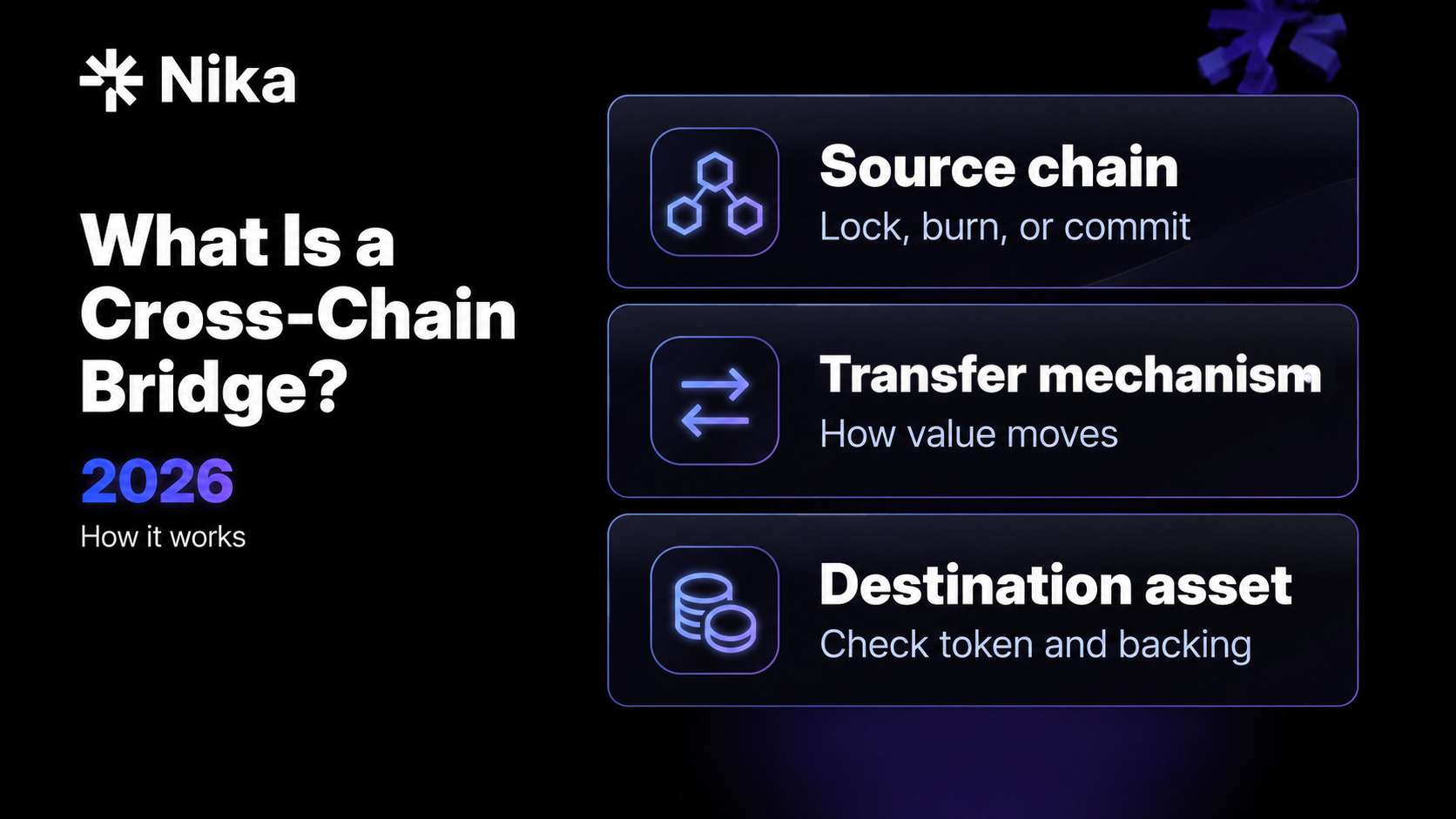
A cross-chain bridge lets you move value from one blockchain to another. Depending on the design, your source asset is locked, burned, deposited into a pool, or committed to an order, and an asset is minted or delivered on the destination chain. The important questions are what you receive, what backs it, and which contracts or participants you rely on.
For users, the difficult part is often coordinating the whole journey: finding a supported route, connecting a wallet, bridging, swapping into the token they actually need, and opening another app to use it. Nika brings supported cross-chain swaps and asset management into one non-custodial app, alongside spot trading, perpetuals, yield, and prediction markets.
Disclosure: This guide is published by Nika. Nika integrates third-party cross-chain and trading infrastructure. Nika does not run a bridge or a DEX. You interact directly with the underlying protocols through Nika. An integrated interface simplifies the experience; the underlying route still carries its own fees, execution conditions, and risks.
The 30-second answer
A bridge coordinates a transfer of value between separate blockchains. It can deliver a wrapped token, a natively issued token, or another asset through a combined swap-and-bridge route. Check the destination network, the exact token you will receive, the amount after fees, and the route’s security and recovery rules.
With Nika, you can access supported cross-chain swaps without separately coordinating a bridge website and a trading interface. Nika’s integrations include LI.FI, deBridge, Relay, and Across, as well as trading infrastructure such as Jupiter and DFlow. The providers used depend on the networks, assets, and available route; not every transaction uses every integration.
For the practical process, see how to bridge crypto between chains.
What does bridge mean in crypto?
Blockchains maintain separate ledgers. An Ethereum transaction does not automatically update a Solana balance. A bridge provides a mechanism for an action on one chain to result in an asset transfer or issuance on another.
The asset does not physically travel between ledgers. Contracts and other participants coordinate the corresponding changes. The Ethereum Foundation’s bridge documentation distinguishes designs that rely on external verifiers from those that rely more directly on the connected chains’ verification mechanisms. Those differences affect security, connectivity, cost, and speed.
Bridges can also carry messages and data. This guide focuses on the asset transfers users encounter when funding wallets, trading, or accessing applications on another network.
How does a cross-chain bridge work?
Four common mechanisms are useful to understand. They are not mutually exclusive categories: a service can combine liquidity, messaging, and solver-based settlement in the same route.
| Mechanism | What happens on the source chain | What you may receive | Main dependencies |
|---|---|---|---|
| Lock and mint | Assets are locked in a contract or custody arrangement | A bridge-issued representation of the asset | Reserve security, mint authorization, verification, and redemption |
| Burn and mint | Tokens are burned | Newly minted tokens on the destination chain | Issuer or protocol authorization, attestation, contracts, and chain finality |
| Liquidity network | Assets are deposited or transferred under the route’s rules | Assets supplied from destination-side liquidity | Available liquidity, contracts, verification, and settlement |
| Intent or solver route | Funds are committed through the provider’s order or settlement mechanism | Assets delivered by a solver or other liquidity provider | Order terms, fulfillment, contracts, verification, and settlement |
Lock and mint
An asset is locked on the source chain, and a corresponding token is minted on the destination chain. That destination token represents a claim on the locked reserve. Returning it through the supported redemption process typically burns the representation and releases the original asset.
The wallet holding the wrapped token can be yours while the reserve backing it remains controlled by the bridge’s contracts or custody arrangement. A reserve compromise can therefore affect you after the transfer has finished.
Burn and mint
The source token is destroyed, and an equivalent amount is minted on the destination chain under the issuer’s or protocol’s rules.
Circle’s Cross-Chain Transfer Protocol, or CCTP, uses this mechanism for native USDC transfers. It avoids creating a separate bridge-wrapped USDC claim, but still depends on Circle’s attestation and issuance infrastructure, contracts, and the connected chains.
Liquidity networks
A route accepts assets on one chain and pays from liquidity already available on another. This can be quick because the destination assets do not need to wait for a new issuance process.
The output is whatever token the route specifies. Liquidity-based delivery does not automatically mean issuer-native tokens. A route can pay out a native token, a wrapped representation, or an intermediate asset. Low liquidity can affect pricing, availability, or completion.
Intent and solver routes
You specify an outcome, such as receiving a particular token on Base. A solver or liquidity provider fulfills the order, often by delivering destination assets before its own settlement completes.
ERC-7683, a Draft standard for intent protocols, describes orders, solvers, and settlement. It does not make every provider’s order lifecycle identical. Approvals, signatures, route selection, expiry, cancellation, and recovery depend on the implementation.
Refunds are provider-specific. An unfilled or failed order may have an expiry, cancellation, refund, or manual recovery process. Check the actual rules rather than assuming funds automatically return.
What is the difference between a bridge and a cross-chain swap?
A bridge-only transfer generally preserves the intended asset exposure while changing networks, although the token representation may change. A cross-chain swap changes both the network and the asset: for example, ETH on Ethereum into SOL on Solana.
The distinction matters because a cross-chain swap can add exchange-rate exposure, spread, price impact, and additional execution dependencies. A single action in an app may coordinate several transactions underneath.
Nika integrates both cross-chain infrastructure and trading infrastructure. LI.FI, deBridge, Relay, and Across support its cross-chain stack, while Jupiter and DFlow support trading on Solana. The cross-chain providers handle movement between networks, while the trading integrations support token execution. Which integrations participate depends on the supported transaction.
Why does bridging feel complicated?
In a manual workflow, users may need to:
- Find a bridge that supports their networks, token, and transfer size.
- Compare quotes across websites with different fee presentations.
- Connect wallets and switch networks.
- Bridge an asset, then swap it separately into the token they need.
- Keep track of gas requirements and destination addresses.
- Check progress across interfaces before opening the application they wanted to use.
Standalone bridge interfaces can offer detailed protocol controls, but users coordinating separate tools do more of this work themselves. Integrated wallets already address some of these problems: MetaMask’s Swaps documentation describes bridging through third-party providers and gasless swaps on certain networks.
Nika’s advantage extends beyond the transfer. Supported cross-chain swaps, trading, yield opportunities, prediction markets, and portfolio management are accessible within the same app. You can move from getting the asset you need to using it without assembling a separate interface for every activity. Each feature still has its own supported assets, networks, and availability conditions.
How Nika simplifies cross-chain activity
Nika combines multiple integrations behind one user experience. Its LI.FI partnership announcement explains how LI.FI aggregates bridges and DEXs for supported cross-chain swaps; its broader stack also includes deBridge, Relay, Across, Jupiter, and DFlow.
| Manual workflow pain point | What Nika brings into the experience |
|---|---|
| Searching separate bridge and swap websites | Access to supported routes through integrated infrastructure |
| Bridging first, then arranging another swap | Combined cross-chain swaps where a supported route is available |
| Managing separate wallet setups for EVM and Solana | Embedded wallets for both ecosystems |
| Handling a seed phrase during onboarding | Account creation with email, Google, or Apple, without requiring seed-phrase management |
| Switching apps after obtaining the destination asset | Spot, perps, yield, predictions, and portfolio tools in one app |
| Wanting to use the wallet outside the app | Exportable EVM and Solana private keys |
Nika’s embedded wallets use Privy. Users can export their EVM and Solana private keys; Privy’s export documentation explains the underlying functionality. Exporting a smart-wallet signer key is distinct from exporting a smart-account contract, so external use depends on the wallet configuration and compatible tooling. For more detail, see whether an MPC wallet is non-custodial.
Choose from the routes available for your assets and review the quoted output, fees, and execution conditions before confirming.
Is crypto bridging safe?
Bridge risk is demonstrated, and the relevant dependencies vary by design. Contracts can contain bugs; verification or signing systems can be compromised; liquidity can become unavailable; and wrapped assets can lose their backing.
On 2 August 2022, Chainalysis estimated that $2 billion had been stolen across 13 bridge hacks, mostly during that year. Bridge attacks represented 69% of funds stolen in 2022 up to that date. These are historical figures, not a current loss rate or a prediction for a particular route.
The lesson is to inspect the mechanism and the asset you will hold. Self-custody of a wallet does not remove the risks of contracts or protocols you use through it. An integrated app also adds dependencies on the third-party providers and execution infrastructure it integrates.
For any route, check:
- Destination asset: the exact token contract or mint address and whether the application you plan to use accepts it.
- Verification and backing: who can authorize delivery or minting, and what backs a wrapped token.
- Execution terms: estimated output, minimum received where applicable, fees, and timing.
- Recovery rules: what happens if fulfillment or a destination swap fails.
- Permissions: which contract receives an approval and how much it can spend.
Do not infer the bridge model from the received token alone. A wrapped asset can be delivered through a liquidity or solver route, and a native asset can arrive through burn-and-mint.
Which route fits what you are doing?
- Moving stablecoins for use in another app: confirm the exact supported version, such as native USDC versus a bridge-issued representation.
- Changing both token and network: compare cross-chain swap quotes by the amount received and execution conditions.
- Moving a small amount: fixed gas costs and minimum charges may dominate the total cost.
- Moving a large balance: test the route, inspect backing and recovery terms, and consider splitting the transfer without assuming that splitting removes protocol risk.
- Withdrawing from an optimistic rollup to Ethereum: compare the canonical withdrawal path with third-party liquidity routes. Their timing and dependencies differ.
For timing, costs, and the practical checklist, read how to bridge crypto between chains.
Frequently asked questions
Does Nika support bridging and cross-chain swaps?
Yes. Nika integrates third-party cross-chain infrastructure, including LI.FI, deBridge, Relay, and Across. Trading integrations include Jupiter and DFlow. Available routes depend on the networks, assets, liquidity, and provider support. Nika does not run a bridge or a DEX. You interact directly with the underlying protocols through Nika.
Do I receive the same token on another chain?
Not necessarily. You may receive an issuer-native token, a wrapped representation, or a different token through a cross-chain swap. Check the quote and the exact destination contract or mint address.
Are refunds automatic if a transfer fails?
There is no universal guarantee. Refund eligibility, timing, cancellation, and recovery procedures depend on the provider, route, and failure stage. A partially completed cross-chain swap may leave you holding an intermediate asset rather than refunding the source asset.
Can a bridge hack affect me after the transfer finishes?
Yes. If you hold a bridge-issued token and the reserve backing it is compromised, the token can lose its backing even though it remains in your wallet.
Does using Nika remove bridge risk?
No. Nika reduces the work of coordinating supported cross-chain activity, but the underlying providers, contracts, networks, and assets retain their own risks.
Do I need a seed phrase to use Nika?
Nika’s embedded-wallet onboarding does not require you to manage a seed phrase. Its EVM and Solana private keys are exportable, giving you a way to control the underlying wallets outside the app with compatible tooling.
Sources
- Ethereum.org: Blockchain bridges
- Circle: Getting started with CCTP
- ERC-7683: Cross Chain Intents
- Chainalysis: Cross-chain bridge hacks, 2 August 2022
- MetaMask: Swaps user guide
- Privy: Export a wallet
- LI.FI: Intermediate assets and partial completion
Explore Nika
Move across supported chains and put your assets to work in one app. Open Nika to explore cross-chain swaps, spot trading, perpetuals, yield, and prediction markets while retaining control of your wallets. Access to perpetuals and prediction markets is subject to the underlying protocols’ terms and availability.
