
Perpetuals vs Futures: Expiry and Funding (2026)
A dated future expires and converges to spot. A perpetual never expires and uses funding instead. Compare costs, margin, liquidation, and regulated venues.
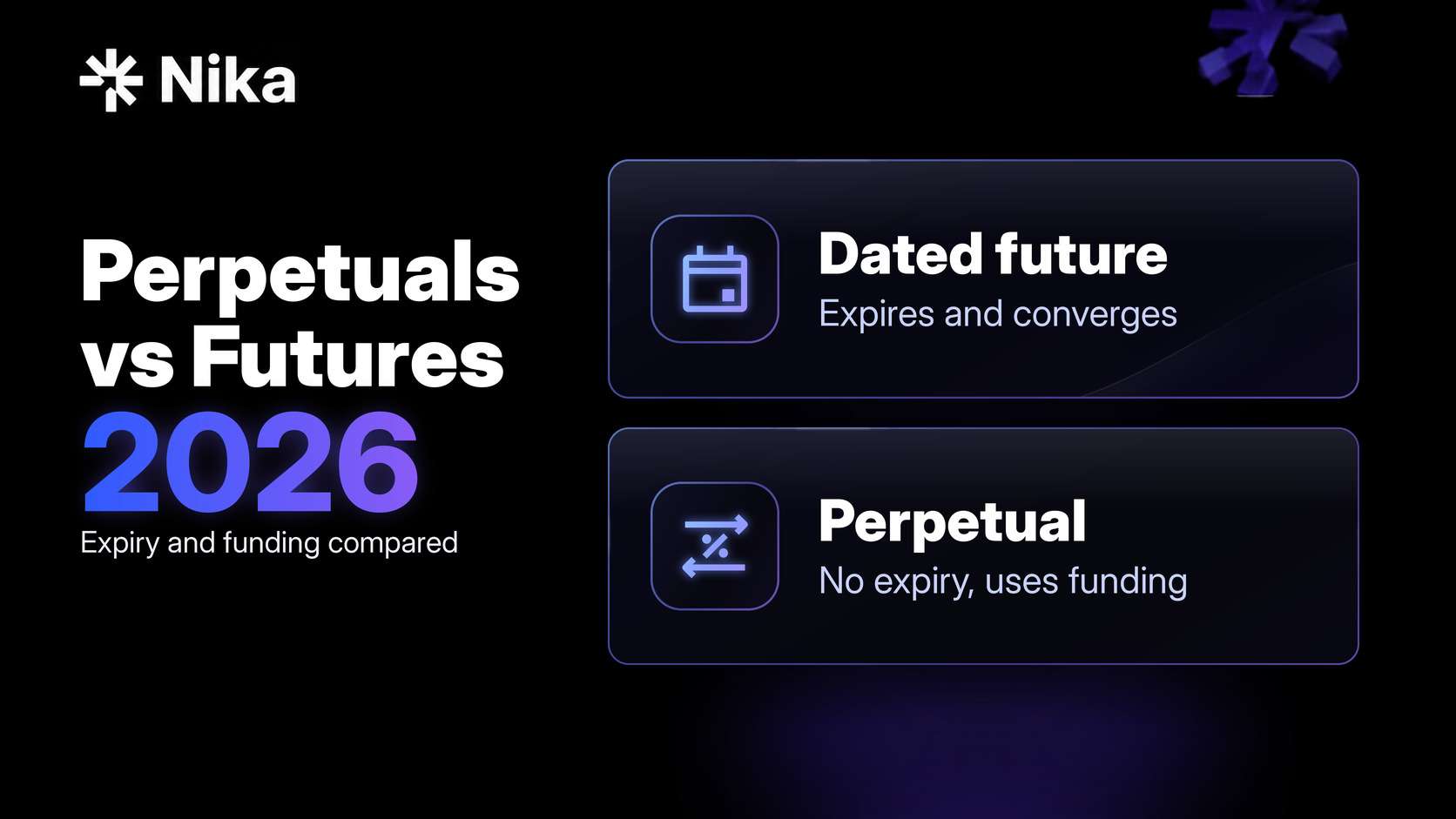
Perpetual futures are a type of futures contract. In this comparison, “futures” means dated futures: contracts with a scheduled expiry. A perpetual has no scheduled expiry and typically uses funding payments to help keep its price near a reference price.
Neither contract gives you ownership of the underlying asset simply because you open a position. Both provide derivative exposure, although some dated futures require physical delivery if held through expiry.
A dated future can suit a hedge with a known end date. A perpetual avoids rolling into a new expiry, but requires you to monitor funding. Expiry and regulation are separate questions: both dated and perpetual products can exist on regulated exchanges, and venue rules determine custody, margin, and access.
Disclosure: Nika offers perpetual trading through Hyperliquid. This guide compares contract mechanics using exchange rulebooks, protocol documentation, and regulatory sources.
The short version
- Expiry: a dated future has one. A perpetual has none; the position stays open while it stays margined.
- Tracking spot: dated futures converge to spot at expiry. Perpetuals use funding to stay near spot the rest of the time.
- Cost of holding: a dated future’s premium or discount is embedded in its price and affects returns as it converges. Rolling adds trading costs. A perpetual pays or receives funding while the position is open at funding timestamps.
- Margin: both are margined, and both can be closed out if your margin runs too thin.
- The trap: funding is charged on the position’s notional value, not on your margin. At leverage, a small-looking rate can be a large share of the money you put up.
Perpetuals vs futures at a glance
| Dated futures | Perpetual futures | |
|---|---|---|
| Expiry | A fixed date. CME Bitcoin futures stop trading at 4 p.m. London time on the last Friday of the contract month, with a business-day fallback | None. The position stays open while it is margined and the market is listed |
| How it tracks spot | Convergence: the contract settles against a reference price at expiry | Funding: a recurring payment between longs and shorts |
| Cost of holding | Basis embedded in the price, plus trading costs when rolling | Funding paid or received at funding timestamps, plus trading costs |
| Settlement | Final cash settlement or physical delivery at expiry; regulated futures also have mark-to-market settlement during the position | No scheduled final expiry; profit and loss and funding are accounted for under the venue’s rules |
| Margin and clearing | Depend on the venue; at CME, clearinghouse requirements apply and brokers can require more | Depend on the venue; onchain venues commonly offer cross or isolated margin, while regulated products can use regulated clearing |
| Typical venues | Regulated derivatives exchanges such as CME | Crypto exchanges and onchain perp DEXs; perpetual and perpetual-style contracts also exist on CFTC-regulated exchanges |
| Potential use | Hedging an exposure with a known date | Maintaining long or short exposure without repeatedly rolling an expiry |
CME details come from CME Rule 350 and the Bitcoin futures contract specifications. Funding mechanics vary by venue; the examples below use Hyperliquid’s funding documentation because it publishes the formula in full.
Do perpetual futures expire?
No. A perpetual has no expiry date and no final settlement date. Hyperliquid’s contract specifications, for example, list delivery and expiration as “N/A” and rely on hourly funding payments instead. The position stays open until you close it, it is liquidated, or the venue delists the market.
“No expiry” does not mean “no cost to hold”. It moves the cost from the roll to funding.
Perpetual-style is not the same as perpetual
Coinbase Derivatives announced perpetual-style futures for July 2025. Those products have five-year expirations, with funding accruing hourly and settling twice daily. They behave like perps in some respects but still expire.
Coinbase’s current US perpetual futures overview also describes no-expiry contracts. Check the specific product’s specifications instead of assuming that every product from the same exchange has the same expiry or funding schedule.
How a dated future tracks spot, and what rolling costs
At expiry, a cash-settled future pays out against a reference price. CME Bitcoin futures, for example, use the CME CF Bitcoin Reference Rate published at 4 p.m. London time on the last trading day (CME Rule 350). Because the contract must settle at that reference, its price converges toward spot as expiry approaches.
Before expiry, a future can trade above spot (a premium) or below it (a discount). The gap is called basis. It reflects market conditions such as financing, expected distributions or storage costs, and demand for exposure. It can be compared with perp funding when evaluating holding costs, but it is embedded in the contract price rather than billed as a separate funding payment.
Worked example: the cost of a premium
This example is hypothetical and excludes fees.
| Step | Number |
|---|---|
| Spot BTC today | $100,000 |
| Three-month future today | $101,500 (1.5% premium) |
| You buy | 1 BTC of exposure through the future |
| Spot BTC at expiry | $100,000 (unchanged) |
| Future settles at | $100,000 |
| Result | −$1,500 on the future, while spot was flat |
The long’s entry price included a 1.5% premium, which disappeared as the contract converged to settlement. That premium was not a separate fee deducted when opening the trade. If the future had initially traded at a discount and spot remained unchanged, the long would have gained from convergence instead.
To keep exposure past expiry, you can sell the expiring contract and buy a later one. The new contract has its own basis, and both legs can incur trading fees, spread, and price impact. Do not count the full difference between the two contract prices as an additional immediate loss on top of basis convergence; it reflects the different contracts you are exchanging.
How do funding rates work?
Positive funding means longs pay shorts; negative funding means shorts pay longs. On Hyperliquid, funding is a payment between traders, not revenue collected by the exchange.
The contract’s premium to the reference price influences funding, but the actual rate determines who pays. Hyperliquid’s formula also includes an interest component and a bounded adjustment, so even a small discount to spot does not necessarily mean negative funding.
Hyperliquid settles funding hourly, at one eighth of its computed 8-hour rate. Its payment formula is position size × oracle price × hourly funding rate. Funding is calculated on notional exposure, not on the collateral you posted.
Other venues use different schedules. Check whether a displayed rate is hourly, eight-hourly, or annualized, and whether funding accrues continuously or applies to positions held at a settlement timestamp.
Worked example: a correct call that still loses money
This example is hypothetical. It uses Hyperliquid’s published formula and its base perps fee rates as checked on 13 October 2026. It excludes Nika fees, other interface fees, spread, and price impact.
You go long 0.1 BTC at $100,000, so the notional is $10,000. Funding runs at an elevated 0.05% per 8 hours for 14 days.
| Step | Number |
|---|---|
| Hourly rate | 0.05% ÷ 8 = 0.00625% |
| Funding per hour | $10,000 × 0.0000625 = $0.625 |
| Funding per day | $0.625 × 24 = $15.00 |
| Funding over 14 days | $15.00 × 14 = $210.00 |
| BTC price move | $100,000 to $101,500 (+1.5%) |
| Gross gain on 0.1 BTC | $150.00 |
| Taker fee to open | $10,000 × 0.045% = $4.50 |
| Taker fee to close | $10,150 × 0.045% = $4.57 (rounded) |
| Net result | $150.00 − $210.00 − $4.50 − $4.57 = −$69.07 |
For simplicity, funding is calculated on a flat $10,000 notional. In practice it is recalculated every hour at the current oracle price and rate, so a rising price would make each payment slightly larger.
The direction was right and the trade still lost money. Against the money you put up, the cost looks larger: at 5x leverage, your margin was $2,000, and the $210 of funding is 10.5% of it, compared with 2.1% of the notional.
The mechanism is symmetric. If funding had been negative at the same rate, the long would have received $210 instead.
Comparing funding with a futures premium
At a constant funding rate of 0.01% per eight hours, a $10,000 long would pay $3 a day, or $90 over 30 days. Rates can change or turn negative, so this is an illustration rather than a forecast.
The dated-futures example has a 1.5% premium over three months, approximately 6% annualized without compounding. Compare funding and basis over the same intended holding period, alongside execution costs and margin requirements. Neither instrument is automatically cheaper to hold.
Fees: maker, taker, and total cost
Trading fees are often charged on notional value for each fill. Hyperliquid’s base perps fee schedule, checked on 13 October 2026, lists 0.045% taker and 0.015% maker, before discounts or interface fees. Higher volume tiers, staking or referral discounts, and HIP-3 market settings can change the applicable rate.
Maker and taker describe the fill, not just the order type. A limit order that immediately matches an existing order is a taker fill. If it rests on the book and another order later matches it, that fill is maker. One order can fill partly as each.
Funding dominates the 14-day example above, but that does not mean trading fees are always a minor cost. Shorter holding periods, frequent trading, and different funding rates change the balance. Compare:
- Trading fees on entry and exit at your actual rates.
- Funding paid or received for a perpetual, or basis and rolling costs for a dated future.
- Spread and price impact for your order size.
- App, broker, or interface fees in addition to venue fees.
- Transfer costs, and any financing or collateral costs that apply.
The worked example uses Hyperliquid venue fees only. It is not an all-in Nika fee quote.
How do margin and liquidation work?
Both instruments require margin. Initial margin is the collateral needed to open a position. Maintenance margin is the minimum equity needed to keep it open. Available leverage and closeout procedures depend on the venue and contract.
On a regulated exchange such as CME, positions are marked to market and gains or losses are settled through variation margin. Losses can require additional funds before the contract expires. If the account falls below required levels, the broker may require a top-up or liquidate the position under its rules. Your broker can require more margin than the clearinghouse minimum. See CME’s mark-to-market explanation.
A dated future therefore generally has no periodic perp funding payment, but it can still have recurring cash-settlement and margin requirements.
Worked example: a 10x long on Hyperliquid
You open an isolated long of 0.1 BTC at $100,000 with $1,000 of margin. In Hyperliquid’s lowest BTC size tier, maximum leverage is 40x and maintenance margin is 1.25% of notional. These margin tiers were checked on 13 October 2026.
Ignoring fees and funding, equity reaches maintenance margin when:
$1,000 + 0.1 × (P − $100,000) = 0.0125 × 0.1 × P
Solving gives P ≈ $91,139, about 8.9% below entry. Here P is the mark price. The buffer is smaller than a full 10% drop because maintenance margin must still be covered.
This is an illustrative threshold, not a guaranteed closing price. Hyperliquid uses mark price for liquidation checks, and a closing order may fill at a different price. Funding paid and trading fees can reduce the margin buffer; funding received can increase it.
Isolated margin separates one position’s collateral from other positions. On Hyperliquid, an isolated backstop liquidation transfers that position and its isolated margin. Cross margin shares collateral across positions; a cross backstop liquidation can transfer all cross positions and cross margin, and the mode you pick also changes where your Hyperliquid liquidation price sits.
For a fuller explanation of mark price, liquidation, and onchain backstops, see What Is a Perp DEX?.
Are perps riskier than dated futures?
There is no universal ranking based on expiry alone. Compare the same underlying exposure, leverage, liquidity, collateral, and venue safeguards.
A perpetual adds a variable funding cash flow and has no scheduled expiry. A dated future has basis risk, a final settlement or delivery obligation, and rolling costs if you need exposure beyond expiry. Regulated clearing can help manage counterparty risk, but it does not prevent trading losses.
For an onchain perpetual, also assess protocol, oracle, bridge, and wallet-access risks. For a custodial exchange, assess the operator’s security, solvency, and account restrictions. High leverage leaves less room for adverse moves in either instrument.
Which is better for beginners?
Neither should be treated as a simple substitute for buying an asset. Both require you to understand notional exposure, collateral, and closeout rules.
- For a dated future: understand expiry, cash settlement or delivery, basis, variation margin, and any planned roll.
- For a perpetual: understand funding direction and interval, the daily cost at your notional exposure, and liquidation rules.
Fully paid spot without borrowing has no margin liquidation or perpetual funding, although the asset’s value can still fall. If you choose derivatives, understand the position’s costs and downside before opening it, rather than relying on the maximum leverage available.
Where can you trade each one?
- Dated futures: regulated exchanges such as CME, through eligible brokers, as well as some crypto exchanges. Contract size, collateral, expiry, and settlement differ.
- Regulated perpetual-style futures: Coinbase’s July 2025 launch used five-year expirations with funding. Its announcement explains that design.
- Regulated perpetual futures: Coinbase’s current US documentation describes no-expiry contracts. The CFTC also approved KalshiEX’s BTCPERP for listing on 29 May 2026. Regulatory approval does not, by itself, confirm retail availability through a particular provider.
- Offshore and onchain perpetuals: crypto exchanges and perp DEXs, subject to their own eligibility rules and applicable law.
Choosing perpetuals does not force you to choose an onchain venue, and choosing dated futures does not automatically guarantee regulated clearing. Check the particular venue and contract.
Being able to load a trading interface does not establish eligibility. Check the provider’s terms, local restrictions, and live product availability before depositing.
Where Nika fits
Nika brings spot trading, perpetuals, yield, prediction markets, and portfolio tools into one non-custodial app. Perpetual trading on Nika connects users to Hyperliquid, whose market rules determine funding, margin requirements, and liquidation.
You can create an account with email, Google, or Apple. Nika uses Privy for its embedded EVM and Solana wallets, so you do not need to write down or manage a seed phrase to get started. Both wallets’ private keys are exportable, allowing you to use compatible external wallet software. Nika does not hold users’ private keys. Privy’s user help center explains embedded-wallet access and export options; protect your login methods and any key you export.
You can trade crypto spot and perpetuals with up to 50x leverage, depending on the underlying market or protocol. Access to perpetuals and prediction markets is subject to the underlying protocols’ terms and availability.
Your trading cost can include Hyperliquid venue fees, Nika’s applicable trading fee, funding paid or received, spread, and price impact. The fee examples in this article show Hyperliquid venue fees only and exclude Nika fees. Review the applicable fees and estimated execution in the app before submitting an order.
The embedded wallet and the trading collateral serve different purposes. After collateral is deposited into Hyperliquid, it is governed by the protocol’s margin, liquidation, and withdrawal rules. An exportable wallet does not remove those protocol risks.
Nika is an interface to the underlying protocols, rather than a CFTC-regulated futures exchange. If you need trading within the US regulated futures framework, choose an eligible regulated provider and check the specific contract’s availability.
For how onchain perpetual venues work, see What Is a Perp DEX?. For a broader comparison, see Best DeFi Trading Platforms in 2026.
So which should you use?
| Your need | What to compare |
|---|---|
| Hedge an exposure ending on a known date | A dated contract with a suitable expiry, contract size, and settlement reference |
| Maintain exposure without a scheduled roll | A perpetual, including likely funding over your holding period |
| Use a US-regulated provider | The specific provider’s eligibility and contract availability, whether dated, perpetual, or perpetual-style |
| Use wallet-based access and onchain settlement | A perp DEX or an app connecting to one, including protocol and collateral risks |
| Own the asset itself | Spot ownership rather than derivative exposure |
Wallet control does not remove issuer or protocol restrictions. For example, Circle’s USDC terms allow certain blocking and freezing actions. Deposited margin also remains subject to the venue’s trading and withdrawal rules.
Frequently asked questions
What is the difference between perpetuals and futures?
Perpetual futures are a type of futures contract. Dated futures have a scheduled expiry and final settlement or delivery. Perpetuals have no scheduled expiry and typically use funding to help track a reference price. Regulation and custody depend on the venue, not expiry alone.
Who pays the funding rate on a perpetual?
Traders pay each other, not the exchange. When funding is positive, longs pay shorts; when it is negative, shorts pay longs. On Hyperliquid, funding is paid hourly on notional value.
How much does it cost to hold a perpetual?
It depends on direction, funding, and fees. A $10,000 long paying 0.05% per eight hours would pay about $15 a day if notional and the rate stayed constant. At a negative rate the long would receive funding. Trading and interface fees also apply.
Is a perpetual cheaper to hold than a dated future?
Not automatically. A perpetual’s holding cost is the funding you pay or receive, which changes over time and can turn negative. A dated future’s cost is mostly its basis, which converges to spot at expiry, plus fees and spread each time you roll. Compare both over the same holding period: at a constant 0.01% per eight hours, funding on a $10,000 long is about $90 over 30 days, while the 1.5% three-month premium in the example above is roughly 6% annualized. Short holds may favor one, longer holds the other, depending on current rates.
Are perps better than futures?
Neither is universally better. Dated futures have expiry and basis to manage; perpetuals have variable funding and no scheduled roll. Compare the same exposure, holding period, costs, and venue safeguards.
Are perpetual futures legal in the US?
Perpetual and perpetual-style futures can be listed on CFTC-regulated exchanges. Coinbase documents both five-year perpetual-style contracts and no-expiry perpetual contracts, and the CFTC approved KalshiEX’s BTCPERP for listing in May 2026. That does not make every offshore or onchain venue available to US residents. Check the specific provider, contract, and eligibility rules.
What happens when a perpetual position is liquidated?
The venue attempts to reduce or close exposure under its liquidation rules. On Hyperliquid, isolated liquidation affects that position and its assigned margin; a cross backstop liquidation can transfer all cross positions and cross margin. Trigger prices and execution prices can differ.
Sources
- CME Rulebook, Chapter 350: Bitcoin futures
- CME: Bitcoin futures contract specifications
- CME: Mark-to-market
- Hyperliquid: Funding
- Hyperliquid: Contract specifications
- Hyperliquid: Fees
- Hyperliquid: Liquidations
- Hyperliquid: Margin tiers
- Hyperliquid: Clearinghouse
- Coinbase: July 2025 perpetual-style futures announcement
- Coinbase: US perpetual futures overview
- CFTC: Approval of KalshiEX BTCPERP for listing, 29 May 2026
- Privy: User help center
- Nika: Trade
- Circle: USDC terms
Venue rates, margin tiers, and product documentation checked on 13 October 2026. Live conditions and availability can change.
Explore perps with Nika
If you want to trade crypto perpetuals from a wallet you control, alongside spot and other markets in one app, open Nika and review what is available where you live.
This article is for informational purposes and is not financial, legal, or tax advice. Perpetual and dated futures are leveraged derivatives that can lose money quickly, and positions can be liquidated. Availability varies by jurisdiction and venue. Contract terms, fees, and limits can change.
