
What Is a Perp DEX? Onchain Perps in 2026
A perp DEX lets you trade perpetual futures onchain with margin from a wallet you control. How funding, fees, and liquidation work, and who can use one.
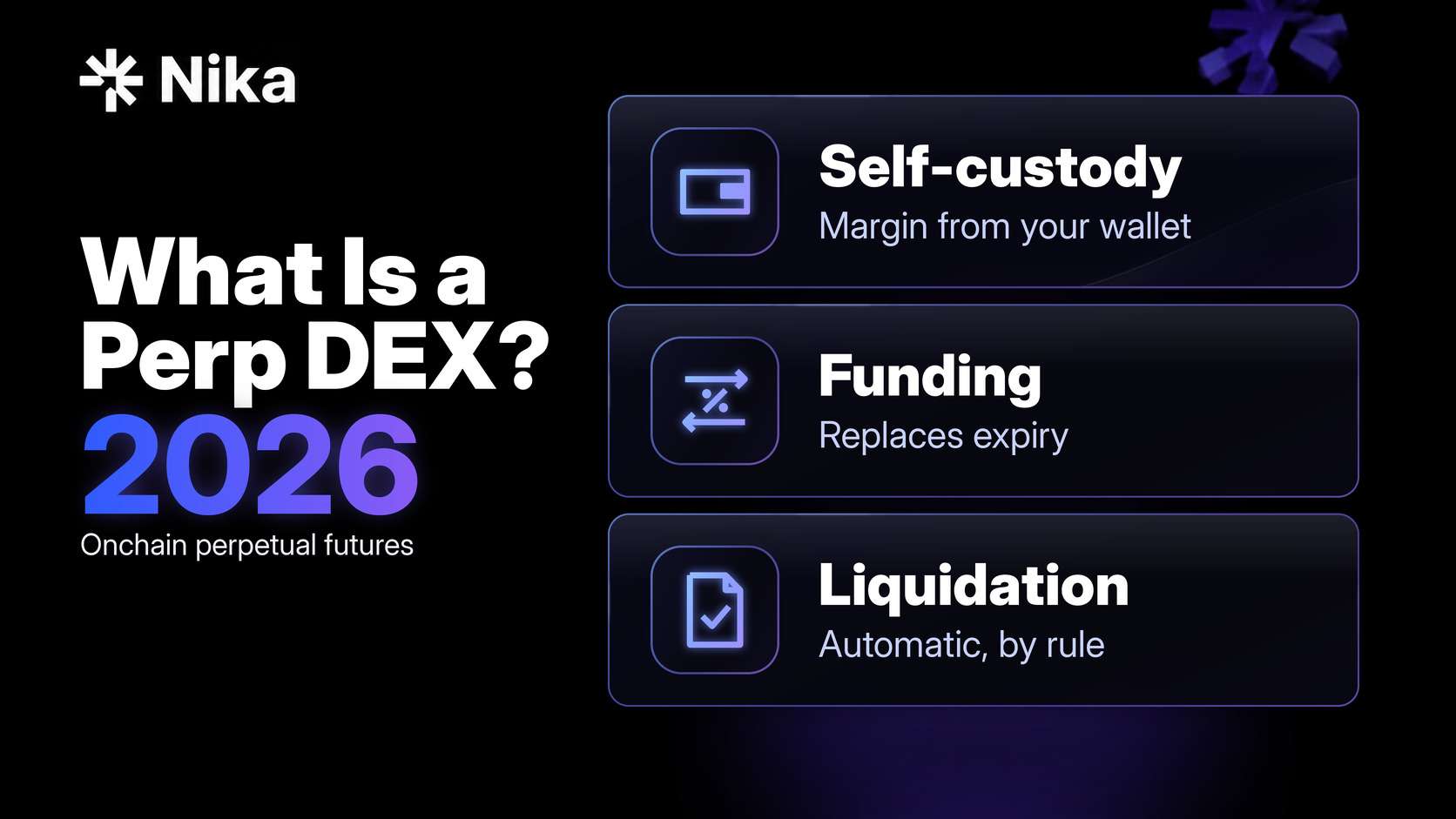
A perp DEX is a decentralized exchange for perpetual futures: derivatives that track an asset’s price and have no expiry date. You deposit collateral, open a long or a short, and may pay or receive funding while the position is open. Settlement and margin records are maintained onchain, although matching and other infrastructure vary by venue.
A perp gives you price exposure, not ownership of the underlying asset. A BTC perpetual position does not put bitcoin in your wallet.
Whether a perp DEX suits you depends on where you can trade, how you want to manage your wallet, and which protocol risks you accept. Deposited trading collateral is governed by the venue’s rules. Fees, funding, liquidity, and liquidation mechanics determine how the position behaves once you open it.
Disclosure: Nika offers perpetual trading through Hyperliquid. This guide uses protocol documentation and regulatory sources to explain the mechanics and risks.
The 30-second answer
- Perpetual futures have no scheduled expiry. A position can stay open while it meets margin requirements and the market remains listed.
- Funding helps anchor the contract to its reference price. Positive funding means longs pay shorts; negative funding means shorts pay longs.
- A perp DEX settles those contracts onchain against margin that you deposit from your own wallet, under rules published in its documentation and code.
- Leverage increases gains and losses relative to your collateral. Liquidation can occur when equity falls below maintenance margin.
- Costs include trading fees, funding, the spread, and price impact, plus any interface or network costs. A venue’s headline fee is only one line of that total.
- Access varies. Many onchain venues restrict certain jurisdictions in their own terms, and US-regulated perpetual products now exist on CFTC-regulated exchanges.
How does a perp DEX work?
A perp DEX provides a market for long and short exposure, maintains margin under its protocol rules, and applies funding and liquidation. Some venues match traders through order books; others route trades against liquidity pools. Five parts do most of the work.
No expiry date
A traditional futures contract expires. To keep the exposure, you close the expiring contract and open the next one, which is called rolling. A perpetual removes that step. Hyperliquid’s contract specifications, for example, list delivery and expiration as “N/A” and rely on hourly funding payments instead.
Long or short from the same screen
Going long profits if the price rises; going short profits if it falls. On a spot market, shorting usually means borrowing the asset first. On a perp venue, both directions use the same contract, which is why traders use perps to hedge as well as to speculate.
Margin and leverage
Margin is the collateral you post. Leverage is the ratio between the position’s notional value and that collateral. With $1,000 of margin at 5x, you control $5,000 of exposure, and a 1% price move changes your equity by about 5%, before fees and funding. You do not have to use the maximum leverage available.
Two margin modes are common. Isolated margin assigns a fixed amount of collateral to one position. Cross margin shares collateral across positions, which is more capital-efficient and puts more of your balance behind each one. Hyperliquid’s margining documentation describes both and states that maximum leverage depends on the asset.
Leverage limits vary by asset and position size. On Hyperliquid’s margin tiers page, checked on 13 October 2026, BTC allows up to 40x on positions up to 150 million USDC of notional and 20x above that, while many smaller assets are capped at 10x. Other venues publish different limits.
Funding: who pays whom
Funding helps keep a perpetual’s price near its reference price. On Hyperliquid, it is paid between traders: positive funding means longs pay shorts; negative funding means shorts pay longs. The exchange does not collect those payments.
The premium to the oracle price influences funding, but it does not determine the direction by itself. Hyperliquid’s formula includes an interest component and a bounded adjustment, so a small discount to spot can still produce positive funding. Check the actual rate rather than inferring it from the last traded price.
Hyperliquid pays funding hourly, at one eighth of its computed 8-hour rate. The payment is position size × oracle price × hourly funding rate. It is based on notional exposure, not your margin. Other venues use different formulas and intervals.
For how funding compares with the cost of holding a dated contract, see Perpetuals vs Futures.
Liquidation
Liquidation happens when your account equity falls below the maintenance margin, and your margin mode changes how your liquidation price is calculated on Hyperliquid. On Hyperliquid, according to its liquidations documentation:
- Maintenance margin is half of the initial margin at the asset’s maximum leverage. For an asset with 40x maximum leverage, that is 1.25% of notional.
- The protocol first sends market orders to the order book to close the position. If that restores the margin requirement, any remaining collateral stays with the trader.
- If equity falls below two thirds of maintenance margin without successful liquidation through the order book, the liquidator vault can take over the position and its associated margin. The maintenance margin is not returned in a backstop liquidation.
- Liquidations use a mark price that combines external exchange prices with the venue’s own order book.
Do not assume you will have time to add collateral after a warning. Liquidation is automatic. A stop-loss order can help manage risk, but its execution price is not guaranteed, and thin liquidity or fast moves can prevent it from closing the position before liquidation.
Oracle price, mark price, and execution price
These prices serve different purposes:
| Price | What it is used for on Hyperliquid |
|---|---|
| Oracle price | The external reference used to calculate funding notional and the premium |
| Mark price | The protocol’s valuation used for unrealized profit and loss and liquidation checks |
| Execution price | The price at which your order actually fills on the book |
They can differ, particularly during volatile markets. A liquidation threshold is based on mark price, not necessarily the last traded price or the price at which the closing order fills. See Hyperliquid’s liquidation and funding documentation.
Worked examples
The examples below are hypothetical. They use Hyperliquid’s published formulas and base fee rates as checked on 13 October 2026. Venue-fee examples exclude Nika fees and other interface fees. They are illustrations, not live quotes or predictions.
Example 1: funding on a long position
You go long 0.1 BTC when the oracle price is $100,000, so the notional value is $10,000.
| Scenario | 8-hour rate | Hourly rate (8-hour rate ÷ 8) | Cost per hour | Cost per day (× 24) | Cost over 30 days |
|---|---|---|---|---|---|
| Baseline: interest component only, no premium | 0.01% | 0.00125% | $0.125 | $3.00 | $90.00 |
| Crowded long: elevated positive funding | 0.05% | 0.00625% | $0.625 | $15.00 | $450.00 |
For simplicity, the table holds the oracle price at $100,000. In practice the payment is recalculated every hour at the current oracle price and the current rate, and the rate can turn negative, in which case the long receives instead of pays.
If the baseline hourly rate stayed unchanged for a year, the payments would total $1,095 on $10,000 of notional, or 10.95% without compounding. This is a constant-rate illustration, not a forecast or a guaranteed return for shorts.
Funding is charged on notional, but your losses come out of margin. If you opened that $10,000 position with $2,000 of margin (5x), the $450 in the crowded scenario is 4.5% of the position and 22.5% of your margin.
Example 2: where liquidation actually sits
You open an isolated long of 0.1 BTC at $100,000 with 10x leverage, so you post $1,000 of margin. BTC’s maximum leverage in this tier is 40x, so the maintenance margin rate is 1.25%.
Equity at price P is $1,000 + 0.1 × (P − $100,000). Maintenance margin at price P is 0.0125 × 0.1 × P. Setting them equal:
- $1,000 + 0.1P − $10,000 = 0.00125P
- 0.09875P = $9,000
- P ≈ $91,139
That is about an 8.9% drop, not the 10% that “10x leverage” might suggest, because the maintenance margin must still be covered at the liquidation price. The result matches Hyperliquid’s published formula: $100,000 − ($1,000 − $125) ÷ 0.1 ÷ (1 − 0.0125) ≈ $91,139. Funding paid and trading fees reduce margin and can move liquidation closer to the current price. Funding received can increase the margin buffer. Here, P represents the mark price; the threshold is an estimate, not a guaranteed execution price.
Example 3: the fee on a round trip
Hyperliquid’s fee schedule sets perps fees by tier based on rolling 14-day weighted volume, where weighted volume = 14-day perps volume + 2 × 14-day spot volume, assessed at the end of each day in UTC. At the base tier (0 to $5 million), the published rates are 0.045% taker and 0.015% maker. These are venue-only rates checked on 13 October 2026, before interface fees or discounts.
The fee formula is notional × rate, charged on each fill:
| Leg | Notional | Taker at 0.045% | Maker at 0.015% |
|---|---|---|---|
| Open | $10,000 | $4.50 | $1.50 |
| Close | $10,000 | $4.50 | $1.50 |
| Round trip | $9.00 | $3.00 |
Exceptions matter. Higher tiers, staking discounts, referral discounts, and certain quote assets change the rate. HIP-3 markets can have deployer-specific fee settings, and eligible markets can use growth mode to reduce fees. An app or interface that routes your order can add its own fee on top of the venue fee.
Maker, taker, and limit orders
Maker and taker describe how a fill happens, not which order type you chose. A maker fill rests on the book and is matched later by someone else. A taker fill executes against an order already on the book.
A limit order can be either. If BTC is offered at $100,000 and you place a buy limit at $100,000, it can fill immediately as a taker. If you bid $99,900 and nobody sells to you yet, the order rests and can later fill as a maker. One order can do both: part fills immediately, and the rest rests. Hyperliquid’s order types include a post-only option (ALO) that only executes as a resting order, which is the explicit way to avoid a taker fill on that venue.
The total cost of a trade
Trading fees are only one part of the total. Funding can dominate a long-held position, while fees, spread, and price impact can matter more for short trades. Before you compare venues, add up:
- Trading fees on entry and exit, at your actual tier and maker or taker status
- Funding paid or received at each funding timestamp while your position is open
- Spread and price impact: the gap between the best bid and offer, plus any extra cost when your order uses several price levels
- Interface fees charged by an app or front end on top of the venue fee
- Network and transfer costs for moving collateral onto and off the venue
A worked comparison: a $10,000 taker round trip at the base tier costs $9.00 in venue fees. Holding it for 30 days through the crowded-long scenario above costs $450 in funding. Entering 0.05% above the mid price and exiting 0.05% below it costs about another $10. In that case funding is roughly fifty times the venue fee, so a lower fee alone does not make a venue cheaper.
Perp DEX vs centralized perp exchange
On a perp DEX, settlement and margin state are maintained by the protocol. On a centralized exchange, the operator generally maintains customer balances and trades on its internal ledger. Both approaches require you to understand who or what controls deposited collateral.
| Perp DEX | Centralized perp exchange | |
|---|---|---|
| Collateral | Deposited into protocol-controlled margin accounts or smart contracts | Held under the exchange’s custody and account rules |
| Account | Often wallet-based; interfaces may also offer email or social login | Usually an exchange account, commonly with identity verification |
| Matching | Onchain order book, offchain matching, or liquidity-pool execution | Typically an internal matching engine |
| Settlement records | Onchain and publicly verifiable, with architecture varying by venue | Generally maintained on the operator’s internal ledger |
| Main dependencies | Protocol code, validators or sequencers, oracles, bridges, and wallet access | Operator security, solvency, custody arrangements, and account access |
| Eligibility | Venue and interface terms, plus applicable law | Exchange terms and applicable law |
Hyperliquid runs fully onchain order books on its own layer one blockchain. GMX routes trades against liquidity pools and uses oracle-based pricing. Both are called perp DEXs, but their execution and fee models differ.
Decentralization is a spectrum. Check who runs validators or sequencers, publishes price feeds, controls upgrades, and can change market settings. An onchain record does not mean every component is decentralized, withdrawals cannot be interrupted, or losses can be reversed.
For more on exchange custody, see Your exchange just became a bank.
How big is onchain perps trading?
DefiLlama’s perps dashboard tracks decentralized perpetual trading. On 13 October 2026, it displayed approximately $634 billion in aggregate reported 30-day volume, including approximately $205 billion for Hyperliquid, or about 32%.
These are rolling reported notional-volume figures, not unique capital or user deposits. They change continuously, and the same capital can trade many times. The dashboard also distinguishes normalized from reported volume where available.
Aggregate volume does not tell you the spread or depth in the market you want to trade. Compare the executable price and available size for your own order.
Are perpetual futures legal in the US?
Perpetual and perpetual-style products can be listed on CFTC-regulated exchanges. That does not establish that a US resident may trade on any offshore exchange or perp DEX.
Coinbase Derivatives announced five-year perpetual-style contracts for July 2025. Its current US perpetual futures documentation also describes no-expiry contracts. These are different product designs; check the specifications of the contract you intend to trade.
On 29 May 2026, the CFTC approved KalshiEX’s BTCPERP contract for listing. Approval to list a contract is different from confirmation that it is live and available through a particular retail provider.
Venue eligibility and local law both matter. Being able to load an interface does not establish that you are eligible to trade. Check the relevant terms and restrictions before depositing.
Is perp trading risky?
Yes. The main risks are structural:
- Liquidation. Higher leverage leaves a thinner buffer. Example 2 shows a 10x long liquidated after a drop of about 8.9%.
- Funding. A position paying funding incurs a running cost whether or not its price moves your way. The rate and payment direction can change.
- Losses beyond one position. On Hyperliquid, isolated liquidation affects the position and its assigned margin, rather than unrelated cross positions. Under cross margin, a backstop liquidation on Hyperliquid can transfer all cross positions and cross margin to the liquidator. Venues also run backstops such as auto-deleveraging for extreme moves.
- Protocol, bridge, and oracle risk. Bugs, chain interruptions, bridge failures, or faulty price feeds can cause losses or interfere with trading and withdrawals.
- Wallet access and security. Recovery depends on the wallet model. With a seed-phrase wallet, losing the phrase and all other access can make funds inaccessible. With an embedded wallet, protect the linked login and recovery methods. An exported private key must be kept secure. Malicious approvals can put funds at risk, and finalized onchain transactions generally cannot be reversed. For how wallet recovery models differ, see What Is a Non-Custodial Wallet? and Is an MPC Wallet Non-Custodial?.
How to choose a perp DEX
There is no single best perp DEX. The right venue depends on what you trade and where you live. Five checks hold up as the market changes:
- Depth in your markets: the spread and available size for your order, not headline volume.
- Access: the venue’s terms for your jurisdiction.
- Total cost: the fee tier you will actually pay, the funding interval and formula, and any interface fee.
- Liquidation model: maintenance margin, mark price source, and what happens when the book is thin.
- Collateral: which assets count as margin and how you withdraw them.
For a broader comparison of onchain trading venues, see Best DeFi Trading Platforms in 2026.
Where Nika fits
Nika brings spot trading, perpetuals, yield, prediction markets, and portfolio tools into one non-custodial app. Perpetual trading on Nika connects users to Hyperliquid, whose market rules determine funding, margin requirements, and liquidation.
You can create an account with email, Google, or Apple. Nika uses Privy for its embedded EVM and Solana wallets, so you do not need to write down or manage a seed phrase to get started. Both wallets’ private keys are exportable, allowing you to use compatible external wallet software. Nika does not hold users’ private keys. Privy’s user help center explains embedded-wallet access and export options; protect your login methods and any key you export.
You can trade crypto spot and perpetuals with up to 50x leverage, depending on the underlying market or protocol. Access to perpetuals and prediction markets is subject to the underlying protocols’ terms and availability.
Your trading cost can include Hyperliquid venue fees, Nika’s applicable trading fee, funding paid or received, spread, and price impact. The fee examples in this article show Hyperliquid venue fees only and exclude Nika fees. Review the applicable fees and estimated execution in the app before submitting an order.
The embedded wallet and the trading collateral serve different purposes. After collateral is deposited into Hyperliquid, it is governed by the protocol’s margin, liquidation, and withdrawal rules. An exportable wallet does not remove those protocol risks.
Nika is an interface to the underlying protocols, rather than a CFTC-regulated futures exchange. If you need trading within the US regulated futures framework, choose an eligible regulated provider and check the specific contract’s availability.
So should you use a perp DEX?
- You want wallet-based access and onchain settlement. A perp DEX may fit, provided you accept its protocol risks and meet its eligibility rules.
- You need a US-regulated provider. Look for an eligible provider offering the specific futures contract you want.
- You want to own an asset to hold. Fully paid spot gives ownership without perpetual funding or margin liquidation.
- You are new to derivatives. Learn how notional exposure, margin, funding, and liquidation work before opening a leveraged position.
Frequently asked questions
What is a perp DEX?
A perp DEX is a decentralized exchange for perpetual futures, which have no scheduled expiry. You deposit collateral into the protocol, trade long or short price exposure, and may pay or receive funding. You do not own the underlying asset through the perp position.
How do funding rates work on a perp DEX?
Positive funding means longs pay shorts; negative funding means shorts pay longs. On Hyperliquid, funding is paid hourly on notional exposure, using the oracle price. Premiums influence the rate, but the actual funding rate determines who pays.
What fees does a perp DEX charge?
Most charge a percentage of notional on each fill, with different rates for maker and taker fills and tiers based on volume. Hyperliquid’s base tier lists 0.045% taker and 0.015% maker. Funding, spread, price impact, and any interface fee come on top.
Is a limit order always a maker order?
No. A limit order that matches a resting order immediately is a taker fill. It becomes a maker fill only if it rests on the book and is matched later. Some venues offer a post-only option that cancels rather than taking.
Is perp trading risky?
Yes. Leverage increases losses relative to collateral, positions can be liquidated, and funding paid reduces returns. Protocol, oracle, bridge, and wallet-access risks also apply. Recovery options depend on the wallet model.
Can you lose more than you deposit on a perp DEX?
On Hyperliquid, an isolated backstop liquidation transfers that position and its assigned margin; unrelated cross balances are untouched. A cross backstop liquidation can transfer all cross positions and cross margin, so you can lose more than the margin initially allocated to one trade. These mechanics describe the protocol’s treatment of collateral, not a universal promise of negative-balance protection across every perp DEX. Check the specific venue’s rules.
Can US traders use a perp DEX?
It depends on the venue. Many onchain and offshore perp venues restrict US persons in their own terms, and access to perpetuals and prediction markets is subject to the underlying protocols’ terms and availability. If you are in the US and want a regulated route, Coinbase Derivatives offers perpetual-style and perpetual futures on a CFTC-regulated exchange. Check your eligibility for the specific venue and contract before you deposit.
Which perp DEX has the highest volume?
The ranking changes over time. On DefiLlama’s dashboard checked on 13 October 2026, Hyperliquid had the largest reported 30-day volume at approximately $205 billion. Volume does not measure executable depth in any single market.
Sources
- Hyperliquid: Contract specifications
- Hyperliquid: Funding
- Hyperliquid: Margining and margin tiers
- Hyperliquid: Liquidations
- Hyperliquid: Clearinghouse
- Hyperliquid: Fees
- Hyperliquid: Order types
- Hyperliquid: Order book
- Hyperliquid: Auto-deleveraging
- GMX: Introduction
- DefiLlama: Perps dashboard
- Coinbase: July 2025 perpetual-style futures announcement
- Coinbase: US perpetual futures overview
- CFTC: Approval of KalshiEX BTCPERP for listing, 29 May 2026
- Privy: User help center
- Nika: Trade
Venue rates, margin tiers, volume figures, and product documentation checked on 13 October 2026. Live conditions and availability can change.
Explore perps with Nika
If you want to trade crypto perpetuals from a wallet you control, alongside spot and other markets in one app, open Nika and review what is available where you live.
This article is for informational purposes and is not financial, legal, or tax advice. Perpetual futures are leveraged products that can lose money quickly, and positions can be liquidated. Availability varies by jurisdiction and venue. Fees, limits, and terms can change.
