
How to Bridge Crypto Between Chains in 2026
Bridge crypto step by step, compare the amount received, and understand timing and recovery. Explore supported cross-chain swaps through Nika.
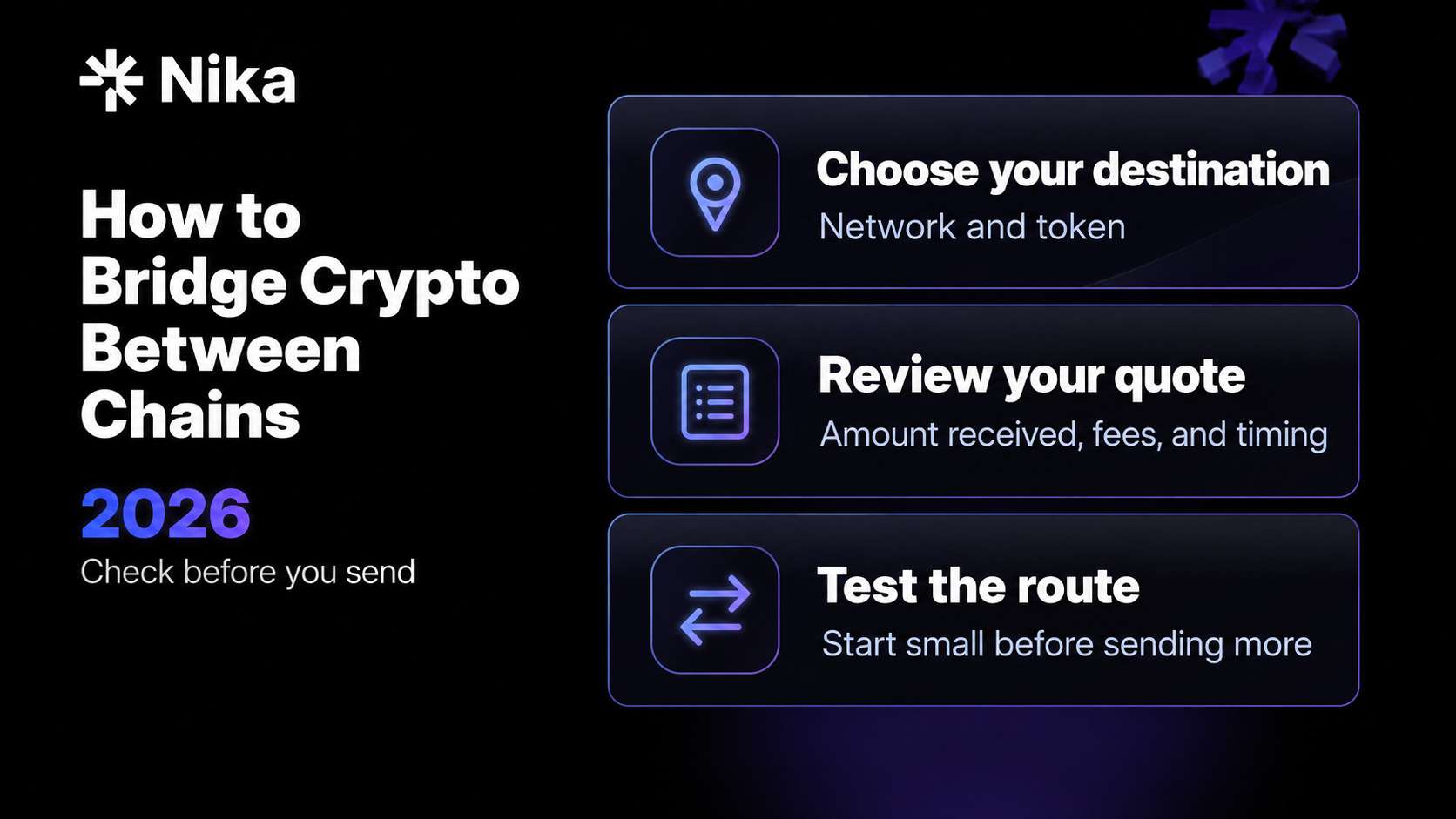
To bridge crypto, choose the destination network and token, check the route and total cost, confirm the receiving wallet, and authorize the required transactions. Fast liquidity and solver routes can complete in seconds or minutes, while some canonical rollup withdrawals take days. Actual timing depends on the route and network conditions.
The frustrating part is often everything around the transfer: opening bridge websites, comparing inconsistent quotes, switching wallets, and arranging another swap after the funds arrive. Nika brings supported cross-chain swaps into the same app you use to trade and manage your assets.
Disclosure: This guide is published by Nika. Nika integrates third-party cross-chain and trading infrastructure. Nika does not run a bridge or a DEX. You interact directly with the underlying protocols through Nika. Its interface simplifies supported workflows, while provider-specific fees, risks, and recovery rules still apply.
The 30-second answer
Choose what you want to receive and on which network. Check the exact destination token, receiving address, expected amount after fees, gas requirements, and estimated time. On an unfamiliar route or with a large balance, send a small test before the full transfer.
In Nika, supported cross-chain swaps use integrated infrastructure including LI.FI, deBridge, Relay, and Across. Trading integrations such as Jupiter and DFlow also support the broader experience. The providers involved depend on the assets, networks, and route. Review the live quote rather than assuming a particular provider, price, or recovery process.
For the mechanics and security differences, start with what a cross-chain bridge is.
Why manual bridging takes more work than it should
With separate tools, moving an asset can mean finding a bridge, connecting a wallet, switching networks, waiting for delivery, opening a DEX, and swapping again before you can use the destination app. Each interface may present fees and transaction status differently.
Other integrated wallets already reduce some of this work. MetaMask, for example, offers bridging within Swaps and gasless swaps on certain networks. The relevant comparison is the complete workflow, not whether every competing platform requires a separate bridge website.
Nika connects supported cross-chain activity with spot trading, perpetuals, yield, prediction markets, and portfolio management. Its cross-chain integrations and connected DEX protocols bring more of the journey into one app, instead of leaving you to assemble an interface for each activity.
| Common friction in a manual workflow | How Nika addresses it |
|---|---|
| Finding separate bridge and swap interfaces | Integrated access to supported cross-chain routes |
| Bridging first and swapping separately afterward | Combined cross-chain swaps where supported |
| Setting up wallets for different ecosystems | Embedded EVM and Solana wallets |
| Managing a seed phrase during onboarding | Sign-up with email, Google, or Apple without requiring seed-phrase management |
| Opening another platform to use the destination funds | Trading, yield, predictions, and portfolio tools within the same app |
Compare the quote for your specific assets and networks, including the amount received and the full cost.
How to bridge crypto, step by step
1. Choose the destination network and asset
Start with what you want to do after the transfer. If a destination app accepts native USDC on Base, confirm that exact token version rather than selecting another token with the same ticker.
If you want to change both the token and network, you need a cross-chain swap. ETH on Ethereum into SOL on Solana is different from keeping ETH exposure through a wrapped representation on Solana.
2. Confirm wallet addresses and gas requirements
Check the source and destination networks and their corresponding wallet addresses. Solana and EVM addresses use different formats; never assume an address is valid for both.
You usually need the source network’s gas token unless the flow explicitly provides another payment or sponsorship mechanism. You may also need destination gas for your next transaction. Some routes include destination execution costs or offer a gas top-up, but check the actual quote. Do not assume all gas is covered because an interface is integrated.
3. Select a supported route and compare the quote
Read the expected output, minimum received where applicable, network charges, provider fees, any app fee, and estimated completion time. For a swap, also consider price impact and slippage.
Compare the same input amount, output token, and destination network. A route with a lower headline fee can still deliver fewer tokens. Quotes expire and can change before execution.
4. Verify the exact destination token
Check its contract address on EVM networks or mint address on Solana against the issuer’s documentation and the destination application’s supported assets. A native token and a bridge-issued representation can share a similar name while having different backing and acceptance.
Also check the provider’s failure and recovery terms. Refunds, cancellations, and expiry rules vary, and a partially completed route can deliver an intermediate asset.
5. Test an unfamiliar route
Use an amount above the route’s minimum that you are comfortable testing. Confirm the destination network, address, token, and received balance before increasing the size.
A successful test checks the workflow at that moment. It does not guarantee identical pricing, liquidity, or execution for a larger transfer.
6. Review approvals and authorize the transfer
Confirm which contract is receiving permission and the amount it can spend. Depending on the asset, network, and provider, you may need a token approval, a signed order, one or more transactions, or additional destination actions.
Avoid assuming the process always takes one signature. Review each requested authorization against the transfer you intend to make.
7. Track completion and confirm the outcome
Use the app or provider’s transaction status and the relevant block explorers. Confirm that you received the expected asset, not just that a source transaction succeeded.
If the transfer is delayed or partially completed, follow the provider’s recovery instructions. Do not submit another transfer until you understand the status of the first; a second submission can create another transaction and additional fees.
How to move assets across supported chains with Nika
Nika combines embedded wallets with cross-chain and trading integrations. Its LI.FI integration announcement describes an integrated bridge-and-swap experience; the broader stack also includes deBridge, Relay, Across, Jupiter, and DFlow.
The supported flow follows the same core checks:
- Open Nika and sign in. Account creation supports email, Google, or Apple, without requiring seed-phrase management.
- Choose the asset and network you are starting from, and what you want to receive. Use a pair supported in the app. Not every network or token combination has an available route.
- Review the quote. Check the destination network and wallet, expected output, fees, and any execution conditions displayed. The providers used depend on the available route.
- Confirm the requested authorizations and track the transaction. Check the received balance and token once the route completes.
- Continue within Nika. Use available trading, yield, prediction, and portfolio features, subject to their own asset, network, and regional support.
The benefit is less work coordinating separate tools. Follow the authorizations and gas requirements for the route shown; a combined interface can coordinate several underlying transactions.
Nika’s wallets are non-custodial and use Privy infrastructure. EVM and Solana private keys are exportable, so users can control the underlying wallets with compatible external tooling. Privy’s documentation explains export and distinguishes a smart-wallet signer key from the smart-account contract itself. See whether an MPC wallet is non-custodial for more background.
What happens underneath an intent route?
An intent describes the result you want rather than requiring you to assemble every execution step. A typical provider-specific flow looks like this:
| Stage | What happens | What to check |
|---|---|---|
| Quote and order | The application constructs a supported order or route | Output asset, network, recipient, fees, and expiry |
| Authorization and funding | You authorize the required actions; source funds are committed under the provider’s rules | Approvals, signatures, contracts, and funding status |
| Fulfillment | A solver or liquidity provider delivers destination assets | Exact asset received and fulfillment status |
| Settlement | The provider’s mechanism verifies fulfillment and settles payment | Any outstanding claim or recovery actions |
This is an illustrative lifecycle, not a universal specification. Routes differ in how orders are submitted, funds are held, solvers are selected, and settlement works. ERC-7683 provides a standardization framework for intent protocols, rather than guaranteeing identical behavior across providers.
Which bridge mechanism are you using?
Check the route documentation; the destination token alone does not identify the mechanism.
| Mechanism | Main characteristic | Practical consideration |
|---|---|---|
| Lock and mint | Source assets back a destination representation | The token may retain exposure to the bridge reserve after arrival |
| Burn and mint | Source tokens are burned and destination tokens minted | Depends on the issuer or protocol’s attestation and issuance rules |
| Liquidity network | Delivery uses assets already available on the destination | Liquidity, token version, and pricing are route-specific |
| Intent or solver route | A provider fulfills the requested outcome and settles afterward | Check fulfillment, expiry, cancellation, and recovery terms |
| Canonical rollup bridge | Uses the rollup’s canonical cross-domain mechanism | Timing depends on the rollup, direction, and proof system |
These categories overlap. Circle’s CCTP is an example of native USDC burn-and-mint. A solver can also deliver a wrapped asset, so liquidity or intent-based delivery does not guarantee a native token.
How do you bridge to Base?
Choose Base as the destination, select a supported asset, review the receiving address and quote, and authorize the supported route. Confirm you can pay for your next action on Base; ETH is its gas token unless the application provides another supported payment mechanism.
Moving into Base is different from making a canonical withdrawal back to Ethereum. A deposit or third-party route does not inherit the same withdrawal waiting period simply because Base is involved.
How do you withdraw from Base to Ethereum?
Base’s canonical withdrawal documentation describes three stages: initiate on Base, prove on Ethereum, and finalize on Ethereum after the applicable window.
Following the Beryl upgrade, live on mainnet from 25 June 2026, Base documents a five-day finalization window for a single-proof dispute game. The dual-proof path, backed by both TEE and ZK proofs, has a one-day window. State proposal timing and prove/finalize transactions can add to the total wait.
Third-party liquidity routes can deliver funds sooner by fronting the destination assets. They do not shorten the canonical protocol window and carry their own fees and dependencies.
Optimism documents approximately seven-day OP Stack mainnet withdrawals, while Arbitrum describes an approximately seven-day challenge period for child-to-parent messaging. Do not generalize those delays to every rollup or every transfer direction.
How do you bridge ETH to Solana?
You cannot send an Ethereum transaction directly to a Solana wallet and receive ETH there. The networks have separate ledgers, asset systems, and address formats.
Choose the intended result:
- To use SOL or a stablecoin on Solana: choose a supported cross-chain swap into that asset.
- To retain ETH exposure on Solana: choose a supported representation of ETH, checking its backing and acceptance at the destination.
Verify the Solana receiving address and token mint. You may need SOL for subsequent transactions. A wrapped token can arrive through a liquidity or solver route as well as through a direct lock-and-mint flow, so inspect the actual route.
What is the cheapest way to bridge crypto?
There is no permanent cheapest option. Compare the total outcome for the same transfer:
- Source and destination execution costs, including any separately required claim or finalization transactions.
- Bridge, solver, or liquidity-provider fees.
- Any wallet or application fee.
- Swap spread, price impact, and slippage when the route exchanges assets.
- The value of the exact destination token you will hold.
Use Nika’s integrated quote to assess the available route for your transfer. Compare the actual amount received and execution conditions, rather than headline fees alone.
What if a bridge transaction is delayed or fails?
First distinguish a pending source transaction, an unfilled order, an ongoing canonical withdrawal, a failed destination swap, and a completed transfer of the wrong asset. They need different responses.
Use the provider’s status and transaction identifiers to establish which stage completed. Check the applicable expiry, cancellation, refund, claim, or support process before taking another action.
Automatic refunds are not guaranteed. Eligibility and timing depend on the provider and route. Some recovery processes require a transaction or support intervention. A completed bridge step may also leave an intermediate token on the destination chain if the final swap fails. LI.FI’s documentation explains its partial-completion statuses and intermediate assets.
For the broader security checklist, see what a cross-chain bridge is.
Frequently asked questions
Can I bridge crypto through Nika?
Yes. Nika supports cross-chain activity through integrations including LI.FI, deBridge, Relay, and Across, with trading infrastructure such as Jupiter and DFlow in its broader stack. Available routes depend on provider support, networks, assets, and liquidity. Review the options offered in the app.
How long does bridging take?
Some liquidity and solver routes complete in seconds or minutes; actual timing depends on confirmations, liquidity, fulfillment, and network conditions. Canonical optimistic-rollup withdrawals can take days. Base’s documented window is five days for single-proof withdrawals or one day on its dual-proof path, plus other processing time.
Do I need gas on both chains?
Check the route. Source gas is usually required unless another payment mechanism is provided. Destination delivery costs may be included, but later transactions can still require the destination gas token. An integrated flow does not mean all gas is sponsored.
Will I receive a refund if the route fails?
It depends on the provider, route, and failure stage. A route may offer expiry, cancellation, a refund, manual recovery, or delivery of an intermediate asset. Do not assume an automatic refund.
Can I bridge inside MetaMask?
Yes. MetaMask’s Swaps feature integrates third-party bridging providers. Compare the complete quote and supported workflow with other options, including Nika, rather than assuming a separate bridge website is always required.
Does Nika remove cross-chain risk?
No. It reduces the work of coordinating supported swaps and subsequent activities. Underlying provider, contract, network, and asset risks still apply.
Sources
- Ethereum.org: Blockchain bridges
- ERC-7683: Cross Chain Intents
- Circle: Getting started with CCTP
- Base: Canonical withdrawals
- Base: Beryl upgrade overview
- Optimism: Messaging between L1 and L2
- Arbitrum: Child-to-parent chain messaging
- Solana: Accounts and address formats
- MetaMask: Swaps user guide
- Privy: Export a wallet
- LI.FI: Intermediate assets and partial completion
Explore Nika
Spend less time coordinating tools and more time using your assets. Open Nika to access supported cross-chain swaps, then explore trading, yield, prediction markets, and portfolio management in the same non-custodial app. Access to perpetuals and prediction markets is subject to the underlying protocols’ terms and availability.
