
What Is a Tokenized Stock? Rights and Risks
Learn how tokenized stocks work, what rights each structure gives you, and where the risks sit. See how Nika brings stock markets into one app.
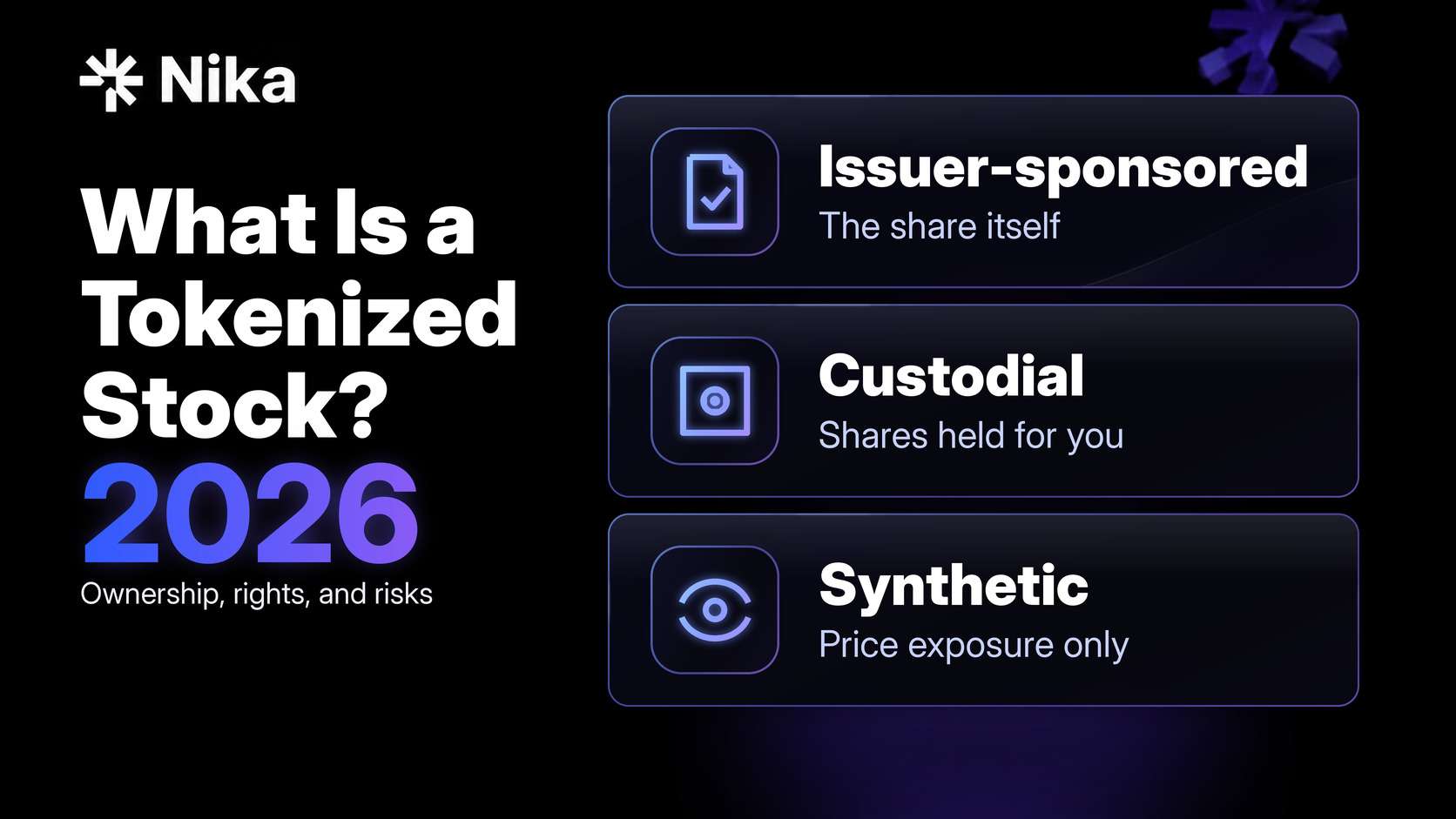
A tokenized stock is a token on a blockchain whose value is linked to a publicly traded share. Depending on the structure, the token can be the share itself, an indirect interest in a share held by a custodian, or a separate contract that only tracks the share’s price. The important questions are what you hold, who issued it, and which rights come with it.
For users, the appeal is access: fractional amounts, trading outside traditional exchange hours, and holding stock exposure alongside crypto in one wallet. The experience can still be fragmented across trading platforms, wallets, and portfolio tools. Nika brings stock markets, crypto, commodities, yield, and prediction markets into one non-custodial app, with spot and perpetual trading and a shared interface for tracking your portfolio.
Disclosure: This guide is published by Nika, a non-custodial interface for spot and perpetual trading. Nika does not issue tokenized stocks. This guide uses SEC publications and issuers’ own documentation to explain the structures and risks.
The 30-second answer
A tokenized stock gives you exposure to a company’s share price through a token. The token’s structure, not its ticker, decides whether you own the share. The SEC describes three models: issuer-sponsored tokens, custodial tokens backed by shares held for holders, and synthetic tokens that track the price without any claim on the company.
Before you buy, check the issuer, the structure, which shareholder rights apply, how redemption works, and who can buy it. Tokenized securities are still securities, and most retail tokenized stock products today are offered only outside the US.
For the gold equivalent of the same ownership question, see what backs a tokenized gold token.
How do tokenized stocks work?
The SEC staff Statement on Tokenized Securities of 28 January 2026 defines a tokenized security as a security “formatted as or represented by a crypto asset, where the record of ownership is maintained in whole or in part on or through one or more crypto networks.” It groups them into securities tokenized by or for the issuer, and securities tokenized by unaffiliated third parties.
In practice, most tokenized stocks available to retail users today come from third parties. A common shape is:
- An issuer or its partners buy the underlying shares in the traditional market.
- A regulated broker or custodian holds the shares, often in a separate legal vehicle.
- The issuer mints tokens on one or more blockchains against those holdings.
- The tokens trade in wallets, on onchain venues, or inside the issuer’s own app, under the issuer’s terms.
The share does not move onto the blockchain. The token is a record that points back to an arrangement offchain, and the strength of that arrangement is what you are evaluating.
Do you own the stock?
It depends on the model. The SEC’s investor education page on tokenized securities describes three:
| Model | Who issues it | What you hold | Shareholder rights | Main dependencies |
|---|---|---|---|---|
| Issuer-sponsored | The company or its agent | The security itself, recorded onchain | Same legal rights as a traditional share of that class, although the token can be a different class | The issuer’s recordkeeping and transfer agent |
| Custodial | A third party holding the share | An indirect interest through a security entitlement | Same rights and benefits as holding the share through a broker-dealer | The custodian, the issuer of the token, and their legal structure |
| Synthetic | A third party, without holding title for you | A linked security or derivative that tracks the price | “No claims or rights against the issuer of the referenced security” | The token issuer’s solvency, terms, and price source |
A flat “you never own the stock” is wrong, and so is a flat “you always do.” The staff statement adds that third-party tokens “may or may not confer upon the holder of the crypto asset any rights as a holder of the underlying security,” and that holders “may be exposed to risks with respect to the third party, such as bankruptcy, to which a holder of the underlying security would not necessarily be exposed.”
Three live examples, three different designs
These descriptions come from each provider’s own documentation, checked on 14 October 2026. They are examples of structures, not ratings.
- Robinhood Europe Classic Stock Tokens are derivative contracts under MiFID II. Robinhood’s Classic Stock Tokens FAQ says “you do not own the underlying stock” and “you will not have certain shareholder rights like voting.” Classic Stock Tokens cannot currently be sent to other wallets or platforms, and Robinhood states investors “may lose up to the full amount of their invested capital due to market conditions or the insolvency of Robinhood.”
- Ondo tokenized stocks are issued by Ondo Global Markets (BVI) Limited. Ondo’s documentation says they are fully backed total return trackers designed to give “economic exposure to the underlying asset, not direct title,” without shareholder voting or information rights. They are generally available to non-US investors, and one token does not necessarily equal one share, because reinvested dividends change the shares per token.
- Coinbase tokenized stocks on Base went live on 24 August 2026. Base’s launch announcement describes shares bought by authorized participants and held by Alpaca “in a bankruptcy-remote structure,” with token holders holding “a direct claim on the share.” Access is for non-US users in eligible jurisdictions.
Three products can show the same ticker in a wallet and give you three different legal positions. Read the offering document of the specific token, not the ticker.
Tokenized stocks vs stock perpetuals vs shares in a brokerage account
These are often grouped together, but they are different instruments.
| Share in a brokerage account | Tokenized stock | Stock perpetual | |
|---|---|---|---|
| What you hold | A share or security entitlement through a broker | A token whose rights depend on its structure | A leveraged derivative position on a price |
| Ownership of the share | Yes, through the broker | Depends on the model | No |
| Leverage | Only with a margin account | Not inherent; fully paid by default | Yes, with margin and liquidation |
| Ongoing costs | Broker fees | Issuer and trading costs, spread | Trading fees and funding paid or received |
| Trading hours | Exchange hours, plus any broker extended sessions | Set by the issuer and venue; often 24/5 with pauses | Set by the venue; can include weekends |
| Main risks | Market and broker risk | Market, issuer, custodian, and smart contract risk | Market, liquidation, funding, and protocol risk |
A stock perpetual gives you price exposure, not ownership of the share. On Hyperliquid, markets created under HIP-3 are defined and operated by a deployer, who sets the oracle, contract specifications, and leverage limits, and can settle a market. Check those settings for the market you trade. For how funding, margin, and liquidation work, see what a perp DEX is, and for the difference between perpetual and dated contracts, read perpetuals vs futures.
Why do people buy tokenized stocks?
The common reasons are:
- Access. Tokenized stocks can give people outside the US exposure to US companies without a US brokerage account, subject to each issuer’s eligibility rules.
- Fractional amounts. You can buy a small dollar amount rather than a whole share.
- Hours. Many products trade beyond traditional exchange hours, although issuers can pause trading between sessions and during corporate actions. Ondo, for example, says its tokens “generally trade 24/5, but there are exceptions.”
- Composability. A transferable token can be used in onchain applications that support it, for example as collateral.
None of these change what the token legally represents. A convenient wrapper around a weaker claim is still a weaker claim.
What are the risks of tokenized stocks?
- Fewer rights than the share. Voting, information rights, and dividends depend on the structure. Synthetic and total-return designs typically do not pass through voting.
- Issuer and custodian risk. Third-party models add parties between you and the company. SEC staff warn that holders can face risks such as the third party’s bankruptcy.
- Price divergence. A token can trade away from the share’s price, especially when the underlying exchange is closed or liquidity is thin. Some tokens also track a changing number of shares per token.
- Corporate actions and pauses. Splits, dividends, and mergers can pause trading or change balances under the issuer’s rules.
- Eligibility. Most retail products exclude US persons. Being able to load an interface does not establish that you are eligible to buy.
- Wallet and contract risk. Self-custody of a token does not remove the issuer’s role. Sending tokens to the wrong address is generally irreversible, and copycat tokens can reuse tickers, so check the contract address against the issuer’s own documentation.
Are tokenized stocks legal?
Tokenized stocks can be offered legally, but whether a particular product can be offered to you depends on its structure, the applicable jurisdiction, and compliance with securities and distribution rules. Putting a security on a blockchain does not exempt it from those rules. SEC Commissioner Hester Peirce put it plainly in July 2025: “Tokenized securities are still securities.” The January 2026 staff statement adds that the format in which a security is issued, onchain or offchain, “does not affect application of the federal securities laws,” and every offer and sale must be registered unless an exemption applies.
Being legal to exist is different from being available to you. Robinhood’s Classic Stock Tokens are offered to customers in the EU and EEA; Ondo’s and Coinbase’s tokens are generally offered to non-US users in eligible jurisdictions. Check the issuer’s eligibility rules and your local law before buying.
How Nika fits
Nika brings tokenized stock spot markets and stock perpetuals into the same app as crypto, commodities, yield, and prediction markets. You can explore available markets, choose between holding a spot token and opening a perpetual position, and track your portfolio through one interface. This reduces the need to switch between separate market apps and portfolio tools.
You can trade tokenized stocks on Nika, including Ondo tokenized stocks and xStocks. Ondo’s tokens provide economic exposure under the issuer’s terms, as described above. xStocks are issued by Backed Assets (JE) Limited, a Jersey company, as tracker certificates backed 1:1 by the underlying stock or ETF. The xStocks product legal overview explains that they provide economic exposure rather than direct equity ownership, do not confer shareholder voting rights, and are not offered in the United States or to U.S. persons. Neither product makes you a shareholder of the company.
For leveraged long or short exposure, Nika also provides access to stock perpetuals through Hyperliquid. Market pages such as Nvidia on Nika list spot exposure and perpetual contracts with up to 20x leverage on that market. Each perpetual follows the venue’s and deployer’s rules for funding, margin, and liquidation; it does not give you ownership of a share. Market availability and leverage limits can change.
Getting started does not require setting up a separate wallet or writing down a seed phrase. You can create a Nika account with email, Google, or Apple, and Nika uses Privy for its embedded EVM and Solana wallets. Both wallets’ private keys are exportable, allowing you to use compatible external wallet software. Nika does not hold users’ private keys. Privy’s user help center explains embedded-wallet access, and its wallet export documentation covers export options. Protect your login methods and any key you export.
Nika provides the interface; each token’s issuer determines its ownership, redemption, and eligibility terms. Controlling your wallet does not change those asset terms, and collateral deposited into Hyperliquid remains subject to the protocol’s rules. Before confirming a trade, review the applicable Nika and issuer or venue fees, spread, price impact, and any perpetual funding costs.
Which product fits what you are doing?
| Your need | What to compare |
|---|---|
| Full shareholder rights, including voting | A brokerage account, or an issuer-sponsored or custodial token that documents those rights |
| Stock exposure in a wallet, outside the US | The token’s issuer, structure, eligibility rules, and redemption terms |
| Small amounts or trading beyond exchange hours | Fractional availability, trading sessions, and spread outside market hours |
| Leveraged long or short exposure | A stock perpetual, including funding, margin, and the market’s leverage limit |
| Holding tokenized assets alongside crypto | Contract addresses, custody of the wallet, and each issuer’s terms |
For the wider category, read the rise of tokenized real-world assets.
Frequently asked questions
Can I trade tokenized stocks on Nika?
Yes. Nika provides access to tokenized stock spot markets, including Ondo tokenized stocks and xStocks, alongside stock perpetuals through Hyperliquid. Choose the instrument that fits the exposure you want and check its availability in your jurisdiction. A spot token and a perpetual position give you different rights and risks.
Are tokenized stocks safe?
They carry market risk plus issuer, custodian, and smart contract risk, depending on the structure. SEC staff warn that third-party token holders can face risks, such as the third party’s bankruptcy, that a direct shareholder would not necessarily face.
Do tokenized stocks pay dividends?
Some do, some reinvest them, and some pass none through. Ondo’s tokens, for example, reinvest dividends net of withholding tax by changing the shares per token. The issuer’s terms decide.
Can US residents buy tokenized stocks?
Most retail tokenized stock products today are offered only outside the US, including Robinhood’s EU Classic Stock Tokens and Coinbase’s tokens on Base. Check the issuer’s eligibility rules and your local law.
Is a stock perpetual the same as a tokenized stock?
No. A stock perpetual is a leveraged derivative position on the price, with margin, funding, and liquidation at a liquidation price set by your margin. It does not give you ownership of the share or any shareholder rights.
Can I transfer my stock tokens to another wallet?
Transferability depends on the token, supported network, and issuer restrictions. Nika’s embedded EVM and Solana wallet keys are exportable, but that does not make every asset freely transferable. Check the specific token’s terms and the destination wallet’s network support before transferring.
Sources
- SEC Investor.gov: Tokenized securities
- SEC staff: Statement on Tokenized Securities, 28 January 2026
- SEC Commissioner Hester Peirce: Enchanting, but Not Magical, 9 July 2025
- Robinhood Europe: Classic Stock Tokens FAQ
- Ondo: Ondo tokenized stocks overview
- Base: Stocks just got updated, 24 August 2026
- xStocks: Product legal overview
- Hyperliquid: HIP-3 builder-deployed perpetuals
- Privy: User help center
- Privy docs: Export a wallet
Issuer terms, eligibility, and product documentation checked on 14 October 2026 (xStocks on 15 October 2026). Live conditions and availability can change.
Explore Nika
Explore stock spot and perpetual markets alongside crypto and commodities in one non-custodial app. Use Nika to trade, track your portfolio, and explore yield and prediction markets, with simple onboarding and exportable EVM and Solana wallets. Asset and feature availability depends on your jurisdiction and the applicable issuer or protocol terms.
