
Decentralized Prediction Markets in 2026: How They Work and the Best Platforms
How decentralized prediction markets work in 2026: smart contracts, oracles, fees, risks, US access, and which onchain platforms fit which trader.
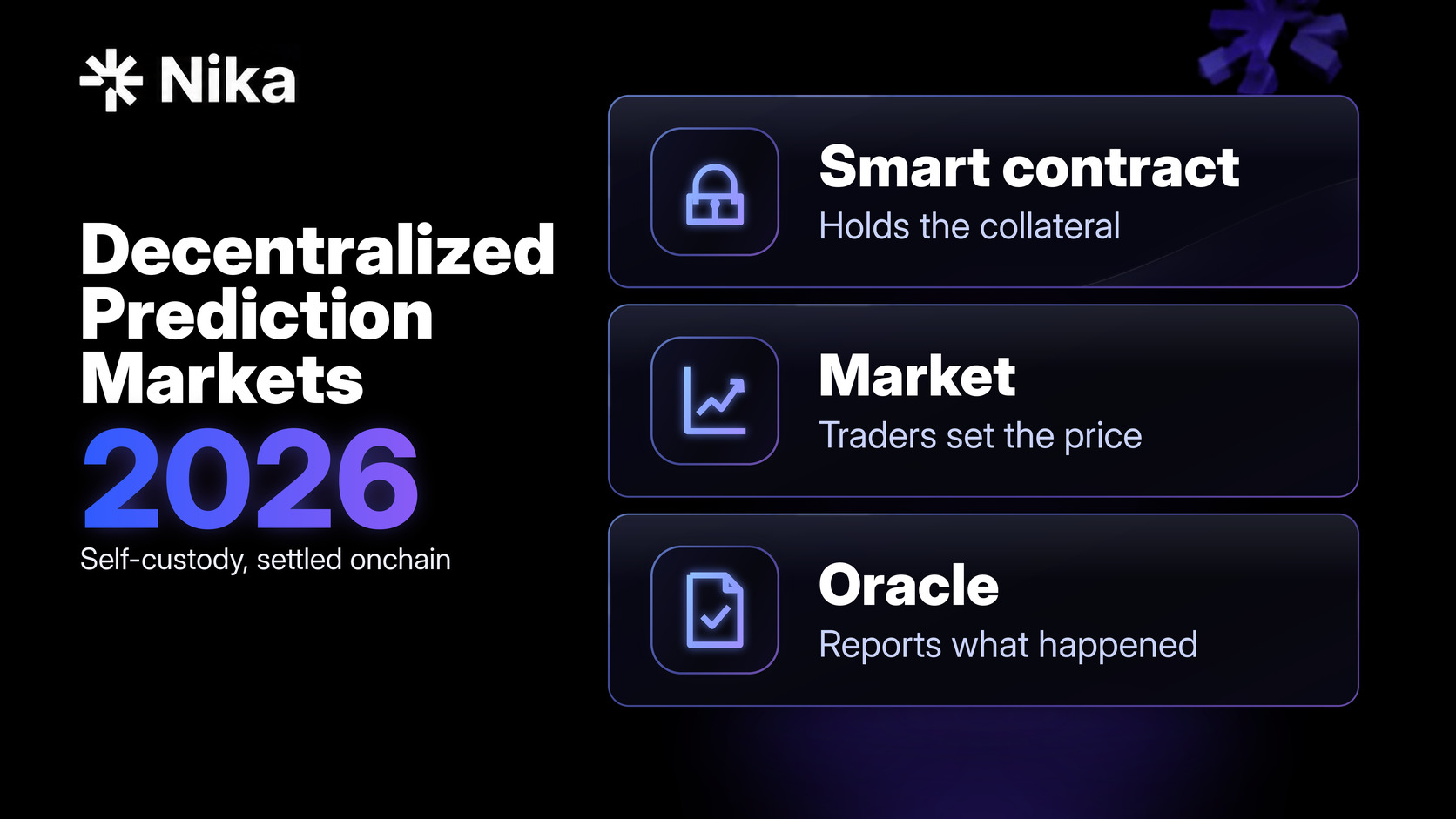
A decentralized prediction market is an onchain market where you trade shares in a real-world outcome, a smart contract holds the collateral, and an oracle reports the result. Shares usually trade between one cent and 99 cents, and the price is the market’s running estimate of how likely that outcome is. When the market settles, winning shares redeem for one dollar and losing shares are worth nothing.
In 2026 the category is no longer a niche experiment. Custodial and onchain venues together set large monthly totals (The Block: about $50.6 billion across Kalshi, Polymarket and Polymarket US in July 2026), and the onchain side now has one venue far ahead on reported volume, a Base challenger focused on short-dated markets, an infrastructure layer other apps run on, and non-custodial apps that put event contracts next to the rest of a portfolio.
This guide explains the mechanics, fees, risks, and US access rules, then compares the main decentralized options by use case. It is not a ranking of every prediction market, and it is not legal advice.
Disclosure: This guide is published by Nika, a non-custodial trading app. Nika’s prediction markets are powered by Polymarket international, not Polymarket US. We describe each venue from public documentation and separate products that share a brand name.
The 30-second answer
- What it is: an onchain market on a defined real-world outcome. A smart contract holds collateral; an oracle reports the result.
- Who holds your money: typically you do, in a wallet you control. That is the structural difference from a custodial exchange or a sportsbook.
- Pricing: shares usually run from one cent to 99 cents. Read the price as an implied probability, not a guarantee.
- The onchain leader: Polymarket international is the largest onchain venue covered here by reported notional volume.
- US access: Polymarket US is a separate CFTC-regulated, custodial product for US residents. Polymarket international does not accept US users. Unregistered onchain venues sit in unsettled legal territory for US residents.
- The catch: smart contract risk, oracle disputes, irreversible key loss, spreads and fees on the way in and out, and the fact that many retail participants lose money.
How we compared them
We compared decentralized venues on six criteria:
- Structure: Is it a consumer market, infrastructure other apps use, or an interface over another venue?
- Custody and funding: Who holds balances, and how do deposits, settlement, and withdrawals differ?
- Fees: What is the published fee formula or range, and how are makers and takers treated?
- Markets and liquidity: What categories are offered, and what does aggregate volume actually measure?
- Access and regulation: Who can trade, and how does that differ from CFTC-regulated dollar venues?
- Risk: What can go wrong beyond picking the wrong outcome?
We used platform documentation, regulatory records, and published research. We did not open or fund accounts for this article.
What is a decentralized prediction market?
It is a market where you buy and sell shares in whether something happens: a rate decision, an election result, a sports outcome, or another defined event. Each outcome share pays one dollar if it happens and nothing if it does not.
Prices carry the information. A share trading at 63 cents means the market currently prices that outcome near 63%. As news arrives, traders move the price, and the price is the forecast. That part is true of every prediction market, onchain or custodial.
The decentralized part is about who stands behind the market. On a centralized venue such as Kalshi, the company holds customer dollars, runs the book, and decides which contracts exist under its rulebook. On an onchain venue, collateral sits in smart contracts on a public blockchain, positions are tied to a wallet you control, and settlement is a transaction anyone can inspect.
You will also see the labels web3 prediction markets, onchain prediction markets, or crypto prediction markets. The structure is the same idea with different marketing language.
Polymarket US is not a decentralized venue. It is a CFTC-designated contract market with a custodial dollar account. Polymarket international at polymarket.com is the onchain product. Treating them as one platform is the most common mistake in this category. For the full three-way comparison with Kalshi, see Kalshi vs Polymarket.
How decentralized prediction markets work
Three pieces matter: a smart contract that holds collateral and pays winners, a market where traders set the price against each other, and an oracle that reports what happened.
The smart contract holds the collateral
One dollar of collateral typically mints a matched pair of Yes and No shares. Limitless states this clearly in its docs: every pair of Yes and No shares is fully collateralized by one dollar of USDC. The winning share redeems for a dollar; the losing share expires worthless.
That is why shares are priced between one cent and 99 cents. The two sides of a binary market have to sum to a dollar, so a price is a claim on a fixed pot rather than a bookmaker’s quoted line. There is usually no margin, no liquidation cascade, and no borrowed exposure inside the contract itself.
Payout versus profit, with a worked example
The following example is hypothetical and excludes fees unless stated. The contract’s own rules govern settlement.
Suppose a YES share costs 60 cents and you buy 100 shares:
| Outcome | Cost of shares | Settlement payout | Profit or loss before fees |
|---|---|---|---|
| YES wins | $60 | $100 | $40 profit |
| YES loses | $60 | $0 | $60 loss |
The $100 winning payout includes the return of the $60 you spent. It is not $100 of profit on top of your stake.
You can often sell before the event resolves if another trader will buy at a price you accept. If those 100 shares sell at 70 cents, you receive $70 and make $10 before fees. If they sell at 40 cents, you receive $40 and lose $20 before fees. Fees can apply on both the entry and the exit, and a displayed portfolio mark does not promise that your full size can exit at that mark.
The market sets the price; there is no house line
You trade against other participants. Some venues match on a central limit order book; some use an automated market maker; some support both. In each case the counterparty is another trader, not a bookmaker taking a house position against you.
“No house” does not mean “no fees.” Polymarket’s international exchange began charging taker fees in January 2026, starting with 15-minute crypto markets, and since 30 March 2026 has charged category-based taker fees on most markets (changelog). Limitless charges dynamic taker fees on its order book. What you avoid is a sportsbook-style built-in margin on the quoted line, not the full cost of trading.
The oracle decides what actually happened
A blockchain cannot see the outside world. Something has to tell the contract who won.
Polymarket international resolves most prediction markets through UMA’s optimistic oracle. Someone proposes an outcome and posts a bond; a challenge window opens; if nobody disputes the proposal, it stands. If it is disputed, the question can escalate to a vote of UMA token holders. Polymarket also uses Chainlink TWAP feeds for certain up-down crypto markets where the inputs are a defined price stream rather than a judgment call.
Neither design removes human judgment from every market. It relocates judgment from a company’s private desk to a public process with money at stake. Always read the written resolution criteria before you trade. Two markets can share a similar headline and still settle on different deadlines, sources, or edge cases.
Fees and total execution cost
Venue fees are only one part of what you pay. Spreads, available size, intermediary on-ramps, bridges, and any app interface fee can matter more than a small difference in the fee coefficient.
Polymarket international fee formula
On Polymarket international, taker fees use:
fee = C × feeRate × p × (1 − p)
where C is the number of shares, p is the share price in dollars (so 50 cents is 0.50), and feeRate depends on the market category. Makers are not charged a trading fee under the published schedule. Fees are rounded to five decimal places.
This category schedule has applied since 30 March 2026; the sports rate rose from 0.03 to 0.05 on 10 July 2026 (changelog).
Reviewed from Polymarket’s fee documentation in October 2026:
| Category | Taker feeRate | Fee for 100 shares at 50 cents |
|---|---|---|
| Crypto | 0.07 | $1.75 |
| Sports, economics, culture, weather, other / general | 0.05 | $1.25 |
| Politics, finance, tech, mentions | 0.04 | $1.00 |
| Geopolitics | 0 | $0.00 |
Worked arithmetic for crypto at the midpoint: 0.07 × 100 × 0.50 × 0.50 = $1.75. Buying 100 shares at 50 cents costs $50 before fees, so the $1.75 fee is 3.5% of the stake, not 7% of it. The coefficient and the effective percentage of money spent are different measures.
Polymarket documents no platform fee to deposit or withdraw USDC on the international exchange. On-ramps, exchanges, bridges, and other intermediaries can still charge. These figures are direct venue fees, not the total cost through every app.
Maker status is not the same as order type
A maker adds a resting order to the book. A taker executes against size that is already available. A limit order can do either.
If shares are offered at 60 cents and your buy limit is 60 cents, the order can fill immediately as a taker. If your limit is 58 cents and no seller accepts it, the order may rest as a maker. One order can also fill partly as a taker and leave a remainder resting as a maker. Never assume every limit order is fee-free.
Limitless fees (Base)
Limitless is non-custodial and collateralized in USDC on Base. On its order-book markets, published taker fees are price-dependent ranges rather than a single closed-form coefficient:
- Buy fees: about 0.40% to 3.00%, paid in outcome tokens
- Sell fees: about 0.42% to 1.50%, paid in USDC
Its docs state that resting maker liquidity is not charged, while orders that match immediately are. Treat that the same way as above: a limit that crosses the book can still be a taker fill. Limitless also documents a flat 0.40% fee on AMM markets, with possible promotional exceptions. Check the fee shown on the order you are about to send.
Compare the full cost, not only the fee column
Suppose one book offers 100 identical YES shares at 60 cents and another offers them at 62 cents. The second purchase costs $2 more before fees. A 2% card or on-ramp fee on a $100 deposit adds another $2. Either gap can dwarf a one-cent difference in trading fees.
Before you trade, compare:
- Contract terms (outcome, deadline, source)
- The bid-ask you can actually hit for your size
- Available depth at your price
- Entry fee and likely exit fee
- Any intermediary or interface fee
Aggregate volume does not tell you whether your specific market is cheap to enter or exit.
Why trade onchain?
The usual case for onchain prediction markets is custody, verifiability, and wallet-based access:
- You hold the keys. Polymarket’s help center states that Polymarket international is non-custodial, does not take possession of your funds, and lets you export your private key.
- No house position. You trade against other participants, not against a sportsbook line.
- Public settlement. Collateral, trades, and payouts are onchain and inspectable.
- Wallet access rather than a dollar brokerage account. That can matter outside the US, where a CFTC-regulated dollar account may be unavailable or less useful.
Onchain does not mean unrestricted by geography. Polymarket international geoblocks or limits trading in many places, including the US and the UK, and local law still applies wherever you are. Self-custody also changes who can recover access: if you lose the key, there is no support ticket that restores it.
Deposit clearance, trading balances, resolution, and moving assets offchain are different stages. Do not convert a typical processing window into a guaranteed end-to-end withdrawal time.
What are the risks?
Decentralized prediction markets concentrate several risks differently from a custodial exchange:
| Risk | What to weigh before you fund |
|---|---|
| Smart contract risk | Collateral sits in code. Audits reduce risk; they do not eliminate bugs or upgrade risk. |
| Oracle and resolution risk | Loose wording, delayed official data, or a dispute can delay settlement or resolve in a way you did not expect. |
| Key and approval risk | Lost keys and harmful approvals are usually irreversible. |
| Liquidity risk | An early exit needs a willing buyer at a price you accept. |
| Trading loss | A losing binary share settles at zero; fees raise the breakeven. |
| Access risk | Geographic and product restrictions can change while capital is committed. |
Most retail participants lose money in this category. The Roosevelt Institute estimated that ordinary Kalshi users lost more than half a billion dollars from launch through May 2026, and CNBC reporting in May 2026 cited Kalshi figures showing a large majority of traders were unprofitable over a recent six-month window, plus research finding that about 69% of Polymarket accounts had lost money since 2022. Treat that as a category warning, not a reason to skip reading the contract in front of you.
Trade only with money you can afford to lose, and size positions before you need an emergency exit.
Are decentralized prediction markets legal in the US?
Partly, and the product name matters.
Under US federal law, the CFTC asserts jurisdiction over event contracts traded on registered platforms. Serving US users lawfully generally requires a designated contract market (and related clearing arrangements where applicable).
Polymarket US, operated by QCX LLC, is listed in the CFTC’s designated contract market records. It is a custodial, dollar-funded exchange for US residents. It is not the same product as Polymarket international.
Polymarket international remains unavailable to US users under Polymarket’s geographic rules. In April 2026, Polymarket reportedly sought CFTC approval to reopen its main exchange to US traders, according to a Bloomberg report summarised by CoinDesk. Polymarket’s transparency page still says US traders are prohibited on the international platform and points them to Polymarket US.
Other onchain platforms that are not CFTC-registered sit in unsettled territory for US residents. Several states are also challenging prediction-market activity under gambling laws; an attorney general’s complaint or an interim order is not the same thing as a final ruling on the merits. Confirm your own state’s rules and the venue’s current eligibility screens before funding anything.
For regulated-dollar reviews, see Is Kalshi Legit? and Is Novig Legit?. For how event contracts differ from sportsbooks, see Prediction Markets vs Sports Betting.
The best decentralized prediction markets in 2026
The useful shortlist is Polymarket international, Limitless, Azuro, and Nika, and they are not four copies of the same product. Polymarket international and Limitless are markets you trade on directly. Azuro is infrastructure that other apps run on. Nika is a non-custodial app whose prediction markets are powered by Polymarket international.
| Platform | Best for | Chain / setup | Custody | Collateral | Markets |
|---|---|---|---|---|---|
| Polymarket international | Depth and breadth | Polygon | Self-custody wallet | pUSD backed by USDC | Politics, crypto, world events, sports, and more |
| Limitless | Short-dated onchain trading | Base | Self-custody | USDC | Crypto and stock prices, events, sports, politics |
| Azuro | Builders, and sports via frontends | Several EVM chains | Self-custody via each app | Varies by app | Sports-weighted; set by each app |
| Nika | Self-custody markets next to spot, perps, and yield | Multichain app interface | Self-custody | Onchain balances | Predictions powered by Polymarket international, plus other Nika products |
Availability, fees, and legal status change. Confirm current rules before funding. Aggregate volume figures below are notional research totals, not proof of depth in any single market.
Polymarket international · the largest onchain venue by reported volume
Polymarket international is the reference decentralized prediction market for most traders who can access it. It runs on Polygon, settles trading in pUSD (an ERC-20 backed by USDC), and resolves prediction markets through UMA’s optimistic oracle, with Chainlink TWAP used for certain up-down markets. Custody is wallet-based: Polymarket states that it does not take possession of funds and that the private key is exportable.
Breadth is the reason to start here when you are eligible. Politics, crypto, geopolitics, and sports can all carry meaningful books, which is not true of every challenger. NEXT Predict’s analysis of Aldrin data reported September 2026 notional volume of about $4.4 billion for Polymarket international, separate from about $8.6 billion for Polymarket US. Notional volume values each contract at its $1 payout face, so it is not the same as capital deposited or capital at risk. Limitless reports more than $1 billion traded in total (Limitless docs).
- Good: active books across many categories, broad market menu, self-custody, transparent fee schedule by category.
- Watch: geoblocked or limited in many jurisdictions including the US; easy to confuse with Polymarket US; oracle and key risks remain.
Limitless · short-dated markets on Base
Limitless is a non-custodial prediction market on Base with USDC collateral and a central limit order book as its core trading model. Its signature is speed: hourly and daily markets on crypto and stock prices, alongside events, sports, and politics. Shares are priced between $0.01 and $0.99, and Yes/No pairs are fully collateralized by $1 USDC.
It closed a $10 million seed round in October 2025 ahead of its LMTS token launch and describes itself as the leading prediction market on Base. It is younger and usually thinner than Polymarket international, and short-dated markets reward attention in a way longer-dated books do not. Review the live fee on each order; the published CLOB ranges are not a single flat percent of stake.
- Good: fast markets, order-book pricing, non-custodial USDC collateral on Base.
- Watch: narrower liquidity than the category leader; short-dated trading is its own skill; fee curves differ from Polymarket’s coefficient model.
Azuro · the layer underneath other apps
Azuro is not primarily a single consumer destination. It is a decentralized protocol that provides tooling and liquidity infrastructure so other apps can host prediction and betting interfaces on EVM chains. If you want Azuro exposure as a trader, you use a frontend built on it, and quality varies by that frontend.
Volume historically skews toward sports, which is where Azuro started. For builders, pooled liquidity is the point: a new app can inherit shared depth instead of starting from an empty book.
- Good: shared liquidity model, sports-oriented ecosystem, useful infrastructure for builders.
- Watch: no single consumer brand experience; evaluate the specific app, its custody model, and its fee schedule.
Nika · markets beside the rest of the portfolio
Nika is a non-custodial app where prediction markets sit alongside spot trading, perpetual futures, and yield tools. Prediction market access is powered by Polymarket international, not Polymarket US. The pitch is consolidation: event positions next to the rest of an onchain portfolio, from a wallet you control.
Nika does not provide a route around Polymarket’s geographic restrictions. Prediction market access follows the underlying product’s eligibility rules and is unavailable to US users. Nika is not a CFTC-regulated exchange. If you want regulated dollar event contracts with US tax paperwork handled by a DCM, compare Kalshi or Polymarket US directly. If you want short-dated Base markets specifically, Limitless is the sharper direct venue.
Trades through Nika can include Nika fees on top of the underlying venue schedule. Review the total shown before confirming an order.
- Good: self-custody, markets powered by Polymarket international, other trading products in one interface.
- Watch: not a regulated US exchange; not the deepest standalone book; eligibility and fees still depend on the underlying market and your location.
More on prediction markets on Nika, and a wider field including regulated venues in Kalshi alternatives.
Which one should you use?
- The widest onchain market menu: Polymarket international, where you are eligible.
- Fast, short-dated trading on Base: Limitless.
- Building an app, or following sports through an Azuro frontend: Azuro, evaluated app by app.
- Self-custody markets next to spot, perps, and yield: Nika, for eligible users who want Polymarket international access inside a broader portfolio app.
- Regulated dollars and a US DCM account instead: Kalshi or Polymarket US. Start with Kalshi vs Polymarket.
Pick on custody, eligibility, and the market you actually want to trade, in that order. Sign-up incentives are a weak reason to choose any of these.
Settlement and risks to weigh before you fund
Read the full rules before buying. The exact wording, time zone, source, and exception clauses matter more than how you interpret a headline.
On Polymarket international, an undisputed UMA proposal can resolve in roughly two hours after proposal, while disputed cases can take days. An event finishing in the real world is not always the same moment funds become redeemable. If you need capital by a particular date, account for market resolution and the separate steps of moving assets offchain.
Regulated status and self-custody solve different problems. A DCM designation does not protect you from a losing contract or a thin book. Self-custody does not protect you from a bad approval, a contract bug, or an unexpected resolution.
Frequently asked questions
What is an example of a decentralized prediction market?
Polymarket international is the clearest large example: it runs on Polygon, holds collateral in smart contracts rather than a company trading account, resolves prediction markets through UMA’s optimistic oracle, and lets you export the wallet key. Limitless on Base is another consumer example with an order-book model and USDC collateral.
What are the top prediction markets in 2026?
By recent notional volume research, Kalshi has led the broader category, with Polymarket US and Polymarket international also large. Only Polymarket international, Limitless, Azuro-based apps, and similar onchain systems are decentralized in the sense used here. Kalshi and Polymarket US are CFTC-regulated custodial venues with different tradeoffs.
What is the best decentralized prediction market?
It depends on the job. For eligible users, Polymarket international has the broadest markets and the highest reported volume of the onchain venues covered here. Limitless is stronger for short-dated Base markets. Azuro is infrastructure rather than one consumer app. Nika suits eligible users who want markets powered by Polymarket international beside other self-custody products.
Do people actually make money on prediction markets?
Some do; many do not. Sourced analyses of Kalshi and Polymarket activity show large shares of accounts losing money over multi-year or multi-month windows. Treat the category as a skill market with professionals in it, and size accordingly.
Who really wins in prediction markets?
Concentrated, informed traders. The profit data on Polymarket points the same way: a small group of accounts captures most of the gains, and the rest of the field funds it. Position sizing matters more than conviction. A CEPR discussion paper covering 588 million Polymarket trades found the top 1% of profitable users captured 76.5% of profits (CEPR DP21615).
Are any prediction markets legal in the US?
Yes. Kalshi and Polymarket US are CFTC-designated contract markets available to eligible US residents, subject to product and state-level constraints. Polymarket international does not accept US users. Unregistered onchain platforms remain unsettled for US residents. Confirm your own state and the venue’s screens before funding.
Can I use decentralized prediction markets outside the US?
Often, but not universally. Wallet access does not override a venue’s geoblock list or your local law. Polymarket international blocks or limits trading in many jurisdictions. Check both the platform rules and local rules before you fund.
Is a limit order always fee-free?
No. A limit order only sets the worst price you will accept. If it immediately matches resting size, that fill is a taker trade and can incur a taker fee. If it rests and later gets taken, it can be a maker fill.
Does Nika offer Polymarket US?
No. Nika’s prediction markets are powered by Polymarket international. They follow that product’s eligibility restrictions and are unavailable to US users. Direct venue fee tables in this article do not include every possible Nika or funding charge.
Sources
- Polymarket international: Trading fees and category coefficients
- Polymarket: pUSD collateral
- Polymarket: Resolution (UMA and Chainlink TWAP)
- Polymarket: Geographic restrictions
- Polymarket help: Non-custodial funds and key export
- Polymarket transparency: US vs international products
- CFTC: QCX LLC d/b/a Polymarket US
- Limitless docs: Share collateralization and pricing
- Limitless docs: Fees
- Limitless $10M seed round, October 2025
- Azuro docs: Protocol overview
- UMA: Optimistic oracle overview
- Roosevelt Institute: Kalshi user losses through May 2026
- CNBC: Retail prediction-market losses, May 2026
- NEXT Predict: September 2026 notional volume (Aldrin data)
- The Block: July 2026 combined monthly volume record
- Polymarket: Predictions changelog (fee effective dates)
- CoinDesk: Polymarket reportedly seeking CFTC approval to reopen main exchange to US traders, 28 April 2026
- CEPR DP21615: Who Wins and Who Loses in Prediction Markets? Evidence from Polymarket
- Nika
Explore prediction markets with Nika
If you want prediction markets alongside spot, perpetuals, and yield in a self-custody app, Nika brings markets powered by Polymarket international into one interface where you are eligible.
This article is for informational purposes and is not financial, legal, or tax advice. Prediction markets involve risk, including loss of capital, and their legal status varies by location. Onchain platforms add smart contract, oracle, and key-management risk. Product availability, fees, and terms can change.