
Best Kalshi Alternatives in 2026: Polymarket and Self-Custody
Looking past Kalshi? Compare Polymarket, other event markets, and self-custody apps on fees, regulation, and who holds your funds, updated for 2026.
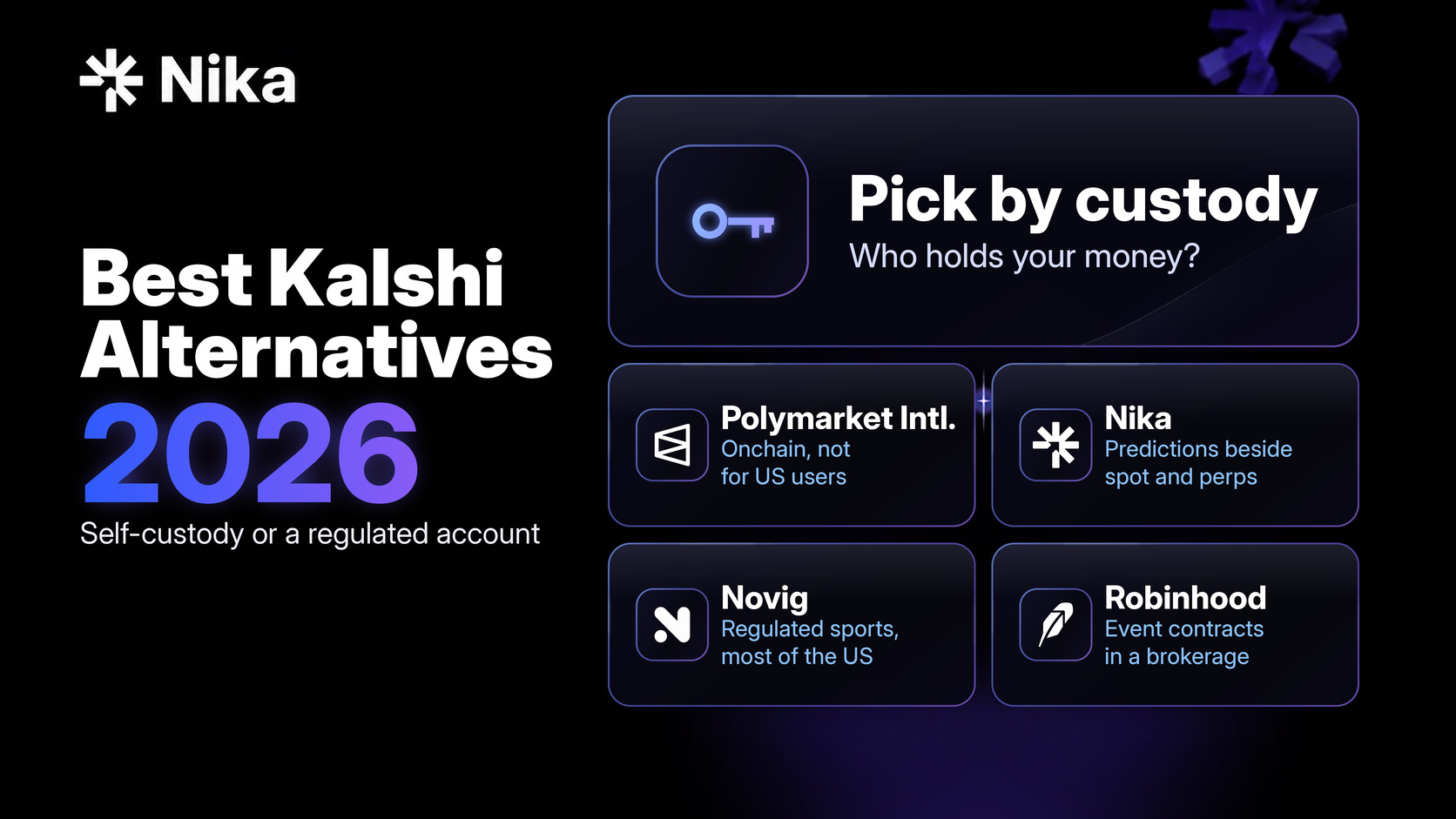
The best Kalshi alternative depends on whether you want a regulated dollar account or a wallet you control.
For a custodial, USD-funded account, Robinhood, Novig, ProphetX, and Polymarket US compete with Kalshi under CFTC oversight. For self-custody outside the US and other restricted locations, Polymarket’s international exchange lets you trade from a wallet you control, and Nika puts prediction markets powered by that exchange beside spot, perpetuals, and yield in one non-custodial app. PredictIt still serves politics under position caps, and Manifold is a play-money way to learn the mechanics.
Disclosure: This guide is published by Nika, one of the apps compared here. Nika’s prediction markets are powered by Polymarket’s international exchange, not Polymarket US.
The 30-second answer
- Regulated and USD: Kalshi, Robinhood, Novig, ProphetX, or Polymarket US. Custodial accounts with dollar deposits and withdrawals.
- Self-custody: Polymarket’s international exchange, or Nika for prediction markets next to other onchain products. You trade from a wallet you control. Neither offers prediction market trading to US users.
- Sports-first: Novig or ProphetX. Both are CFTC-designated sports exchanges.
- Broad event markets in a familiar brokerage app: Robinhood, which offers event contracts from several regulated exchanges through its futures brokerage.
- Politics with position caps: PredictIt.
- Practice without real stakes: Manifold.
- Main caveats: custodial risk on regulated venues, self-custody responsibilities onchain, state challenges to sports and other contracts, and product availability that can change by location.
How we compared them
We compared platforms on four criteria:
- Custody: Who holds your money, and how do deposits and withdrawals work?
- Regulation and access: Who oversees the venue, and where can you use it?
- Markets and fees: What can you trade, and what does a typical fill cost?
- Fit: Which tradeoffs suit which trader?
We used each platform’s published documentation, CFTC filings, court reporting, and our related guides linked below. We did not open or fund accounts for this article.
Kalshi alternatives at a glance
| Platform | Best for | Custody | Funding | US access | Markets |
|---|---|---|---|---|---|
| Kalshi (baseline) | Regulated event trading with dollar rails | Custodial (Kalshi Klear) | USD | Broad; some categories state-restricted | Politics, economics, sports, culture |
| Polymarket US | Regulated Polymarket markets with dollar funding | Custodial | USD | US residents; state challenges apply | Politics, news, crypto, sports |
| Polymarket international | Onchain self-custody trading | Non-custodial | Stablecoins (pUSD / USDC) | Not available to US users | Politics, news, crypto, sports |
| Nika | Self-custody with predictions beside other products | Non-custodial | Wallet / supported networks | Prediction markets not available to US persons; other products vary by jurisdiction | Predictions powered by Polymarket international, plus spot, perps, yield |
| Robinhood | Event contracts inside a mainstream brokerage app | Custodial | USD | US | Event contracts routed to regulated venues |
| Novig | Peer-to-peer US sports | Custodial | USD | US except Arizona, Michigan, and Nevada | Sports |
| ProphetX | Sports-native regulated trading | Custodial | USD | US (CFTC) | Sports |
| PredictIt | Political forecasting under caps | Custodial | USD | Limited | Politics |
| Manifold | Practice and community forecasting | Play-money | n/a | Available | User-created |
Fee, access, and product details below reflect documentation reviewed for this guide in October 2026; fee schedule dates appear beside the figures. Confirm current rules in each app before you fund.
Regulated dollar alternatives
Kalshi: the baseline
Kalshi is a CFTC-designated contract market. Trades clear through Kalshi Klear, its affiliated CFTC-registered clearinghouse. You fund in US dollars, and your balance sits with Klear rather than in a wallet you control. Its markets span politics, economics, sports, culture, and combos. For custody, funding, state cases, and tax documents, see is Kalshi legit.
Best fit: Traders who want a regulated dollar account and Kalshi’s market menu.
Main tradeoff: Custodial funds, and state challenges that can change which contracts you can trade.
Polymarket US: regulated Polymarket with dollar rails
Polymarket operates two separate products. Polymarket US, run by QCX LLC, is a CFTC-designated contract market available to US residents. It is custodial and funded in dollars, closer to Kalshi than to Polymarket’s international exchange. Polymarket’s international exchange is onchain, non-custodial, and does not accept US users. For the full three-venue comparison, see Kalshi vs Polymarket.
Best fit: US residents who want Polymarket’s markets through a regulated, dollar-funded account.
Main tradeoff: Custodial funds, and the same category of state challenges that other CFTC sports venues face.
Robinhood: event contracts in a familiar app
Robinhood offers event contracts through Robinhood Derivatives, its futures brokerage, on several regulated venues: KalshiEX LLC, ForecastEx, North American Derivatives Exchange, and Rothera Exchange and Clearing, a CFTC-registered exchange and clearinghouse founded as a joint venture between Robinhood and Susquehanna International Group. The upside is low-friction funding inside an app many people already use. The tradeoff is the same as any custodial broker: your funds and access sit on the platform’s terms, and the contract menu depends on which venues Robinhood routes to.
Best fit: Mainstream users who want event contracts without opening a separate exchange account.
Main tradeoff: Custodial, US-focused, and limited to the contracts Robinhood chooses to offer.
Novig: peer-to-peer sports
Novig is a peer-to-peer sports exchange. Its exchange entity, Ludlow Exchange LLC, has been a CFTC-designated contract market since 16 June 2026. On 4 August 2026 it retired its sweepstakes product and relaunched as a real-money exchange. Trades clear through Bitnomial Clearinghouse.
Novig does not build a sportsbook vig into its prices, but it is not fee-free on every fill. Under its published fee schedule, reviewed on 9 October 2026, maker fills and pre-game straight trades carry no trading fee. Takers pay coefficient × price × (1 − price) per contract: 0.03 on most live trades, 0.06 on live NCAAF, NHL, and MLB trades and on futures (golf and tennis futures have been exempt since 10 September 2026), and 0.10 on parlays, where the fee is included in the quoted price. Card, debit card, and Apple Pay deposits carry a 3% processing fee. It is available across the US except Arizona, Michigan, and Nevada, for users 21 or older. Full detail: is Novig legit.
Best fit: US sports traders who want peer-to-peer pricing and mostly trade pre-game or rest orders that fill as makers.
Main tradeoff: Sports only, custodial, short track record under the current structure, and ongoing state litigation.
ProphetX: sports-native regulated trading
ProphetX LLC was designated a CFTC contract market on 11 June 2026 and registered as a derivatives clearing organization on 10 June 2026. It is built as a sports-native prediction market under that dual registration. Like Novig, it is strong in its lane and narrow outside it.
Best fit: Sports traders who want a purpose-built regulated venue.
Main tradeoff: Custodial and sports-focused.
Self-custody alternatives
Polymarket international: onchain self-custody
On Polymarket’s international exchange, you trade from a wallet you control. Settlement uses pUSD, an ERC-20 token on Polygon backed by USDC. Polymarket says it does not take possession of your funds, and you can export your private key. The exchange is not CFTC-regulated and does not accept US users. It also blocks or limits trading in other places, including the UK, France, and Germany, and local law still applies wherever you are.
Best fit: Users outside restricted jurisdictions who want self-custody and Polymarket’s onchain markets.
Main tradeoff: You manage keys, stablecoin funding, and protocol risk yourself. It is a different product from Polymarket US.
Nika: predictions beside your other positions
If you want prediction markets in the same self-custody app as your other trading, Nika is one option. Nika is a non-custodial app that brings spot trading, perpetual futures, yield, prediction markets, and portfolio tools into one interface. Its prediction markets are powered by Polymarket’s international exchange, not Polymarket US, and prediction market orders on Nika are not available to US persons. You can create an account with email or a supported social login and control your wallet.
Self-custody shifts control and responsibility to you. Assets deposited into a protocol remain subject to that protocol’s rules and risks, and availability of other products varies by jurisdiction. Trades through Nika can include Nika fees in addition to the venue’s fee. Nika is not a CFTC-registered exchange. If you want a regulated, dollar-funded event-contract account, Kalshi, Robinhood, Novig, ProphetX, or Polymarket US is the more direct fit. You can read more about prediction markets on Nika. For how Nika compares with other DeFi trading platforms on spot, perpetuals, and related tools, see Best DeFi Trading Platforms in 2026.
Best fit: Eligible users outside the US who want Polymarket international markets next to spot, perps, and yield in one non-custodial app.
Main tradeoff: Not a regulated custodial venue, and access depends on jurisdiction and the underlying protocols.
Niche and practice options
PredictIt: politics under caps
PredictIt focuses on political event contracts. It operates under CFTC staff no-action relief rather than as a registered designated contract market. Each participant’s investment in any one contract is capped (currently $3,500 under the amended relief tied to the federal campaign-contribution limit). It remains a niche politics venue rather than a full Kalshi replacement.
Best fit: Politics-first traders who accept position caps.
Main tradeoff: Politics-only scope, investment limits, and thinner liquidity than the larger regulated exchanges.
Manifold: practice and community
Manifold runs on Mana, a play-money currency that cannot be converted to cash. It is a useful place to learn how prediction markets behave without risking real funds. Separate prize drawings may offer real prizes under their own rules, but that does not make Manifold a real-money Kalshi alternative for everyday trading.
Best fit: Beginners and community forecasters.
Main tradeoff: Not a real-money replacement for regulated or onchain venues.
Custodial or self-custody
Every alternative here answers one question: who holds your money?
On a custodial platform, the company does. You get a balance on a screen and a regulated process behind deposits, settlement, and withdrawals. Federal registration sets rules for how customer funds are handled; it does not make every withdrawal instant or remove the risks of holding a balance with a company.
Self-custody flips the control model. Your funds sit in a wallet you control rather than in a company database. That also means you carry the keys, and phishing, lost credentials, harmful approvals, and smart contract failures remain possible. Controlling your wallet does not remove resolution disputes or geographic restrictions on the trading interface.
Polymarket’s international exchange and Nika are the self-custody options in this comparison. Kalshi, Polymarket US, Robinhood, Novig, ProphetX, and PredictIt are custodial. For how decentralized markets work in general, see decentralized prediction markets.
Fees: what changes by model
Custodial dollar venues and onchain venues price trades differently.
- Kalshi and Polymarket US use a formula on standard trades: coefficient × contracts × price × (1 − price). Kalshi’s general taker coefficient is 0.07 under its fee schedule effective 7 July 2026; Polymarket US uses 0.0695 for standard straight trades under its fee schedule effective 7 October 2026. On 100 contracts at 50 cents, a taker pays $1.75 on Kalshi and $1.74 on Polymarket US. Exceptions apply: some Kalshi series carry a maker fee or no fee, Polymarket US pays a maker rebate on eligible straight trades, and since 7 October 2026 Polymarket US has charged a 0.10 taker coefficient on table-tennis markets, with no maker rebate on combo fills. A limit order that fills immediately is charged as a taker.
- Novig has no vig in the price. Under its fee schedule, maker fills and pre-game straights are free; takers pay coefficient × price × (1 − price) per contract on live trades (0.03, or 0.06 on NCAAF, NHL, and MLB), futures (0.06; golf and tennis exempt since 10 September 2026), and parlays (0.10, included in the quote). Card, debit card, and Apple Pay deposits add a 3% fee.
- Polymarket international uses the same formula with category-based taker coefficients (schedule reviewed on 9 October 2026), from 0.07 on crypto to 0 on geopolitics, and does not charge makers. Maker rebates follow program rules. There is no Polymarket fee to deposit or withdraw USDC; on-ramps may charge their own fees.
- Robinhood and ProphetX publish their own schedules; check the fee shown before you confirm a trade.
- Nika prediction market trades use Polymarket international, and Nika fees can apply in addition to the venue fee. Review the total shown before you confirm.
Compare the total cost of a trade, not just the fee column. The bid-ask spread, price impact on larger orders, card or funding fees, and any app fee often matter more than a one-cent difference in venue fees; for small trades, a card deposit fee or a wide spread can cost more than the trading fee. Kalshi vs Polymarket works through examples. Fee schedules in this category change often, so read the live fee page in the app.
| Cost | Custodial USD venues | Onchain venues |
|---|---|---|
| Venue trading fee | Coefficient formula on most trades; Novig charges takers on certain trades | Category-based taker coefficient on Polymarket international; no maker fee |
| Spread and price impact | Apply on every venue | Apply on every venue |
| App or broker fees | A broker can add a commission | An interface such as Nika can add its own fee |
| Funding | Bank, card, or similar rails | Stablecoin deposit |
| Network cost | None for the trade itself | Blockchain gas unless sponsored by an interface |
| Withdrawals | Platform rules and holds | Onchain, controlled by you |
Are Kalshi alternatives legal in the US?
At the federal level, Kalshi, Novig, ProphetX, and Polymarket US operate under CFTC oversight. State law is the catch, especially for sports contracts. Federal appeals courts have split, in rulings on preliminary injunctions rather than final judgments: the Third Circuit sided with Kalshi against New Jersey in April 2026, while the Ninth Circuit (Nevada, 28 August 2026) and Sixth Circuit (Ohio and Tennessee, 25 September 2026) ruled against Kalshi on sports-event preemption. Other states have injunctions, lawsuits, or cease-and-desist activity that can reach Kalshi, Polymarket US, Novig, and similar venues. New York’s attorney general, for example, sued Polymarket US on 24 September 2026; the suit sets out the state’s allegations, not a ruling. Availability in your state can change while you hold an open position.
A wallet does not change who is eligible. Polymarket’s international exchange does not accept US users, and prediction market orders on Nika are not available to US persons.
Kalshi also accepts international users outside the 55 jurisdictions named in its member agreement, including the United Kingdom, Canada, Australia, France, and Ireland, and places subject to US sanctions. International accounts get fewer payment options. Polymarket’s international exchange blocks or limits trading in many other places, including the UK, France, and Germany. Nika does not provide a route around those restrictions.
Bottom line: check your location and the platform’s current eligibility before you fund anything.
How to choose
Work through four questions in order:
- Custody. Do you want your own keys, or is a regulated custodial account fine?
- Availability. Is the platform open where you live today?
- Markets. Broad event contracts, sports only, politics only, or predictions next to spot and perps?
- Feel. A familiar brokerage app, a dedicated exchange, or one onchain interface?
Your answers usually point to one or two names, not the whole table. Many traders use more than one venue: a regulated dollar account for some markets and an onchain wallet for others.
Common mistakes to avoid
- Funding an account before checking your state’s current rules
- Assuming regulated means your money sits in an account in your name
- Comparing platforms on sign-up bonuses instead of custody, fees, and market depth
- Treating play-money results on Manifold as proof you will profit with real money
- Trusting a review that predates a platform’s last relaunch (Novig replaced its product model in August 2026)
- Assuming Polymarket US and Polymarket’s international exchange are the same product
Frequently asked questions
What is the best alternative to Kalshi?
It depends what you want. For a regulated custodial venue, Robinhood, Novig, ProphetX, and Polymarket US are the main USD options. For self-custody, Polymarket’s international exchange is the wallet-based option where it is available, and Nika is one option if you want those markets beside spot and perpetuals.
Is Polymarket better than Kalshi?
They solve different problems. In the US, compare Kalshi with Polymarket US: both are CFTC-regulated and custodial. Outside the US, Polymarket’s international exchange is the self-custody option. Full side-by-side: Kalshi vs Polymarket.
Is there a self-custody alternative to Kalshi?
Yes. Polymarket’s international exchange keeps funds in a wallet you control. Nika offers prediction markets powered by Polymarket international in a non-custodial app alongside spot, perpetuals, and yield. Neither offers prediction market trading to US users, and neither is a CFTC-registered dollar exchange.
Are Kalshi alternatives legal in the US?
Many are CFTC-regulated, including Kalshi, Novig, ProphetX, and Polymarket US. Availability still varies by state, especially for sports. Confirm local rules before funding.
Can I use a crypto wallet to trade prediction markets?
Yes, on onchain venues where you are eligible. Polymarket’s international exchange and Nika’s prediction markets let you trade from a wallet you control, but neither is available to US users. Kalshi, Polymarket US, and the other regulated venues here use custodial dollar accounts instead.
Can I trade event contracts outside the US?
Often, but check the lists. Kalshi accepts international users outside the 55 jurisdictions named in its member agreement, which include India, Singapore, and Thailand as well as the UK and Canada, and places subject to US sanctions. Polymarket’s international exchange blocks or limits trading in places that include Singapore, Taiwan, and Thailand. Local law also applies.
Can I use Kalshi and another prediction market at the same time?
Yes. Accounts are separate, and some traders use a regulated dollar venue alongside an onchain platform.
What are the fees on Kalshi alternatives?
Custodial venues usually charge a per-contract or coefficient fee. Novig still has no vig in the price, but taker fees apply on live trades, futures, and parlays. Polymarket’s international fees vary by category. Check each platform’s live fee page.
Does Kalshi send a 1099?
Kalshi issues 1099 forms for interest, rewards, and certain crypto activity when IRS thresholds are met, plus a yearly profit and loss statement. Its Help Center does not describe a 1099 for event-contract winnings. How gains are taxed depends on your circumstances; speak with a tax professional if you trade at any size.
Sources
- CFTC: CFTC designates KalshiEX LLC as a contract market, 4 November 2020
- CFTC: CFTC grants Kalshi Klear LLC DCO registration, 29 August 2024
- CFTC industry filing: QCX LLC d/b/a Polymarket US, designated contract market
- PR Newswire: Polymarket acquires CFTC-licensed exchange and clearinghouse QCEX for $112 million
- Polymarket documentation: Fees
- Polymarket US documentation: Trading fee schedule
- Polymarket documentation: Polymarket USD (pUSD)
- Polymarket documentation: Geographic restrictions
- Kalshi fee schedule
- Kalshi Help Center: What tax documentation does Kalshi provide?
- Kalshi member agreement
- Kalshi Help Center: Can I trade on Kalshi from outside the United States?
- CFTC industry filing: Ludlow Exchange, LLC, designated contract market
- Novig Help Center: Fees on Novig
- Novig Help Center: Eligibility and legality
- Novig Help Center: Standard and discount deposit pricing
- Novig blog: Novig launches nationwide, 4 August 2026
- CFTC industry filing: ProphetX LLC, designated contract market, 11 June 2026
- CFTC industry filing: ProphetX LLC, derivatives clearing organization, 10 June 2026
- PR Newswire: ProphetX obtains CFTC approval for sports-native exchange, 11 June 2026
- Robinhood Help Center: How event contracts work
- US Court of Appeals for the Third Circuit: KalshiEX LLC v. Flaherty, 6 April 2026
- US Court of Appeals for the Ninth Circuit: KalshiEX LLC v. Assad, 28 August 2026
- US Court of Appeals for the Sixth Circuit: KalshiEX LLC v. Schuler and Orgel, 25 September 2026
- New York Attorney General: Lawsuit against Polymarket US, 24 September 2026
- CFTC Letter 25-20: Amendment of PredictIt no-action relief
- PredictIt Terms and Conditions
- Manifold FAQ: What is mana
- CFTC industry filing: Rothera Exchange and Clearing LLC, designated contract market
- Rothera FAQ: ownership and registrations
Explore prediction markets with Nika
If you want prediction markets alongside spot, perpetuals, and yield in a self-custody app, Nika brings them into one interface. Explore the available products and choose the ones that fit your goals and experience.
This article is for informational purposes and is not financial, legal, or tax advice. Prediction markets and event contracts involve risk, including loss of capital, and their legal status varies by location. Product availability, fees, and terms can change.