
How Does Polymarket Work? A Plain English Guide
What is Polymarket and how does it work? Learn how shares priced 1 to 99 cents trade, how markets resolve, what fees cost, and how Polymarket US differs.
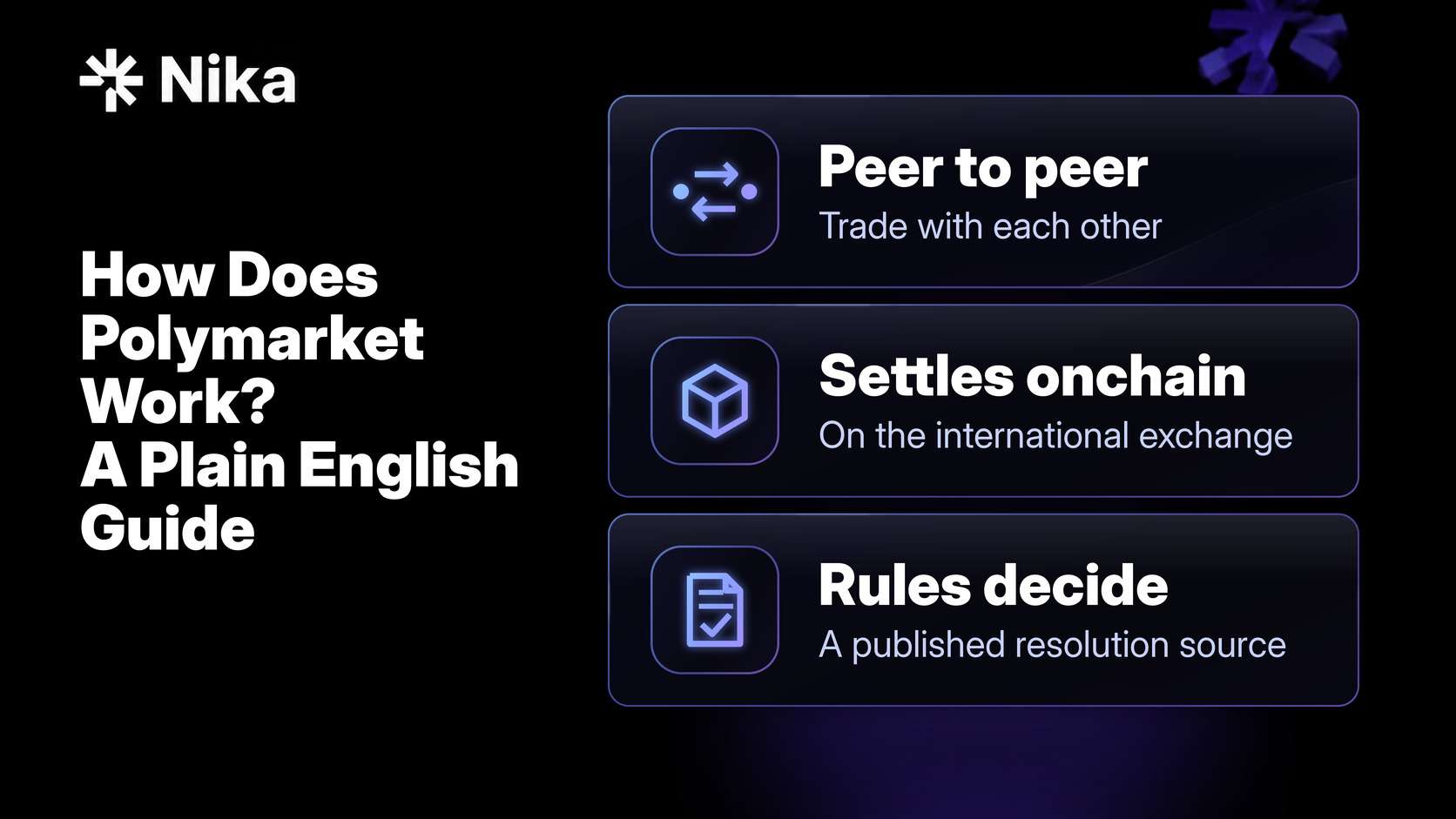
Polymarket is a prediction market where people trade YES and NO shares on real-world events with each other, not against a house. A share pays $1 if its outcome happens and $0 if it does not, so its price reads as the market’s estimate of the probability.
This guide explains what Polymarket is and how Polymarket works, with a worked trade, resolution, costs, ownership, and the two Polymarket products. If you are coming from sports betting, start with how a prediction market differs from a sportsbook.
Disclosure: This guide is published by Nika, an app where you can trade prediction markets alongside crypto, stocks, commodities, and forex. It explains Polymarket mainly using Polymarket’s own documentation.
What is Polymarket? The short answer
Polymarket runs a peer-to-peer order book where traders buy and sell YES and NO shares priced between $0.00 and $1.00. Winning shares redeem for $1 and losing shares for $0. On the international exchange, trades settle through smart contracts on Polygon, and the collateral is pUSD, a token backed by USDC (Polymarket docs).
- Price equals implied probability. A YES share at 65 cents means the market sees roughly a 65% chance.
- You can exit before the end. Sell your shares any time before resolution if there is a buyer.
- Rules decide the result. Each market resolves under its own published rules and resolution source.
Polymarket international vs Polymarket US
Polymarket runs two separate products, and facts about one do not always carry over to the other.
Polymarket international is the exchange at polymarket.com. It is onchain and non-custodial: assets sit in your own wallet, and Polymarket says it “never takes possession of your funds.” Collateral is pUSD on Polygon. Its published geographic restrictions put the US, the UK, France, Germany, Australia, and several Canadian provinces, including Ontario, on a close-only list, where you can close existing positions but not open new ones (Polymarket docs).
Polymarket US is a CFTC-designated contract market operated by QCX LLC, which the CFTC designated on 9 July 2025 (CFTC). Polymarket announced on 21 July 2025 that it had closed its acquisition of QCEX, a CFTC-licensed exchange (QCX LLC) and clearinghouse (QC Clearing LLC), for $112 million (Polymarket via PR Newswire). It requires identity verification before you can deposit or trade and, according to New York’s attorney general, launched in the US in December 2025.
Polymarket US is federally regulated, but state challenges continue, including a lawsuit New York’s attorney general announced on 24 September 2026, which is an allegation, not a ruling (New York Attorney General). For custody, funding, and fees side by side, see Kalshi vs Polymarket. To learn how the other exchange works, read what Kalshi is and how it works.
The rest of this guide describes the international exchange unless it says otherwise.
How a Polymarket trade works
Prices are probabilities
Every share is priced between $0.00 and $1.00, and the price is the market’s view of the probability. The price you see on a market is the midpoint between the best bid and the best ask. If that spread is wider than 10 cents, Polymarket shows the last traded price instead (Polymarket docs).
The displayed price is not always what you pay. If the best bid is 34 cents and the best ask is 40 cents, the market shows 37 cents, but you pay 40 cents to buy now and receive 34 cents to sell now.
The order book
Polymarket uses a central limit order book. Bids are the highest prices buyers will pay, and asks are the lowest prices sellers will accept. Every order is technically a limit order; a “market order” is simply priced to fill right away. An operator matches orders offchain, and matched trades settle onchain on Polygon, so you keep custody of your assets until a matched trade settles.
New shares come into existence when the two sides agree. If one trader bids 60 cents for YES and another bids 40 cents for NO, the prices add up to $1, the orders match, and 1 pUSD of collateral creates one YES share and one NO share for the two buyers. Polymarket sets no trading size limit, but large orders can move the price, so check the depth of the book before you trade in size.
A worked example
This is a hypothetical illustration. It excludes taker fees and the spread.
| Step | Amount |
|---|---|
| Buy 100 YES shares at 40 cents | $40 |
| If YES wins: 100 shares × $1 | $100 back, $60 profit |
| If NO wins: 100 shares × $0 | $0 back, $40 loss |
| Sell all 100 early at 55 cents instead | $55 back, $15 profit |
The $100 payout includes the $40 you put in; it is not $100 of profit. Fees change the numbers a little: if your purchase fills as a taker order in a sports market, Polymarket’s fee table puts the fee on 100 shares at 40 cents at $1.20.
Selling before resolution
You are not locked in. You can sell your shares at any time before the market resolves, as long as someone wants to buy them. In thin markets, the gap between bid and ask can be wide, so an early exit can cost more than the headline price suggests.
Combos (Polymarket’s parlays)
Yes, you can parlay on Polymarket. Combos combine two or more outcomes into one YES and NO position (Polymarket docs). Prices come from a request for quote: your request starts an auction among market makers, who submit executable prices, and you accept the best one. If no one quotes, the order does not fill.
Every leg must be right for a Combo to pay; one wrong leg loses the whole position. You can still sell a Combo before resolution. Polymarket’s help center says Combos are currently available on sports markets only, covering moneyline, spread, and total.
Getting started: wallet, funding, and withdrawals
- Sign up. Polymarket offers three ways: a Google account, an email address with a six-digit code, or a crypto wallet such as MetaMask, Rabby, or Phantom (Polymarket Help Center). Never share your login code with anyone.
- Deposit. Click Deposit, pick a method, token, and network, and send funds to the deposit address shown in your account. Deposits from supported chains are converted to pUSD on Polygon automatically (Polymarket docs). Check the network and address before you send; transfers to the wrong chain or address cannot be reversed.
- Trade. Pick a market, read its rules, choose YES or NO, and set your price and size.
- Withdraw. Go to Portfolio, click Withdraw, and enter the recipient address, token, amount, and network (Polymarket Help Center). When you withdraw to USDC, pUSD is unwrapped and swapped for native USDC.
Polymarket charges no fee to deposit or withdraw USDC, though intermediaries such as Coinbase or MoonPay may charge their own. On Polymarket US, the flow is different: you sign up with Google or Apple ID and complete identity verification (Polymarket US docs), then fund with a card, bank transfer, or other supported method and withdraw back to the original funding source (Polymarket US docs).
Separately, the Nika app uses the same YES and NO mechanics on its prediction markets page: shares trade between 1 and 99 cents, correct shares settle at $1 automatically, and you can exit early at the market price. Prediction markets sit in the same Nika account you use for crypto, stocks, commodities, forex, and yield, with no separate signup.
How Polymarket markets resolve
Every market has written rules that set the resolution source, the end date, and how edge cases are handled. Read the rules, not just the title: the rules decide how a market resolves (Polymarket docs).
Most prediction markets resolve through the UMA Optimistic Oracle:
- Proposal. Anyone can propose the winning outcome by posting a bond, typically $750 pUSD. A correct, undisputed proposer gets the bond back plus a reward; a wrong or early proposal loses the bond.
- Challenge window. A two-hour challenge period follows. With no dispute, the market resolves, usually about two hours after the proposal.
- Dispute. A challenger posts a matching bond, which starts a second proposal round. If that proposal is also disputed, the question goes to UMA’s Data Verification Mechanism.
- Vote. After a debate period of 24 to 48 hours, UMA token holders vote over about 48 hours. A disputed market takes four to six days in total.
In rare cases where neither outcome applies, a market resolves 50-50 and each share redeems for $0.50. Polymarket can add “Additional context” to a market’s rules when something unforeseen happens, but a clarification cannot change the fundamental intent of the question. Once a market resolves, trading stops, and winning shares can be redeemed for $1 with no deadline.
Short-term “Up or Down” crypto markets work differently. They compare a Chainlink time-weighted average price at the start and end of a set window and resolve without UMA’s proposal and dispute process. For how oracle design and disputes compare across onchain venues, see our guide to decentralized prediction markets.
On Nika, markets are settled by the underlying prediction market protocol according to its published rules and resolution source, and settlement criteria are shown before you trade.
What trading on Polymarket costs
On the international exchange, Polymarket fees apply only to takers; makers are never charged. The taker fee is calculated as shares × fee rate × price × (1 minus price), so it peaks at 50 cents and shrinks toward 1 cent and 99 cents (Polymarket docs). Fee rates by category, checked on 30 October 2026:
| Category | Taker fee rate | Fee on 100 shares at 50 cents |
|---|---|---|
| Crypto | 0.07 | $1.75 |
| Sports, economics, culture, weather, and other | 0.05 | $1.25 |
| Finance, politics, mentions, and tech | 0.04 | $1.00 |
| Geopolitics | 0 | $0 |
| Combos (any legs) | 0.05 | $1.25 |
The rate is a coefficient, not a percentage of what you spend: $1.75 on a $50 trade is 3.5%. A limit order is not automatically fee-free either. If it matches a resting order as soon as you place it, that fill pays the taker fee.
Polymarket US has its own schedule. Its standard taker coefficient is 0.0695, a maximum of $1.74 on 100 contracts at 50 cents, effective 19 October 2026, with different terms for Combos and some sports (Polymarket US docs).
The fee is only part of the cost. Count the spread between bid and ask, price impact when a large order eats through several price levels, and any on-ramp or exchange fees to move money in and out. For how these costs compare with other venues, see fees across other event markets.
If you trade prediction markets in the Nika app, Nika fees can apply on top of venue fees, so check the total before you confirm. Gas fees are covered automatically in the Nika app.
Who owns Polymarket and how it makes money
Shayne Coplan is Polymarket’s founder and CEO, according to ICE’s October 2025 announcement. Intercontinental Exchange, the owner of the New York Stock Exchange, announced on 7 October 2025 that it would invest up to $2 billion in Polymarket and become a global distributor of Polymarket’s event data to institutional customers (ICE). ICE made an initial $1 billion direct investment in October 2025 and completed a further $600 million on 27 March 2026, which ICE says, with planned share purchases, completes its obligations under the arrangement (ICE). Polymarket US is operated by QCX LLC.
Polymarket makes money mainly from taker fees on fee-enabled categories. It says it does not charge fees or profit from trading on geopolitical and world events markets. Fees also fund a Maker Rebates Program, paid daily to market makers to deepen liquidity, and a tiered Taker Rebate Program. The ICE agreement adds data distribution to institutions.
Who can use Polymarket?
Access depends on which product and where you are. The international exchange does not accept new orders from the US and puts a published list of countries and regions on close-only, while sanctioned jurisdictions such as Iran, Syria, Cuba, and North Korea are blocked completely. US residents use Polymarket US instead, which requires an account with identity verification, including your legal name, date of birth, residential address, and Social Security number, before you can deposit or trade. Local law still applies, and access rules change.
Prediction markets are also available in the Nika app. Access to perpetuals and prediction markets is subject to the underlying protocols’ terms and availability.
Risks to understand before you trade
- You can lose your whole stake. A losing share is worth $0.
- Smart contract risk. Trades and collateral depend on onchain contracts working as designed.
- Oracle disputes and ambiguous rules. A market can resolve differently from how you read the headline, and disputes can delay payouts for days.
- Thin liquidity. Wide spreads and shallow books make it costly to enter or exit, and a Combo may get no quote at all.
- Wallet access. On the international exchange, you are responsible for your login and keys. Polymarket warns that if you lose your private key, you lose access to your funds. Our guide to a wallet only you control covers the trade-offs.
- Regulatory change. Access lists and state actions can change what you can trade, including on positions you already hold.
- Prices are crowd estimates, not facts. A 90-cent share can still lose.
Prediction markets on Nika are not leveraged, so your maximum loss is limited to the amount you pay for your position, and there is no liquidation risk. Self-custody of a wallet does not remove a protocol’s own rules and risks.
Prediction markets on Nika
Nika offers prediction markets in the Nika app across politics, sports, finance, technology, crypto, and culture, with 24/7 trading and new markets added regularly. Shares trade between 1 and 99 cents, and each correct share pays $1. Markets are settled by the underlying prediction market protocol according to its published rules and resolution source. Browse prediction markets on Nika, or read how prediction markets on Nika work.
You can create an account with email, Google, or Apple. Nika uses Privy for its embedded EVM and Solana wallets, so you do not need to write down or manage a seed phrase to get started. Both wallets’ private keys are exportable, allowing you to use compatible external wallet software. Nika does not hold users’ private keys. Privy’s user help center explains embedded-wallet access and export options; protect your login methods and any key you export.
You can use Nika in your browser at app.nika.finance, or get the Nika app on iPhone and Android.
Access to perpetuals and prediction markets is subject to the underlying protocols’ terms and availability.
Frequently asked questions
Who owns Polymarket?
Shayne Coplan is Polymarket’s founder and CEO, according to ICE’s October 2025 announcement. Intercontinental Exchange, owner of the New York Stock Exchange, is a major investor, and Polymarket US is operated by QCX LLC.
How does Polymarket make money?
Mainly through taker fees on most market categories; geopolitics markets are fee-free. Intercontinental Exchange also agreed to distribute Polymarket’s event data to institutional customers.
Can you parlay on Polymarket?
Yes, through Combos, which join two or more outcomes into one position that pays only if every leg is right. Prices come from quotes by market makers, and Combos are currently available on sports markets only.
Can people in the US use Polymarket?
US residents use Polymarket US, which as of 30 October 2026 is a CFTC-designated contract market, while the international exchange does not accept new US orders. State challenges continue, including a lawsuit New York’s attorney general announced in September 2026.
How do you withdraw money from Polymarket?
Sell your shares or redeem winning shares after resolution, then withdraw from your Portfolio to a wallet address on the network you choose. Polymarket charges no fee to withdraw USDC, but intermediaries may charge their own.
What crypto does Polymarket use?
pUSD, an ERC-20 token on Polygon backed by USDC, with the backing enforced onchain. You can deposit other supported assets, which are converted to pUSD in your Polymarket wallet.
Can I trade prediction markets on Nika?
Yes. Prediction markets are available from the same Nika account you use for crypto, stocks, commodities, forex, and yield. Access to perpetuals and prediction markets is subject to the underlying protocols’ terms and availability.
Sources
- Polymarket documentation: Polymarket 101
- Polymarket documentation: Prices and orderbook
- Polymarket documentation: Resolution
- Polymarket documentation: Fees
- Polymarket documentation: Polymarket USD (pUSD)
- Polymarket documentation: How Combos work
- Polymarket documentation: Geographic restrictions
- Polymarket documentation: Manage positions
- Polymarket documentation: Deposit
- Polymarket documentation: Withdraw
- Polymarket Help Center: Is Polymarket the house?
- Polymarket Help Center: What are Combos?
- Polymarket Help Center: How to sign up
- Polymarket Help Center: How to deposit
- Polymarket Help Center: How to withdraw
- Polymarket US documentation: Fee schedule
- Polymarket US documentation: Create an account
- Polymarket US documentation: Withdraw funds
- CFTC: QCX LLC d/b/a Polymarket US, designated contract market
- Polymarket via PR Newswire: Polymarket acquires QCEX, 21 July 2025
- ICE: ICE announces strategic investment in Polymarket, 7 October 2025
- ICE: New $600 million investment in Polymarket, 27 March 2026
- New York Attorney General: Lawsuit against Polymarket, 24 September 2026
- Privy: User help center
Fees, products, and access checked on 30 October 2026.
Explore Nika
Trade event outcomes next to crypto, stocks, gold, and forex from one Nika account.
Open Nika to browse event markets next to the rest of your portfolio, or explore 500+ markets on Nika.
Access to perpetuals and prediction markets is subject to the underlying protocols’ terms and availability.
