
What Is Kalshi and How Does It Work?
What is Kalshi? A CFTC-regulated exchange for event contracts. See how a trade works, how contracts settle at $1 or $0, who can use it, and what it costs.
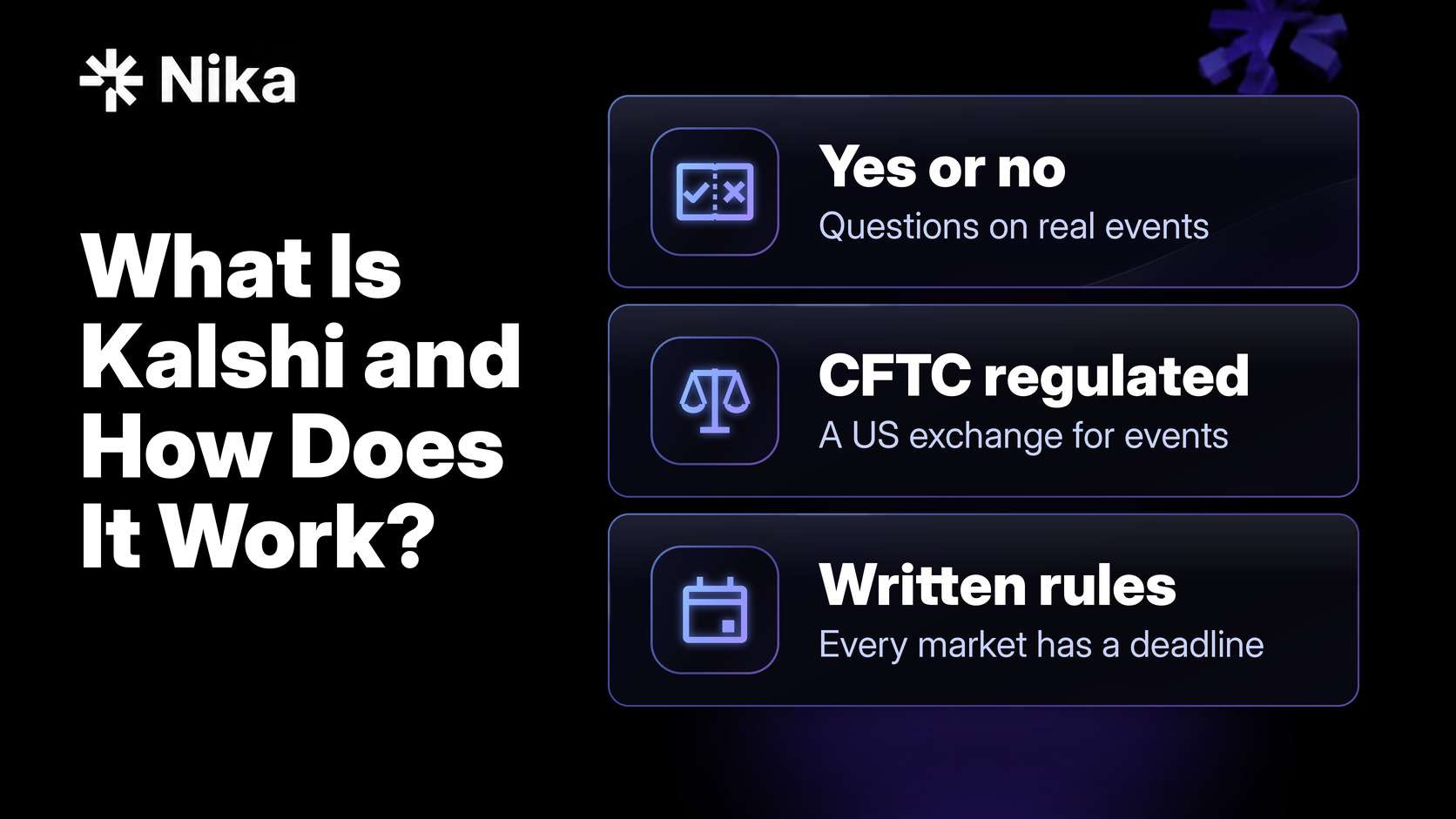
Kalshi is a US exchange, regulated by the Commodity Futures Trading Commission (CFTC), where you buy and sell event contracts: yes or no questions about real events such as elections, interest rates, sports, or the weather. Each contract pays $1 if its side is right at settlement and $0 if not, so its price works like a probability.
This guide explains what Kalshi is, how a Kalshi trade works (with a worked example), what you can trade, how Kalshi makes money, who can sign up, and the risks to weigh before you fund an account.
Disclosure: This guide is published by Nika, a non-custodial app that offers prediction markets, spot trading, perpetual futures, and yield. Nika does not offer Kalshi markets. This guide uses Kalshi’s own documentation and CFTC records.
What is Kalshi? The short answer
- What it is: KalshiEX LLC has been a CFTC-designated contract market since November 2020 (CFTC).
- Who clears trades: Kalshi Klear LLC, Kalshi’s affiliated clearinghouse, registered with the CFTC in August 2024 (CFTC).
- How you make or lose money: a contract settles at $1 or $0, and you can sell before then if another trader buys.
- What it costs: Kalshi charges a fee on most trades. The formula and an example are below.
- Who can use it: people 18 or older who pass identity checks, subject to location limits.
How a Kalshi trade works
Yes and no contracts
Every Kalshi prediction market is a question with a deadline and written settlement rules, such as whether the Fed cuts rates at a given meeting. You can buy YES or NO. Kalshi pairs a YES buyer with a NO buyer, and together they put up $1 per contract. If YES costs 70 cents, NO costs 30 cents (Kalshi Help Center).
Kalshi runs the exchange; the other side of your trade is another user. Prices come from traders’ orders, not from a house line.
Prices read as probabilities (Kalshi odds)
Contracts trade between 1 and 99 cents. A YES price of 40 cents means the market is pricing roughly a 40% chance that the answer is yes. “Kalshi odds” are just these prices, and they move every time traders buy and sell.
The best YES price and the best NO price you can buy at add up to more than $1. Kalshi calls that gap the spread; a narrow spread usually means an active market (Kalshi).
A worked example
This is a hypothetical illustration, not a quote. It uses Kalshi’s general taker fee (checked on 30 October 2026) and excludes deposit, card, or other funding costs.
You buy 100 YES contracts at 40 cents, filled immediately against resting orders.
| Step | Amount |
|---|---|
| Cost of contracts | 100 × $0.40 = $40.00 |
| Taker fee: 0.07 × 100 × 0.40 × 0.60 | $1.68 |
| Total paid | $41.68 |
| If YES wins: payout | $100.00 |
| Profit if YES wins, after the buy fee | $100.00 minus $41.68 = $58.32 |
| Loss if NO wins | $41.68 |
The $100 payout includes the $40 you put in. It is not $100 of profit.
Selling before the event ends
You do not have to hold to settlement. You can sell at the current bid while the market is open, but selling is another trade, so a fee can apply again, and you need a buyer at a price you accept. A likely outcome is not a cheap win: if you pay 90 cents, you risk 90 cents to make about 10 cents before fees.
The Nika app uses the same YES and NO mechanics: on prediction markets in the Nika app, shares trade between 1 and 99 cents, correct shares settle at $1, and you can exit early at the market price.
What you can trade on Kalshi
Event categories
Kalshi lists markets on elections and policy, court cases, economic data such as unemployment and interest rates, company and technology milestones, awards and music charts, weather, and sports (Kalshi Help Center). Combos let you trade a custom combination of events in one position, paying up to $1 per contract. Their prices come from live quotes, so a combo order fills only if another participant quotes it (Kalshi Help Center).
The menu changes often, and some categories, especially sports, are restricted in some states. Our guide on whether Kalshi is legit and where it is available covers those limits.
Perpetual futures
Kalshi is no longer only an event-contract exchange. On 29 May 2026, the CFTC approved KalshiEX’s BTCPERP contract, a perpetual futures contract on the spot price of bitcoin (CFTC). Kalshi announced the product the same day (Kalshi), and bitcoin perpetuals opened for trading on 3 June 2026 (Kalshi Help Center). Kalshi added 24/7 gold and silver perpetuals on 10 September 2026 (Kalshi).
A perpetual has no expiry date. Your profit or loss follows the asset’s price, and funding payments between longs and shorts keep the contract close to the spot price. Unlike a $1 event contract, a perp is leveraged: Kalshi’s help center lists up to 6x on bitcoin, checked on 30 October 2026, and a move against you can liquidate your position (Kalshi Help Center).
Access is separate from event trading. US-based users who have completed identity verification apply for a margin account, answer a questionnaire about experience and risk, and finish a tutorial before their first trade. Kalshi says international availability “may expand in the future” (Kalshi Help Center).
The Nika app gives you access to 500+ markets from one account, and its perpetual futures run on Hyperliquid. Leverage goes up to 50x, and you can use isolated or cross margin, depending on the market. You can see how that works on perpetual futures on Nika, or read how perpetuals differ from dated futures.
How Kalshi makes money
Kalshi says it makes money “by charging a transaction fee on the expected earnings on the contract” (Kalshi Help Center). The trading fee applies when your order matches a resting order right away (a taker trade). Orders that rest on the book usually pay nothing, but some markets list maker fees, and some series have their own fee terms.
The general taker fee works out to 0.07 × contracts × price × (1 minus price), rounded up, with price in dollars. Kalshi’s October 2026 filing with the CFTC gives the per-contract fee at 50 cents as $0.0175 (0.07 × 0.50 × 0.50), the point where it is highest (Kalshi CFTC filing). In plain terms:
- On 100 contracts at 50 cents, the fee is $1.75, which is 3.5% of the $50 spent. The 0.07 is a coefficient, not a flat 7% rate.
- On 100 contracts at 40 or 60 cents, it is $1.68.
- Near 1 or 99 cents, it shrinks to a few cents per 100 contracts.
A limit order is not automatically fee-free. If it matches the book immediately, that fill pays the taker fee. Fees change, so check the fee Kalshi shows before you confirm; the help center says it appears behind the “i” icon next to “You’re buying”. Fees checked on 30 October 2026.
Your balance is custodial: Kalshi Klear holds deposited funds in its settlement account at a bank (Kalshi Klear member agreement). For who holds your balance and how withdrawals work, including deposit holds and tax forms, see our full Kalshi review.
Who can use Kalshi
You must be 18 or older and pass document verification if Kalshi asks for it (Kalshi Help Center). Kalshi’s member agreement also has you confirm that you are “of the age of majority in Your state of residence” (Kalshi Member Agreement).
Sign-up asks for basic personal information, and Kalshi may ask you to confirm it with a government-issued photo ID and, in some cases, a live selfie. Kalshi does not accept commercial addresses or PO boxes (Kalshi Help Center).
Location matters. In the US, several states are fighting Kalshi’s sports contracts in court. Federal appeals courts have split on whether those contracts fall under exclusive CFTC jurisdiction, New Jersey regulators have asked the Supreme Court to take the question (Supreme Court docket 26-299), and in October 2026 the CFTC proposed a rule (CFTC) that would define event contracts, including sports, as swaps (Federal Register). That rule is a proposal, not a final rule. Outside the US, Kalshi accepts users from many countries, but its member agreement dated 1 October 2026 bars event-contract trading from a list of restricted jurisdictions, including the UK, Canada, Australia, and France. Our guide on where Kalshi is available and how it is regulated tracks the details.
Kalshi vs a sportsbook, and Kalshi vs Polymarket
A sportsbook sets the odds and takes the other side of your bet. On Kalshi you trade with other users at market prices, you can sell before the game ends, and the exchange is regulated as a derivatives market at the federal level. Several states dispute that treatment for sports contracts. Read more on how prediction markets differ from sports betting.
Polymarket runs two separate products. Polymarket US is a CFTC-designated contract market operated by QCX LLC (CFTC). Polymarket’s international exchange is onchain: you trade from a wallet you control, using pUSD, a USDC-backed token on Polygon (Polymarket docs), and it restricts trading from the US and a number of other countries (Polymarket docs). For a side-by-side, see how Kalshi and Polymarket compare on fees, custody, and access, or browse other regulated and self-custody options, including how Novig’s peer-to-peer sports exchange works. Separately, non-custodial apps such as the Nika app also offer prediction markets, and our guide to decentralized prediction markets explains how the onchain model works.
Risks to understand before you trade
- You can lose your whole stake. A losing event contract settles at $0.
- Fees add up. You can pay a fee to enter and again to exit, and a card deposit can carry its own processing fee.
- Thin markets cost more. Wide spreads and shallow order books make it harder to buy or sell at a fair price, and combos may get no quote at all.
- The rules decide the result. Settlement follows each market’s written terms and source, not the headline. Read the rules before you buy.
- Your balance is custodial. Funds sit with Kalshi Klear, not in a wallet you control.
- Access can change. A court order or new state rule can restrict a category while you hold a position.
- Perps add leverage. Funding costs and liquidation risk apply on top of price risk.
Can I trade prediction markets on Nika?
Yes, though not Kalshi markets. The Nika app has prediction markets across politics, sports, finance, technology, crypto, and culture. You buy YES or NO shares that trade between 1 and 99 cents, correct shares settle at $1, and you can exit early at the market price. Markets are settled by the underlying prediction market protocol according to its published rules and resolution source. Prediction markets are not leveraged, so your maximum loss is the amount you pay for your position, and they sit in the same Nika account you use for crypto, stocks, commodities, forex, and yield. You can browse event markets on Nika or read how prediction markets work on Nika.
You can create an account with email, Google, or Apple. Nika uses Privy for its embedded EVM and Solana wallets, so you do not need to write down or manage a seed phrase to get started. Both wallets’ private keys are exportable, allowing you to use compatible external wallet software. Nika does not hold users’ private keys. Privy’s user help center explains embedded-wallet access and export options; protect your login methods and any key you export. Gas fees are covered automatically in the Nika app.
You can use Nika in your browser at app.nika.finance, or get the Nika app on iPhone and Android.
Nika fees can apply in addition to the venue’s fee, so review the total before you confirm. If you want a CFTC-regulated dollar account funded from a US bank, Kalshi is the more direct fit.
Frequently asked questions
What does Kalshi actually do?
Kalshi runs a CFTC-regulated exchange that matches buyers and sellers of event contracts. It makes money from a fee on trades, not from taking the other side of your position.
How old do you have to be to use Kalshi?
You must be 18 or older and of the age of majority in your state of residence. You also need to pass Kalshi’s identity verification before you can trade.
How do Kalshi odds work?
The price of a contract in cents is the market’s implied probability, so 65 cents means about a 65% chance. The price moves as traders buy and sell, and the market can be wrong.
Can you lose more than you put in on Kalshi?
On event contracts, no. The most you can lose is what you paid plus fees, because a contract cannot settle below $0. Perpetual futures are leveraged and work differently.
Does Kalshi have perpetual futures?
Yes. Kalshi opened bitcoin perpetual futures for trading in June 2026, after CFTC approval on 29 May, and added gold and silver perpetuals in September 2026 (checked on 30 October 2026). Access requires a separate application.
How is Kalshi different from gambling?
You trade against other users on a CFTC-regulated exchange and can exit before the event ends, while a sportsbook sets the odds and takes your bet. Several states argue that some contracts, especially sports, are gambling under state law; see how prediction markets differ from sports betting.
Do I need a Kalshi account to use prediction markets on Nika?
No. Prediction markets in the Nika app are not Kalshi markets, and they’re available from the same Nika account you use for crypto, stocks, commodities, forex, and yield, with no separate signup. Access to perpetuals and prediction markets is subject to the underlying protocols’ terms and availability.
Sources
- CFTC: CFTC designates KalshiEX LLC as a contract market, 4 November 2020
- CFTC: CFTC grants Kalshi Klear LLC DCO registration, 29 August 2024
- CFTC: CFTC approves BTCPERP contract submitted by KalshiEX, LLC, 29 May 2026
- Federal Register: Further definition of “swap”, inclusions (proposed rule), 19 October 2026
- CFTC industry filing: QCX LLC d/b/a Polymarket US, designated contract market
- US Supreme Court docket 26-299: Flaherty v. KalshiEX LLC
- KalshiEX LLC: Event Contracts Taker Rebate Program, CFTC self-certification, 14 October 2026
- Kalshi Klear member agreement
- Kalshi Member Agreement, 1 October 2026
- Kalshi Help Center: How are prices determined?
- Kalshi Help Center: What are prediction markets?
- Kalshi Help Center: Combos
- Kalshi Help Center: Fees
- Kalshi Help Center: Signing up as an individual
- Kalshi Help Center: Document verification on Kalshi
- Kalshi Help Center: What are perpetual futures?
- Kalshi Help Center: Applying for perpetuals access
- Kalshi: Working with event contracts
- Kalshi: Kalshi launches first-ever perpetual futures in America, 29 May 2026
- Kalshi Help Center: BTC perpetual futures contract specifications, 3 June 2026
- Kalshi: 24/7 gold and silver perpetuals are here, 10 September 2026
- Polymarket documentation: Polymarket USD (pUSD)
- Polymarket documentation: Geographic restrictions
- Privy: User help center
Fees, products, and eligibility checked on 30 October 2026.
Explore Nika
Nika brings prediction markets, spot and perpetual trading, and yield into one non-custodial app.
Open Nika to browse event markets next to the rest of your portfolio.
Access to perpetuals and prediction markets is subject to the underlying protocols’ terms and availability.
