
Kraken vs Coinbase: Fees, Features, and Safety
Kraken vs Coinbase compared: US fees, simple buy vs pro trading, stocks, staking, custody, and state availability, with sources checked October 2026.
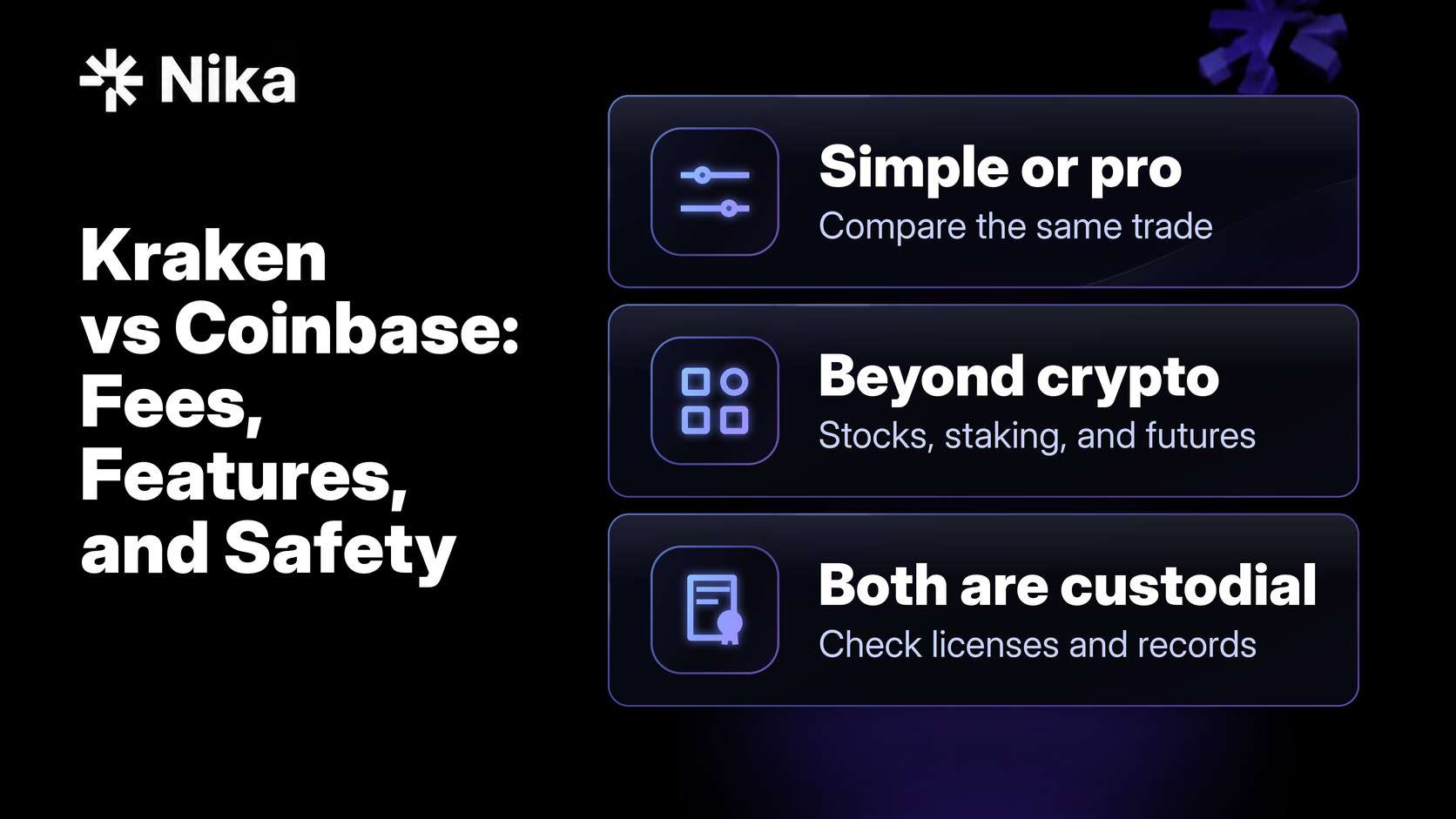
Kraken and Coinbase are both US-licensed, custodial exchanges that now offer crypto and US stocks. Kraken serves every US state except Maine and New York, and Coinbase serves US residents age 18 and older. In 2026, the Kraken vs Coinbase choice comes down to how you trade (simple buy or a pro order book), which extras you want (stocks, staking, futures, or prediction markets), and where you live.
This guide compares the two on fees, products, staking, custody, and state availability. Sources checked 30 October 2026.
Disclosure: This comparison is published by Nika, a non-custodial trading app. We are not affiliated with Kraken or Coinbase. Every product and fee claim below is sourced to the company’s own pages, its SEC filings, or a regulator, checked on 30 October 2026. Fees and availability change, so confirm on the provider’s site before you open an account.
Kraken vs Coinbase: the short answer
- If you mostly buy with a card or bank transfer: Kraken Instant Buy charges 1% (1.5% on custom orders, and up to $2 on small trades) plus a spread. Coinbase includes a spread in simple buy prices, can add a Coinbase fee that varies by payment method, and shows the final price before you confirm. Subscriptions change the math: Kraken+ costs $4.99 a month after a 30-day free trial and waives trading fees on up to $10,000 a month, though spreads and card processing fees still apply, and Coinbase One starts at $4.99 a month.
- If you trade actively on an order book: Kraken Pro and Coinbase Advanced both use maker and taker tiers. Kraken Pro’s first tier is 0.40% maker and 0.80% taker for spot crypto. Coinbase shows Advanced rates after you sign in.
- If you want stocks, futures, or prediction markets too: In December 2025, Coinbase expanded what you can trade to include stocks, commodity futures, perpetual futures, and prediction markets. Kraken offers 11,000+ US stocks and ETFs with no commission in eligible states, and US futures and perpetual futures through Kraken Derivatives US.
Kraken vs Coinbase at a glance
Kraken vs Coinbase comparison, 2026 (sources checked 30 October 2026). Each cell comes from the exchange’s own pages, an SEC filing, or a regulator. “Check with the provider” means we could not confirm the value on a primary source on the date checked.
| Kraken | Coinbase | |
|---|---|---|
| US availability | Not ME or NY; Krak limits | US residents, 18+ |
| Simple buy | 1% plus spread | Spread plus possible fee |
| Pro trading fees, entry tier | 0.40% maker, 0.80% taker | Check with the provider |
| Subscription | Kraken+, $4.99 a month | Coinbase One, from $4.99 |
| Staking | 20% flexible commission | ETH up to 1.65% APY |
| US futures | Futures; Bitnomial perps | Perp-style and commodity |
| Regulatory record | SEC $30M 2023; dismissed 2025 | SEC case dismissed 2025 |
Notes on the table:
- The state limits in Kraken’s US availability cell are Kraken’s Krak restrictions; the state list is in the availability section below.
- Fees, conditions, and sources for every cell are in the sections below, along with the rows we left out of the table: what you can trade (including stocks and prediction markets), custody, US entities and licenses, funding, and margin.
- Both exchanges are on iOS and Android; Kraken offers the Kraken and Kraken Pro apps (app pages in Sources).
Fees compared
Simple buy, sell, and convert
Kraken charges 1% on instant and recurring trades and 1.5% on custom orders, and small instant trades carry a fee of up to $2 instead of the 1%. The price you see on Instant Buy and Sell includes a spread. Converting small balances below the minimum order size costs a fixed 3% (Kraken fee schedule).
Coinbase includes a spread in simple buy and sell prices, and it may add a Coinbase fee that varies by payment method; check with the provider for the fee on your payment method (Coinbase Help, checked 30 October 2026). Coinbase shows the final price, including fees, when you authorize the trade (Coinbase User Agreement).
Pro order-book trading (Kraken Pro vs Coinbase Advanced)
Both platforms charge maker and taker fees that fall as your 30-day volume rises. On Kraken Pro, Tier 1 spot crypto is 0.40% maker and 0.80% taker (Kraken fee schedule).
Coinbase says Simple trading fees are generally higher than those on Advanced trading (Coinbase 10-K). Coinbase shows Advanced rates only after you sign in, so check your tier before you compare.
Subscriptions: Kraken+ and Coinbase One
Kraken+ costs $4.99 a month after a free 30-day trial. It waives trading fees on up to $10,000 of volume a month on Buy, Sell, and Convert trades in the Kraken app or on the web, not on Kraken Pro, and spreads and card processing fees still apply (Kraken fee schedule). It also adds boosted rewards on select stablecoins (Kraken+).
Coinbase One comes in three plans: Basic at $4.99 a month, Preferred at $29.99, and Premium at $299.99. Benefits include zero trading fees on simple trades (capped on lower plans), a staking rewards boost, account protection, priority support, and, on the upper plans, a 25% rebate on Advanced spot fees (Coinbase One).
Funding
Kraken says card, Apple Pay, Google Pay, and ACH payments may carry payment fees, and it lists USD-only deposits for US clients under its Krak restrictions (Kraken). Coinbase supports ACH and wire for USD and lets you buy with a bank account, debit or credit card, Apple Pay, Google Pay, or PayPal.
On either exchange, compare the amount you receive on the same trade size, not the headline rate.
What you can trade
Crypto
We could not confirm either coin count on the pages we read. Kraken publishes a list of tokens restricted for US clients, so check that a coin is available to you.
Stocks and ETFs
Kraken offers 11,000+ US stocks and ETFs with no commission (Kraken stocks), and its fee schedule says regulatory fees may be passed to the investor. Stocks run through Kraken Securities LLC, an SEC-registered broker-dealer and FINRA and SIPC member (Kraken), and stock trading is available to eligible clients in select US states, a list that leaves out Maine, New York, and Washington (Kraken Support). Kraken’s xStocks are not available in the United States; see how tokenized stocks work.
Coinbase began US stock trading in December 2025 through Coinbase Capital Markets, an SEC-registered broker-dealer and FINRA member (Coinbase 10-K). It charges $0 commissions on self-directed stock trades, other fees may apply, and brokerage accounts are limited to US residents (Coinbase stocks).
Futures, perps, and margin
In the US, Kraken’s futures brokerage is provided by NinjaTrader Clearing, LLC, doing business as Kraken Derivatives US, a CFTC-registered futures commission merchant and NFA member (NFA ID 0309379). Margin trading is available to eligible US retail clients (Kraken). Kraken said on 15 June 2026 that “Eligible US clients can now trade perpetual futures on Kraken Pro,” with contracts listed on Bitnomial (Kraken blog). Kraken’s fee schedule also lists Kraken app perps at 0.25% to open and 0.25% to close, “currently available in certain geos.”
Coinbase offers US perpetual-style futures and commodity futures through Coinbase Financial Markets, an FCM. It acquired Deribit in August 2025 and offers perpetual futures to eligible non-US customers through Coinbase International Exchange. For how onchain perpetuals differ from exchange futures, see perpetuals vs futures.
Prediction markets
Coinbase offers event contracts through Coinbase Financial Markets, a registered FCM, and says access is “initially limited to a subset of U.S. users” (Coinbase prediction markets). We could not confirm a Kraken prediction market product on Kraken’s pages, so check with Kraken. Our prediction markets compared guide covers how the main venues differ.
Staking and rewards
Kraken offers onchain staking to US clients in 37 states, plus DC and Puerto Rico, listed on its US quick start page (Kraken Support). Flexible staking on assets with an onchain unbonding period, and staked assets in Kraken’s Rewards program, carry a 20% commission. Other staking commissions vary by asset (Kraken fee schedule). Displayed rates are estimates before commission (Kraken staking). US clients, except accredited investors, cannot use Opt-In Rewards, and the Rewards feature is available only in select states.
Coinbase’s ETH staking page showed “up to 1.65% APY” on 30 October 2026. Coinbase’s help center says residents of California, Maryland, New Jersey, and Wisconsin cannot stake new principal (Coinbase Help). Coinbase One adds a staking rewards boost. We could not confirm Coinbase’s staking commission, so compare the net rate after commission on each before you choose.
For context: in February 2023, Kraken agreed to stop offering its US staking-as-a-service program and pay $30 million to settle SEC charges (SEC).
Custody, licenses, and safety
Both are custodial
Coinbase’s US User Agreement describes a hosted wallet and says Coinbase stores private keys in a combination of online and offline storage. It says customer assets are not Coinbase’s property and are not subject to claims of Coinbase’s creditors (Coinbase User Agreement).
Kraken provides custody for eligible clients through Kraken Financial, a Wyoming-chartered special purpose depository institution, in certain states. Kraken says its digital asset services are offered by Payward Interactive, “not a member of FINRA/SIPC and not FDIC insured” (Kraken stocks). For what a custodial account means day to day, see whether Coinbase is non-custodial.
The other model is self-custody. In the Nika app, wallets are created at sign-up with email, Google, or Apple. Nika uses Privy as the wallet infrastructure provider, and Nika does not hold users’ private keys. Self-custody has its own risks, including lost logins, phishing, and smart contract risk, and there is no bank-style recovery; read what a non-custodial wallet is first.
Licenses
Kraken’s US entity, Payward Interactive, is registered with FinCEN as a money services business and holds state licenses under NMLS ID 1843762 (Kraken disclosures). Coinbase holds money transmitter licenses under NMLS ID 1163082, and Coinbase Custody Trust Company is chartered by the New York State Department of Financial Services (Coinbase licenses). For why that matters as exchanges grow, see how an exchange starts to look like a bank.
Regulatory record
- Kraken, February 2023: settled SEC charges over its US staking-as-a-service program for $30 million and agreed to stop offering it (SEC).
- Kraken, March 2025: the SEC case filed on 20 November 2023 against Payward and Payward Ventures was dismissed with prejudice by joint stipulation on 27 March 2025 (SEC).
- Coinbase, February 2025: the SEC dismissed its civil enforcement action against Coinbase on 27 February 2025 (SEC).
- Coinbase, May 2025: in a Form 8-K, Coinbase said a threat actor paid contractors or employees in support roles outside the United States for customer data. No passwords or private keys were compromised, the personnel could not access customer funds, and Coinbase did not pay the demand (Coinbase 8-K).
Which states can use Kraken or Coinbase?
Kraken, including Kraken Securities and Kraken Adviser, does not serve residents of Maine or New York. Kraken also lists “Krak restrictions” for some states it serves: crypto transfers are not available in Indiana, fiat transfers are not available in Indiana, Louisiana, Massachusetts, and Utah, and residents of Texas and New Hampshire cannot deposit or hold EUR or trade EUR pairs (Kraken).
Coinbase requires US residence and age 18 or older, and some features depend on your location (Coinbase User Agreement). We could not find a single Coinbase page listing state exceptions, so check in the app. Staking is one known limit: no new principal can be staked in California, Maryland, New Jersey, or Wisconsin.
If you live in New York, Kraken is not an option. Coinbase Custody Trust Company is chartered by NYDFS, but confirm on Coinbase that the product you want is available in New York before you sign up.
Kraken vs Coinbase: which should you choose?
| Your need | Better fit | Why |
|---|---|---|
| Small buys, no subscription | Compare both | Instant Buy 1% plus spread |
| Frequent app trades | Kraken+ or Coinbase One | Fee waivers, with limits |
| Stocks plus crypto | Both | No-commission US stocks |
| Futures in the US | Both | Both run FCMs |
| Prediction markets | Coinbase | Event contracts |
| New York or Maine | Coinbase | Kraken does not serve them |
If you buy small amounts often without a subscription, compare Kraken’s Instant Buy price with the Coinbase final price on the same amount. If you buy and sell often in the app, under $10,000 a month, compare Kraken+ with Coinbase One; the conditions for each are in the subscriptions section above.
For more head-to-heads, see Binance vs Coinbase or our trading app comparison.
If you would rather hold your own keys, there is a third option.
Another option: a self-custodial app
The Nika app is not an exchange account; you hold the keys, and Nika does not hold users’ private keys. In the Nika app, trades settle in USDC from your existing balance, and gas fees are covered automatically in the Nika app. You can trade perpetual futures with leverage up to 50x, depending on the market, with isolated or cross margin, depending on the market. The Nika app shows an estimated liquidation price before you confirm a perp trade. Learn how liquidation price is calculated before you use leverage. You can also trade spot gold, silver, oil, and the S&P 500, plus fractional NVDA, AAPL, and TSLA through tokenized stocks, which are not the same as owning shares.
The trade-off: there is no bank-style recovery, and you are responsible for your login and approvals. The Nika app is not a broker-dealer or an FCM.
Asset and feature availability depends on your jurisdiction and the applicable issuer or protocol terms.
Frequently asked questions
Is Kraken cheaper than Coinbase?
It depends on how you buy, so start any Coinbase vs Kraken fee comparison there. Kraken Instant Buy charges 1% plus a spread, Coinbase shows a final price with fees and any spread before you confirm, and both pro platforms use maker and taker tiers, so compare the same trade on both.
Is Kraken available in all US states?
No. Kraken does not serve Maine or New York, and Kraken lists Krak transfer limits in Indiana, Louisiana, Massachusetts, and Utah.
Can I buy stocks on Kraken and Coinbase?
Yes, for eligible US users. Kraken offers 11,000+ stocks and ETFs commission-free through Kraken Securities, and Coinbase offers $0 commission stocks through Coinbase Capital Markets.
Which is better for staking, Kraken or Coinbase?
Kraken publishes a 20% commission on flexible staking and limits onchain staking to listed states, while Coinbase limits new staking in four states. Compare the net rate after commission on each before choosing.
Are Kraken and Coinbase safe?
Both are licensed, custodial exchanges with public regulatory records, including SEC cases dismissed in 2025 and, for Coinbase, a May 2025 customer data incident with no keys or funds accessed. Custody means you rely on each company’s security and policies.
Is there an option where I hold my own keys?
Yes, a non-custodial app such as the Nika app, where wallets are created at sign-up and Nika does not hold users’ private keys. You take on responsibility for your login and approvals.
Sources
- Kraken: Fee schedule
- Kraken: Legal disclosures
- Kraken Support: Where is Kraken licensed or regulated?, 30 September 2026
- Kraken Support: Quick start for clients in the United States, 30 March 2026
- Kraken Support: Unlock stock trading on the Kraken app, 17 August 2026
- Kraken Blog: Announcing CFTC-regulated perpetual futures for US Traders, 15 June 2026
- Kraken Support: US Perpetual Futures, read 30 October 2026
- Kraken Support: Kraken Derivatives eligibility requirements, 28 July 2026
- Kraken: Stocks
- Kraken: Kraken+
- Kraken: Staking
- SEC press release 2023-25, 9 February 2023
- SEC Litigation Release No. 26278, 27 March 2025
- SEC press release 2025-47, 27 February 2025
- Coinbase: US User Agreement
- Coinbase Global: Form 10-K for fiscal year 2025 (SEC EDGAR)
- Coinbase Global: Form 8-K, 15 May 2025 (SEC EDGAR)
- Coinbase Help: Pricing and fees
- Coinbase Help: Staking eligibility
- Coinbase: Coinbase One
- Coinbase: Stocks
- Coinbase: Licenses
- Coinbase: Ethereum staking
- Coinbase: Prediction markets
- App pages: Kraken Support: Kraken’s official mobile apps, Kraken: Kraken Pro, and Coinbase Help: What mobile devices does Coinbase support?
Fees, products, and availability checked on 30 October 2026.
Explore Nika
Hold your own keys and trade crypto, perps, and spot commodities from one USDC balance.
Open Nika to explore markets in the Nika app, or get the Nika app on iPhone and Android.
Access to perpetuals and prediction markets is subject to the underlying protocols’ terms and availability.
Asset and feature availability depends on your jurisdiction and the applicable issuer or protocol terms.
Crypto and leveraged products involve risk, including loss of capital. This guide is not financial advice.
